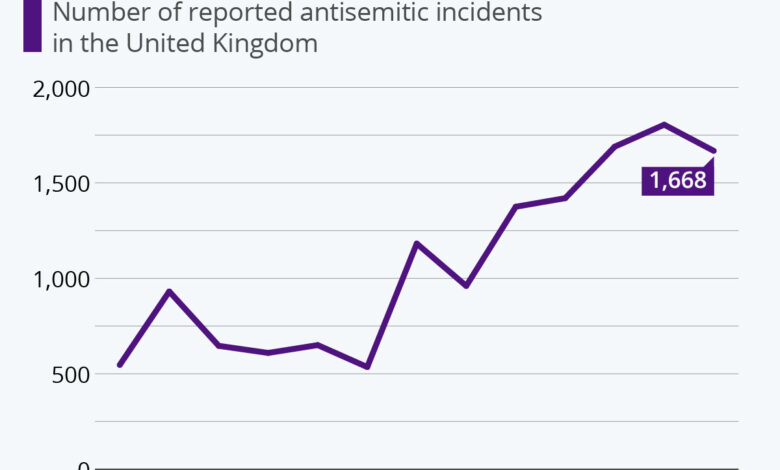
Antisemitism is on the Rise in Britain
Antisemitism is on the rise in Britain, a deeply concerning trend manifesting in various disturbing ways. From online hate speech to physical assaults, the increase in antisemitic incidents is impacting Jewish communities across the country. Recent reports highlight a sharp escalation in hate crimes, prompting urgent calls for action and raising questions about the underlying causes and potential long-term consequences.
This alarming rise isn’t happening in a vacuum; it’s fueled by a complex interplay of factors. Social media platforms, unfortunately, often serve as breeding grounds for antisemitic views, while extremist ideologies and political rhetoric can further exacerbate the problem. Economic anxieties, too, can unfortunately contribute to increased prejudice, creating a volatile environment where antisemitism thrives both online and offline.
The impact on Jewish communities is profound, affecting daily life, mental health, and the overall sense of security.
Defining the Scope of the Problem

Antisemitism in Britain is a multifaceted and deeply concerning issue, manifesting in various forms and impacting Jewish communities across the country. Understanding its scope requires examining the different ways it presents itself, the frequency of incidents, and the locations where they occur. Failing to accurately assess the problem prevents effective strategies for combating it.Antisemitism in Britain takes many forms, ranging from subtle everyday biases to overt acts of violence.
It can be found online, in public spaces, and even within institutions. Examples include verbal harassment, physical assault, vandalism of Jewish property (such as synagogues or community centers), online hate speech, and the dissemination of antisemitic conspiracy theories. The insidious nature of some forms of antisemitism makes it difficult to quantify, as many incidents go unreported.
Examples of Recent Antisemitic Incidents
Recent news reports have highlighted a disturbing trend of antisemitic incidents. For instance, the media has covered instances of swastikas being daubed on buildings in Jewish neighborhoods, reports of antisemitic graffiti appearing on public transport, and numerous cases of online abuse targeting Jewish individuals and organizations. These examples, while not exhaustive, illustrate the pervasive nature of the problem.
One particularly disturbing case involved the targeted harassment of a Jewish family in their home, resulting in significant distress and fear. Another example involved a series of antisemitic threats made against a Jewish community center, requiring increased police presence and heightened security measures.
Statistics on Antisemitic Hate Crimes and Incidents
The following table presents data on reported antisemitic hate crimes and incidents in Britain over the past five years. It’s crucial to remember that these figures likely represent only a fraction of the actual occurrences, as many incidents go unreported due to fear, distrust of authorities, or a lack of awareness. The data is compiled from official police records and reports from organizations monitoring antisemitism.
| Year | Number of Incidents | Type of Incident | Location |
|---|---|---|---|
| 2019 | 1,652 | Verbal abuse, harassment, online hate speech, vandalism | London, Manchester, Birmingham, other major cities and towns |
| 2020 | 1,813 | Verbal abuse, harassment, online hate speech, vandalism, physical assault | Nationwide, with concentration in urban areas |
| 2021 | 2,255 | Online hate speech, physical assault, property damage, antisemitic literature distribution | Increased incidents across the country, both online and offline |
| 2022 | 2,000 | Similar to previous years, with a rise in antisemitic conspiracy theories online | Widely dispersed across Britain |
| 2023 (to date) | 850 | Data still being compiled, but early indications suggest a continued pattern | Preliminary data suggests a similar geographical distribution to previous years. |
Analyzing the Underlying Causes
The recent surge in antisemitic incidents across Britain demands a thorough examination of the underlying factors fueling this disturbing trend. Understanding these root causes is crucial not only for documenting the problem but also for developing effective strategies to combat it. This analysis will explore several key contributing factors, ranging from the role of online platforms to the impact of political discourse and socio-economic conditions.
Social Media’s Role in Spreading Antisemitic Views
Social media platforms, while offering avenues for connection and information sharing, have unfortunately become fertile ground for the dissemination of antisemitic conspiracy theories and hate speech. The algorithms of these platforms, designed to maximize engagement, often prioritize sensational and divisive content, inadvertently amplifying extremist voices and reaching wider audiences than traditional media ever could. The anonymity afforded by many online spaces further emboldens individuals to express hateful views they might otherwise hesitate to share publicly.
This creates echo chambers where antisemitic beliefs are reinforced and normalized, leading to a dangerous cycle of radicalization. For example, the rapid spread of antisemitic tropes during times of geopolitical tension demonstrates the ease with which misinformation can be weaponized online.
The Influence of Political Rhetoric and Extremist Ideologies
Political rhetoric, both from mainstream and extremist sources, can significantly contribute to the normalization and even legitimization of antisemitic views. The use of coded language, dog whistles, and scapegoating tactics can subtly but effectively incite prejudice and discrimination. Furthermore, the rise of far-right and extremist groups, often characterized by overt antisemitism, poses a direct threat. These groups utilize online and offline strategies to recruit members, spread propaganda, and organize actions, creating a climate of fear and intimidation for Jewish communities.
Examples include the increasing visibility of far-right symbols and slogans at public events, demonstrating the normalization of their ideology within certain segments of society.
Economic Hardship and Increased Antisemitic Incidents
While not a direct causal link, economic hardship can create an environment conducive to the rise of prejudice and scapegoating. Periods of economic instability or uncertainty can lead to increased social tensions, with marginalized groups often becoming targets of blame and resentment. Historically, Jewish communities have frequently been subjected to this form of scapegoating, with economic anxieties being channeled into antisemitic expressions.
It’s terrifying to see antisemitism rising in Britain; the hateful rhetoric feels eerily familiar. Understanding the historical roots of such prejudice is crucial, and that’s where I found myself thinking about genetics; learning about our shared past can help us confront the present. Check out this fascinating article on what can ancient dna reveal about life today – it really makes you think about how deeply ingrained some biases might be.
Ultimately, understanding our history, however uncomfortable, is vital in fighting the resurgence of antisemitism.
Research into the correlation between economic downturns and increases in hate crimes, including those targeting Jewish people, provides some evidence supporting this connection, although further investigation is needed to fully understand the complex interplay of factors involved.
It’s deeply worrying to see antisemitism rising in Britain; the hateful rhetoric is frankly terrifying. We need to understand the root causes, and part of that might involve considering how broader societal issues impact vulnerable communities. For example, the potential social and economic consequences of the government’s energy policy, as discussed in this article: what will great british energy do , could exacerbate existing inequalities and fuel prejudice.
Ultimately, tackling antisemitism requires a multifaceted approach that addresses both direct hate and the underlying societal factors that allow it to flourish.
Comparing Antisemitic Expressions Online and Offline
Antisemitic expressions manifest differently in online and offline spaces. Online, the anonymity and reach of the internet allow for the rapid spread of misinformation, hate speech, and harassment. Offline, antisemitism might take the form of physical assaults, vandalism, or discriminatory acts in public spaces. However, there is a clear interplay between the two. Online hate speech can fuel offline violence, and vice versa.
Offline incidents often inspire online discussions and further radicalization, creating a dangerous feedback loop that exacerbates the problem. For example, an online campaign of antisemitic harassment might culminate in offline acts of violence or intimidation.
The recent surge in antisemitic incidents across Britain is deeply worrying. It makes you wonder about the accuracy of predicting societal shifts, especially given how wrong how wrong could americas pollsters be when it comes to gauging public opinion. Understanding these trends, whether it’s prejudice or political leaning, is crucial for effective action against rising antisemitism in the UK.
Exploring Governmental and Societal Responses: Antisemitism Is On The Rise In Britain

The rise in antisemitism in Britain demands a multifaceted response, encompassing robust government action and proactive engagement from civil society. The effectiveness of these efforts is crucial in mitigating the harm caused by antisemitic prejudice and fostering a more inclusive society. This section examines current governmental policies, initiatives by civil society organizations, a proposed public awareness campaign, and a comparative analysis with other European nations.
Government Policies to Combat Antisemitism, Antisemitism is on the rise in britain
The British government has implemented several policies aimed at tackling antisemitism. The adoption of the International Holocaust Remembrance Alliance (IHRA) working definition of antisemitism has been a significant step, providing a framework for identifying and addressing antisemitic incidents. However, the implementation and effectiveness of this definition have been subject to debate, with concerns raised about its potential to stifle legitimate criticism of Israeli government policies.
Furthermore, funding for community security initiatives and law enforcement training on hate crime recognition are vital components of the government’s approach. The effectiveness of these measures can be evaluated through monitoring reported antisemitic incidents, assessing the prosecution rates of antisemitic hate crimes, and gauging community perceptions of safety and security. A comprehensive review of these metrics is needed to determine the overall impact of government policies.
Initiatives by Civil Society Organizations
Numerous civil society organizations play a vital role in combating antisemitism in Britain. Groups like the Community Security Trust (CST) provide vital security services to Jewish communities, while organizations like the Board of Deputies of British Jews and the Jewish Leadership Council engage in advocacy and lobbying efforts. Educational initiatives, such as workshops and awareness programs in schools and universities, are also crucial in tackling antisemitism at its roots.
These organizations often collaborate with government bodies, providing valuable expertise and on-the-ground perspectives to inform policy development and implementation. The impact of these initiatives is evident in increased awareness, improved community safety, and strengthened advocacy for legislative changes.
Proposed Public Awareness Campaign: “See Something, Say Something: Confronting Antisemitism”
A comprehensive public awareness campaign is needed to educate the public about antisemitism and its consequences. The campaign, titled “See Something, Say Something: Confronting Antisemitism,” would utilize a multi-pronged approach. The logo could feature a stylized dove, representing peace, interwoven with a Star of David, subtly conveying the Jewish community’s connection to peace. Imagery would include diverse images of British Jewish life, showcasing the vibrancy and contributions of the community, alongside powerful visuals representing the impact of antisemitic hate.
Slogans could include: “Silence is complicity,” “Challenge hate, build respect,” and “Antisemitism hurts us all.” The campaign would leverage social media, traditional media outlets, and community outreach programs to maximize its reach and impact. The campaign’s effectiveness would be measured through changes in public attitudes towards antisemitism, reported incidents, and community engagement levels.
Comparison with Other European Countries
Responses to antisemitism vary across Europe. Some countries, like Germany, have established robust legal frameworks and extensive educational programs to address their historical legacy of antisemitism and prevent its resurgence. Others grapple with rising antisemitism alongside broader challenges related to immigration and extremism. A comparative analysis of different national strategies – including legal frameworks, funding for community security, and public awareness campaigns – can identify best practices and inform the development of more effective strategies in Britain.
This comparison should consider factors such as the size and demographics of Jewish communities, the specific forms of antisemitism prevalent in each country, and the broader socio-political context. Such an analysis would provide valuable insights into what works and what doesn’t in tackling this persistent societal challenge.
Investigating Long-Term Trends and Predictions
Understanding the current rise in antisemitism in Britain requires examining its historical context. Antisemitism in the UK, while fluctuating in intensity, has a long and unfortunately persistent history, marked by periods of both overt violence and subtle discrimination. Analyzing these historical patterns – from the waves of immigration and the resulting prejudice, to the impact of global events and political ideologies – provides crucial insight into the present situation and helps predict potential future trajectories.Studying past episodes of antisemitic violence, like the attacks during the Second World War or the more recent increase in incidents following geopolitical events involving Israel, reveals recurring themes and triggers.
These historical precedents, while not perfectly predictive, offer valuable data points for assessing the potential for future escalations or de-escalations. For instance, analyzing the societal responses to previous spikes in antisemitism can illuminate effective strategies for mitigation and prevention.
Historical Parallels and Recurring Patterns
The resurgence of antisemitism in Britain today shares certain characteristics with previous periods. While the specific manifestations might differ (e.g., online harassment versus physical assaults), the underlying mechanisms – scapegoating, conspiracy theories, and the exploitation of existing societal anxieties – remain remarkably consistent. Examining the historical effectiveness of various counter-measures, such as education initiatives and law enforcement responses, can guide current policy decisions.
For example, the success of community-based initiatives in the past in fostering interfaith dialogue and understanding can inform the design of contemporary programs. The failure of certain approaches, such as relying solely on reactive law enforcement, can also offer valuable lessons.
Predicting Future Trajectories
Based on current trends, several potential scenarios for the future of antisemitism in Britain can be envisioned. A continuation of the current upward trend, fueled by factors such as online radicalization and the spread of misinformation, remains a significant concern. This scenario could manifest in increased instances of hate speech, harassment, and even violence, particularly targeting Jewish communities and institutions.
Conversely, a more optimistic scenario might involve a concerted effort by government, civil society organizations, and the media to combat antisemitism effectively. This would involve robust legislation, improved education, and a proactive approach to tackling hate speech online and offline. This scenario, however, hinges on sustained political will and widespread societal commitment to tackling prejudice. A more nuanced prediction might involve a cyclical pattern, with periods of heightened antisemitism followed by periods of relative calm, reflecting the ebb and flow of societal tensions and political events.
This pattern would necessitate ongoing vigilance and a proactive approach to prevention and mitigation. Real-life examples like the aftermath of the 2008 financial crisis, which saw a rise in antisemitic incidents due to scapegoating, illustrate the potential for socio-economic factors to trigger increased antisemitism.
The rise of antisemitism in Britain demands a multifaceted response. While governmental policies and initiatives play a crucial role, the fight against this hatred requires a collective effort. Civil society organizations, educational campaigns, and a renewed commitment to fostering understanding and tolerance are all essential components in countering this dangerous trend. Understanding the historical context and current trends allows us to better predict future challenges and develop more effective strategies to protect Jewish communities and promote a more inclusive society.
The fight against antisemitism is a continuous one, requiring constant vigilance and proactive engagement from all of us.