North Korea Conducts Naval Missile Tests Under Supervision of Kim Jong Un as Naval Modernization Accelerates

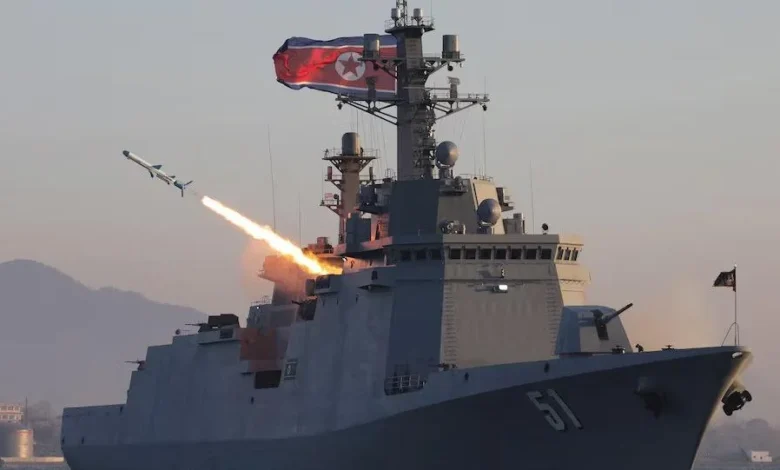
Pyongyang has intensified its maritime strike capabilities following a series of high-profile missile tests conducted from one of its newest and most advanced warships, an event personally overseen by North Korean leader Kim Jong Un. The state-run Korean Central News Agency (KCNA) reported on Tuesday, April 14, 2026, that the drills took place on the preceding Sunday, involving the launch of strategic cruise missiles and specialized anti-ship munitions. These maneuvers represent a significant step in the Democratic People’s Republic of Korea’s (DPRK) ongoing efforts to modernize its naval forces and diversify its delivery platforms for what it describes as "strategic" weaponry—a term frequently used by Pyongyang to denote nuclear-capable systems.
The tests were conducted from the Choe Hyon, a 5,000-ton destroyer that is part of a new class of vessels designed to project power further from the North Korean coastline. According to technical data released by KCNA, two strategic cruise missiles were launched, successfully navigating a pre-determined flight path over the West Sea of Korea—known internationally as the Yellow Sea. The report claimed these missiles remained airborne for more than two hours, demonstrating significant endurance and range. Additionally, an anti-ship missile was tested, reportedly staying aloft for 33 minutes before striking a target with what state media described as "ultra-precision accuracy."
Technical Specifications and Operational Significance
The duration of the flight tests provides insight into the operational range of North Korea’s latest cruise missile technology. A cruise missile capable of flying for over 120 minutes suggests a range that could easily cover the entirety of the Korean Peninsula and reach parts of Japan, depending on the flight speed and trajectory. By launching these assets from a mobile maritime platform like the Choe Hyon, North Korea is attempting to complicate the defensive calculations of the South Korean and United States militaries. Land-based launchers are easier to track via satellite; however, ship-borne missiles offer a level of stealth and mobility that increases the survivability of the North’s arsenal during a potential conflict.
The anti-ship missile test, lasting 33 minutes, suggests a focus on denying access to regional waters for enemy naval groups. In a conflict scenario, such weapons would be intended to target carrier strike groups or amphibious assault ships. Kim Jong Un, during his inspection, expressed "great satisfaction" with the results, noting that the "strategic action readiness" of the Korean People’s Army (KPA) has been substantially bolstered. He reiterated that the continuous enhancement of the nation’s nuclear deterrence remains the "most important priority task" for the state.
The Modernization of the North Korean Navy
For decades, the North Korean Navy was considered the weakest branch of the KPA, consisting largely of aging Soviet-era vessels and small patrol boats suited only for coastal defense. However, under Kim Jong Un’s leadership, there has been a marked shift toward building a "blue water" navy capable of operating further from the shore. The Choe Hyon is one of two 5,000-ton destroyers launched last year, representing the largest surface combatants North Korea has produced in recent memory.
During the Sunday inspection, Kim was also briefed on the progress of two additional destroyers currently under construction, identified as "No. 3 and No. 4." These vessels are reportedly being outfitted with advanced automated combat management systems and vertical launch cells for missiles. The acceleration of this shipbuilding program suggests that Pyongyang is moving toward a permanent maritime presence in both the Yellow Sea and the East Sea (Sea of Japan).
Chronology of Recent Provocations and Military Developments
The April 12 test did not occur in a vacuum; it is part of an accelerating timeline of military activity that has kept regional tensions at a fever pitch.
- January 2026: North Korea began the year by testing a new solid-fuel intermediate-range ballistic missile (IRBM) equipped with a hypersonic glide vehicle.
- February 2026: Pyongyang announced the successful testing of a new 240mm multiple rocket launcher system, specifically designed to target Seoul and surrounding metropolitan areas.
- March 2026: Large-scale artillery drills were conducted near the Northern Limit Line (NLL), the disputed maritime border with South Korea, leading to increased naval patrols by the South Korean Navy.
- Early April 2026: Just days before the naval tests, North Korea conducted a ground-based test of a "super-large" cruise missile warhead, signaling a focus on increasing the destructive power of its tactical weapons.
This timeline indicates a dual-track approach: North Korea is simultaneously refining its long-range nuclear threats against the United States while building highly sophisticated tactical weapons to counter South Korean and Japanese conventional superiority.
Regional Reactions and the Russian Connection
The international community has reacted with concern to the latest naval developments. South Korean officials have been particularly vocal about the speed at which Pyongyang is upgrading its fleet. Yoo Yong Won, a member of the South Korean parliament and the People Power Party, recently highlighted satellite imagery showing rapid construction at the Nampo shipyard. Yoo suggested that the technological leap seen in the Choe Hyon class and the subsequent vessels under construction may not be entirely domestic.
"North Korea is accelerating its naval modernization with what appears to be significant military assistance from Russia," Yoo stated. This sentiment is echoed by various Western intelligence agencies, which have monitored a deepening "comprehensive strategic partnership" between Moscow and Pyongyang. Following North Korea’s provision of artillery shells and ballistic missiles to support Russia’s invasion of Ukraine, analysts believe Russia is reciprocating with sensitive military technology. This assistance likely includes naval engine designs, radar systems, and potentially expertise in missile guidance systems.
The U.S. State Department issued a statement condemning the tests, noting that the use of cruise missile technology, while not explicitly banned by all UN Security Council resolutions in the same way as ballistic missiles, still poses a grave threat to regional stability. Washington reiterated its commitment to the "extended deterrence" of its allies, South Korea and Japan.
Strategic Implications and Analysis
The shift toward ship-launched cruise missiles represents a tactical evolution for Pyongyang. While North Korea’s submarine-launched ballistic missile (SLBM) program has garnered significant headlines, a fleet of surface destroyers equipped with strategic cruise missiles offers a more immediate and cost-effective way to challenge regional naval supremacy.
From a strategic standpoint, these tests serve several purposes:
- Second-Strike Capability: By placing nuclear-capable cruise missiles on surface ships, North Korea creates a "floating" deterrent. Even if land-based silos were neutralized in a first strike, the naval fleet could potentially retaliate from various locations at sea.
- Anti-Access/Area Denial (A2/AD): The anti-ship missiles are designed to keep U.S. aircraft carriers at a distance. If North Korea can credibly threaten high-value naval assets, it gains leverage in diplomatic negotiations and limits the military options available to its adversaries.
- Domestic Propaganda: State media coverage of Kim Jong Un aboard a modern destroyer serves to project an image of a powerful, modernizing nation to the North Korean public, reinforcing the "Byungjin" policy of simultaneous economic and nuclear development.
Furthermore, the choice of the West Sea (Yellow Sea) for these tests is significant. This body of water is a sensitive area for China as well. While Beijing remains North Korea’s primary economic lifeline, the presence of advanced North Korean naval assets and increased U.S.-South Korean naval drills in the Yellow Sea creates a complex security dilemma for the Chinese leadership.
Conclusion
The naval missile tests supervised by Kim Jong Un on April 12, 2026, underscore a transformative period for the North Korean military. No longer content with being a land-locked nuclear power, Pyongyang is aggressively pursuing the capability to project force across the maritime domain. The integration of long-range cruise missiles with a new class of heavy destroyers suggests that the DPRK is building a navy that can do more than just guard its coasts; it is building a navy that can participate in a strategic nuclear standoff.
As construction continues on destroyers "No. 3 and No. 4," and as military cooperation with Russia remains robust, the security architecture of Northeast Asia faces a period of profound uncertainty. The international community now watches closely to see if North Korea’s next move involves the deployment of these "strategic" naval assets in permanent patrol patterns, which would mark a permanent shift in the regional balance of power. For now, Kim Jong Un’s satisfaction with the "ultra-precision" of his new missiles serves as a stark reminder that the Korean Peninsula remains one of the world’s most volatile flashpoints.