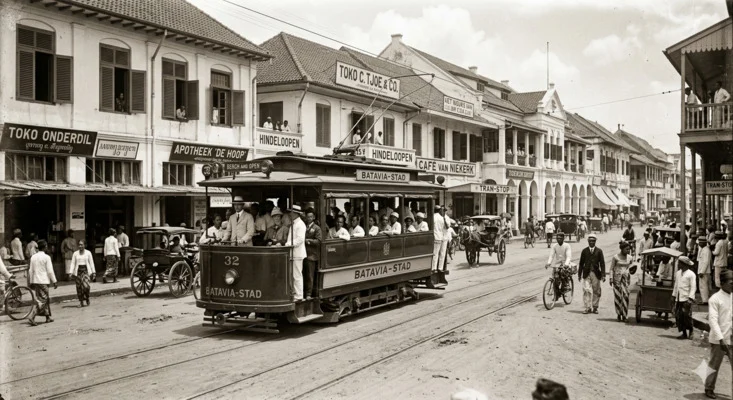
Trams represented a foundational mode of urban transportation in the colonial Dutch East Indies, long preceding the modern electric commuter trains (KRL) that now crisscross Indonesia’s major cities. These early rail-based systems served as the backbone of public transit in burgeoning metropolises, most notably Batavia, the historical name for Jakarta, offering a glimpse into the sophisticated urban planning of a bygone era. Their operational span, from the late 19th century through the mid-20th century, encapsulates a significant period of technological advancement, colonial governance, and post-independence nation-building.
The Dawn of Urban Mobility: Horse Trams and Batavia’s Growth (1869-1882)
The formal commencement of tramline construction in Batavia marked a pivotal moment in the city’s infrastructural development, with work officially beginning on April 10, 1869. This initiative was a direct response to Batavia’s rapid expansion and increasing population density, driven by its status as a vital administrative and commercial hub of the Dutch East Indies. As detailed in the "Perkembangan Transportasi Kereta Api di Jakarta" journal, the initial tram system relied on horse power. These horse-drawn trams, while seemingly rudimentary by today’s standards, offered a revolutionary solution for urban mobility in an era predominantly served by traditional conveyances like horse-drawn carriages (delman) and rickshaws (becak).
The introduction of trams was not merely about efficiency; it reflected a conscious effort by the colonial administration and private enterprises to modernize the city and facilitate commerce. Batavia, with its burgeoning port of Tanjung Priok and its role as a regional trade nexus, required a robust internal transport network to connect its various districts—from the old city center (Kota Tua) to emerging residential and commercial areas. The horse trams, typically operating on narrow gauge tracks, offered a more structured and higher-capacity alternative, capable of moving larger numbers of people and goods along fixed routes, thereby streamlining daily commutes for both colonial administrators and local populations who could afford the fare. This era laid the groundwork for a more integrated urban experience, even as social segregation in transport remained a subtle but undeniable reality.
Technological Leaps: From Steam to Electric (1882-1945)
The late 19th century was characterized by a global wave of technological innovation, and Batavia was not immune to these advancements. By 1882, a significant upgrade saw the horse trams gradually replaced by steam-powered trams. This transition marked a leap in capacity, speed, and overall efficiency. Steam trams, with their characteristic plumes of smoke and rhythmic chugging, quickly became a defining feature of Batavia’s soundscape and street life. Their operation was initially managed by the Bataviasche Tramweg Maatschappij (BTM), a private Dutch company, which later rebranded as Nederlands-Indische Tramweg Maatschappij (NITM). These companies played a crucial role in the financing, construction, and operation of the expanding tram network, often enjoying significant concessions from the colonial government.
The steam tram era, while offering improved services, also brought new challenges, including noise pollution, air quality concerns from coal combustion, and the logistical complexities of maintaining steam engines. This eventually paved the way for the next significant technological shift. In 1899, electric trams were introduced, heralding a new era of clean, quiet, and more powerful urban transport. The advent of electric trams, managed by the Batavia Elektrische Tramweg Maatschappij (BETM), represented a major step towards modernizing Batavia’s infrastructure. Electricity for these trams was typically generated by dedicated power plants, often coal-fired, showcasing the city’s growing industrial capacity. The electric trams rapidly became the preferred mode, offering greater reliability and a smoother ride, and by 1909, Batavia boasted an extensive electric tram network spanning approximately 14 kilometers. This network continued to expand and operate throughout the remaining decades of Dutch colonial rule, adapting to the city’s evolving needs until the tumultuous period of World War II and the subsequent Indonesian struggle for independence.
A Network Takes Shape: Routes, Infrastructure, and Urban Impact
The tram network in Batavia was meticulously planned to connect the city’s most strategic points, facilitating both administrative functions and economic activities. The track gauge, measuring 1,188 mm, was a standard narrow gauge for tramways of that era, allowing for tighter turns in crowded urban environments. The primary routes interconnected key districts, stretching from the bustling commercial hub of Kota Intan (part of the Old Town, near the port) all the way to Kampung Melayu in the eastern part of the city. Along this extensive route, trams traversed vital junctions and landmarks, including Stasiun Batavia NIS (Nederlandsch-Indische Spoorweg Maatschappij, referring to the Dutch East Indies Railway Company station, now Jakarta Kota Station), Batavia BOS (BOS was another railway company), Glodok (a prominent Chinese commercial district), Harmoni (a central administrative and social area), Rijswijk (present-day Juanda, known for its colonial residences and government offices), and Pasar Baru (a vibrant market district).
The strategic placement of these routes had a profound impact on Batavia’s urban development. Areas along the tram lines experienced increased property values, facilitated the growth of commercial establishments, and encouraged residential development. The tram system essentially acted as an armature for urban expansion, defining accessibility and shaping the daily routines of thousands of residents. For the European population and the affluent indigenous and Chinese communities, trams offered a convenient and relatively comfortable mode of transport. For the wider local population, it represented an affordable means to access employment, markets, and social amenities, albeit often with class-based segregation in seating arrangements. The trams were not just a means of transport; they were a symbol of Batavia’s modernity, a constant pulse through its streets, influencing everything from urban planning regulations to the social dynamics of the city.
Trams in a New Nation: Post-Independence and Revolution (1945-1957)
The period following Indonesia’s Proclamation of Independence on August 17, 1945, ushered in an era of profound transformation. The nascent Indonesian government embarked on a comprehensive program of nationalization, seizing assets and enterprises previously owned by Dutch colonial entities. This policy extended to vital sectors, including public transportation, and consequently, the tram system in Jakarta (as Batavia was renamed). The nationalization efforts were not merely economic; they were deeply symbolic, representing the assertion of Indonesian sovereignty over its own resources and infrastructure.
During the Indonesian National Revolution (1945–1949), a period often referred to as the "physical revolution," the trams transcended their primary function as a mode of transport. They became an unlikely, yet potent, medium of struggle and communication for Indonesian freedom fighters. Revolutionaries ingeniously utilized tram carriages to disseminate messages of independence and nationalist propaganda to the populace. These messages, often hand-painted banners or leaflets, would be displayed on or distributed from the trams as they moved through the city, reaching a wide audience and fostering a sense of unity and resistance against returning colonial powers. This unique role underscored the tram system’s deep integration into the social fabric of the city, transforming it from a mere utility into a silent, moving platform for political discourse.
.jpg)
Following the formal recognition of Indonesia’s independence in 1949 and the subsequent administrative consolidation, the nationalized transport assets, including the tram network, were eventually brought under the purview of state-owned enterprises. This culminated in the establishment of Pengangkutan Penumpang Djakarta (PPD) in 1957. PPD was tasked with overseeing public passenger transport in the capital, inheriting the operational responsibilities for the tram system, alongside other emerging modes like buses. This transition marked a shift from privately run colonial infrastructure to a public service model under the newly independent Indonesian government.
The Winds of Change: Modernization and Obsolescence (1950s)
As Jakarta entered the 1950s, a new vision for a modern, independent capital began to take shape, heavily influenced by President Sukarno’s aspirations for a dynamic, forward-looking Indonesia. Within this context, the venerable tram system, despite its long history and previous technological upgrades, increasingly began to be perceived as an anachronism. The prevailing sentiment among urban planners and political leaders was that trams were becoming obsolete, inflexible, and ill-suited to the demands of a rapidly growing metropolis grappling with increasing traffic congestion.
The arguments against trams were multi-faceted. Firstly, their fixed routes and reliance on dedicated tracks were seen as a hindrance to the flexibility required for urban expansion and traffic management. Unlike buses, which could easily adapt to new routes, bypass congested areas, or operate on existing road networks without extensive infrastructure, trams were bound by their rails. Secondly, the maintenance of the aging tram infrastructure—tracks, overhead lines, and rolling stock—was becoming a significant financial burden for the nascent PPD. Decades of operation, compounded by the disruptions of war and revolution, had left much of the system in need of substantial investment for upgrades and repairs. Thirdly, the noise and visual intrusion of the overhead electric lines, along with the physical presence of the tracks, were increasingly viewed as impediments to the aesthetic and functional modernization of Jakarta’s streets, which were envisioned to accommodate a growing number of private vehicles and buses.
President Sukarno himself became a vocal proponent of abolishing the tram system. His vision for Jakarta as a grand, modern capital required efficient, flexible transport that could keep pace with its rapid development. Trams, with their perceived slowness and rigidity, did not align with this ambitious future. This presidential directive was supported by key city officials, most notably Jakarta’s Mayor Syamsurizal. In 1951, Mayor Syamsurizal explicitly stated the necessity of phasing out trams and replacing them with a bus-based transportation system. Buses were championed for their greater flexibility, lower initial infrastructure costs (compared to laying new tram tracks), and their perceived modernity. This policy decision reflected a broader global trend in urban planning during the mid-20th century, where many cities around the world chose to dismantle their tram networks in favor of bus systems and, increasingly, private automobiles.
The Final Stop: Dismantling a Legacy (1956-1962)
Following the clear policy directives from the highest levels of government and municipal administration, the fate of Jakarta’s trams was sealed. The process of phasing out the system was gradual but inexorable. In 1956, the operational fleet still comprised approximately 40 tram units. However, this number began to shrink dramatically as sections of the network were progressively closed down. By 1960, the fleet had been halved, a direct consequence of line closures and the lack of investment in maintenance and replacement of rolling stock.
The decision to transition definitively to a bus-centric public transport system was formally cemented in 1961, when the government officially declared that buses would be the primary mode of public transportation in Jakarta. This declaration accelerated the dismantling process. The remaining tram lines were shut down, and the infrastructure was systematically removed. On a symbolic and practical level, the cessation of tram operations represented a definitive break with the colonial past and a full embrace of a new, independent identity for Jakarta’s urban landscape.
Finally, in 1962, the last tram rolled through the streets of Jakarta. An iconic mode of transport that had served the city for nearly a century, witnessing its transformation from colonial Batavia to the capital of an independent nation, was definitively halted. The removal of the tram tracks and overhead lines physically erased much of its presence, yet its memory endured in the collective consciousness of older generations and in the historical records of the city’s development. The decision, while perhaps seen as progressive at the time, would later be re-evaluated by urban planners globally, as many cities began to rediscover the benefits of light rail and modern tram systems for sustainable urban mobility.
Legacy and Lessons: A Look Back and Forward
The disappearance of trams from Jakarta’s streets marked the end of a significant chapter in the city’s transportation history. For nearly 93 years, from 1869 to 1962, trams were an integral part of Batavia/Jakarta’s daily life, shaping its urban form, facilitating its economy, and even playing a role in its struggle for independence. Their legacy extends beyond mere infrastructure; they symbolize the city’s journey through different eras, reflecting technological progress, colonial influence, and national aspirations.
The decision to abolish the tram system in the 1950s and early 1960s, driven by a vision of modernization and the perceived inflexibility of fixed-rail systems compared to buses, had profound implications. While it cleared the way for a more adaptable bus network and accommodated the rise of private vehicular traffic, it also contributed to the eventual congestion issues that would plague Jakarta for decades. The short-sightedness of dismantling a high-capacity, dedicated-lane public transport system became increasingly apparent as the city’s population exploded and its road infrastructure struggled to cope with the sheer volume of vehicles.
In contemporary Jakarta, with its chronic traffic woes and an urgent need for sustainable urban transport solutions, there has been a renewed interest in rail-based systems. The development of the Jakarta MRT (Mass Rapid Transit) and LRT (Light Rail Transit) systems in recent decades can be seen as a modern echo of the tram’s original purpose: to provide efficient, high-capacity public transport along dedicated corridors. These new systems, while technologically far advanced, address many of the same challenges that the trams once sought to overcome.
The history of Jakarta’s trams offers invaluable lessons for urban planners and policymakers today. It underscores the importance of long-term vision in infrastructure development, the need to consider the full life-cycle costs and benefits of different transport modes, and the dangers of prematurely abandoning established systems without fully understanding their enduring value. While the physical trams may be gone, their historical footprint and the narrative of their rise and fall continue to inform discussions about Jakarta’s future as a truly modern, sustainable, and livable metropolis.