Socio Today
Jakarta, Indonesia – A burgeoning crisis of unprecedented proportions is gripping Indonesia as mountains of waste threaten to overwhelm the nation’s critical infrastructure. Landfills across the archipelago are rapidly reaching — or have already surpassed — their maximum capacity, a dire situation exacerbated by an unrelenting daily surge in waste volume. The urgency of this environmental and public health catastrophe has propelled the government to accelerate the adoption of transformative waste management solutions, with a particular focus on waste-to-energy (WtE) and waste-to-fuel (WtF) technologies.
The Looming Crisis: Indonesia’s Landfill Overload and Environmental Fallout
Indonesia, a nation comprising over 17,000 islands and a population exceeding 270 million, faces immense challenges in waste management. Annually, the country generates an estimated 67-68 million tons of waste, equivalent to approximately 185,000 tons per day. A significant portion of this colossal volume, often exceeding 60%, is mismanaged or ends up in open dumps and overflowing landfills, with only a fraction being properly recycled or processed. This unsustainable trajectory has led to critical land scarcity for new disposal sites and has turned existing ones into environmental time bombs.
The consequences of this waste deluge are multifaceted and severe. Overloaded landfills are significant emitters of methane, a potent greenhouse gas contributing substantially to climate change, far more impactful than carbon dioxide over a shorter timeframe. The leachate, a toxic liquid formed as waste decomposes, contaminates soil and groundwater, posing severe risks to public health and ecosystems. Additionally, the sheer volume of unmanaged waste contributes to plastic pollution in rivers and oceans, threatening marine biodiversity and impacting local economies dependent on fisheries and tourism.
Wakil Menteri Energi dan Sumber Daya Mineral (ESDM), Yuliot Tanjung, recently highlighted the gravity of the situation, projecting that nearly all Landfills (Tempat Pembuangan Akhir – TPA) in Indonesia will reach overcapacity by 2028, if not sooner, unless immediate and significant breakthroughs are achieved. This stark warning underscores the pressing need for a paradigm shift in the nation’s approach to waste.
Government’s Strategic Pivot: Waste-to-Energy as a Dual Solution
In response to this escalating crisis, the Ministry of Energy and Mineral Resources (ESDM) is aggressively advocating for the accelerated development of Waste-to-Energy (WtE) facilities, also known as Pembangkit Listrik Tenaga Sampah (PLTSa). This strategy is envisioned as a dual solution, simultaneously addressing the critical waste problem and contributing to Indonesia’s renewable energy targets. The government has set an ambitious goal: to establish 34 WtE projects across 34 cities within the 2026-2027 period. This rapid deployment strategy signifies a profound commitment to leveraging waste as a valuable resource rather than merely a disposal challenge.
Speaking after an inspection of PT Sumber Organik’s Pembangkit Sampah menjadi Energi Listrik (PSEL) facility at TPA Benowo, Surabaya, on Thursday, April 16, 2026, Wamen ESDM Yuliot Tanjung emphasized the presidential mandate on this issue. "Urban waste management is a priority activity that receives direct monitoring from Bapak President Prabowo. Therefore, serious and systematic efforts are needed so that urban waste no longer becomes a source of problems, but instead provides benefits," Yuliot stated, underlining the high-level political will driving this initiative.
The government’s push for WtE is anchored in a robust legal framework. Peraturan Presiden (Presidential Regulation) Nomor 109 Tahun 2025 has been issued to serve as the legal umbrella, designed to accelerate urban waste management through the conversion of waste into renewable energy using environmentally friendly technologies. This regulation streamlines permitting processes, provides incentives, and clarifies the roles of various stakeholders, aiming to overcome the bureaucratic hurdles that have historically slowed such large-scale infrastructure projects.
Presidential Mandate and the "Indonesia ASRI" Movement
President Prabowo Subianto has personally underscored the critical importance of effective waste management, making it a central pillar of his administration’s environmental agenda. During his address at the National Coordination Meeting of Central and Regional Governments in 2026, President Prabowo announced the impending launch of the "Gerakan Indonesia ASRI." This national movement, an acronym for Aman (safe), Sehat (healthy), Resik (clean), and Indah (beautiful), aims to foster a nationwide culture of cleanliness and environmental stewardship. The initiative reflects a comprehensive approach, seeking to engage communities, local governments, and the private sector in a concerted effort to transform waste management practices across the country.
President Prabowo reiterated the alarming projection that nearly all Indonesian landfills are expected to reach overcapacity by 2028, or even earlier, highlighting the urgency of the situation to regional leaders. "This waste issue has become a problem. It is projected that almost all landfills will experience overcapacity by 2028, even sooner," Prabowo asserted, underscoring the necessity for immediate and decisive action from all levels of government. His strong emphasis aims to mobilize resources and political will across provinces and municipalities to implement sustainable waste solutions.
Pioneering Solutions: The Benowo PSEL and Waste-to-Fuel Initiatives in Surabaya
A shining example of Indonesia’s potential in sustainable waste management can be found in Surabaya, East Java, at the Benowo Landfill. Here, PT Sumber Organik has established and operates a state-of-the-art Pembangkit Sampah menjadi Energi Listrik (PSEL) facility, which was officially inaugurated on May 6, 2021. This facility stands out not only for its operational efficiency but also for its comprehensive approach to waste processing.
Agus Nugroho Santoso, Director Utama of PT Sumber Organik, explained that the facility manages approximately 1,600 tons of waste daily from Surabaya and its surrounding areas. Crucially, unlike many conventional waste management sites that only process newly generated waste, PT Sumber Organik also tackles accumulated old waste. "We process both old and new waste into beneficial materials," Agus stated, highlighting the facility’s role in remediating historical waste burdens while managing current inflows. The Benowo PSEL exemplifies an integrated approach, converting municipal solid waste into a valuable energy source.
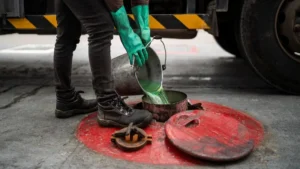
Beyond the existing PSEL, the Benowo TPA is also home to an ambitious new project: a waste-to-fuel (WtF) facility being constructed by PT Prakarsa Energi Sejahtera (SEP). This facility is specifically designed to further reduce landfill volumes by converting plastic waste into renewable fuel. The process involves several sophisticated stages, beginning with meticulous sorting or "handpicking" to ensure that only suitable plastic materials are fed into the pyrolysis unit.
Pyrolysis, a thermochemical decomposition of organic material at elevated temperatures in the absence of oxygen, is central to the WtF process at Benowo. The plastic waste is processed using pyrolysis machines, with a crucial addition of a flue gas treatment system. This system is implemented to ensure that all emissions meet the stringent quality standards set by the Ministry of Environment, mitigating potential air pollution concerns. The output of this advanced process is a Renewable Fuel Oil (BBMT) that is equivalent to diesel oil.
Currently, the waste-to-fuel plant is undergoing construction. Once operational, it will have the flexibility to adjust its processing capacity to match the volume of urban waste requiring urgent treatment. A pilot project has already demonstrated promising results, indicating that the facility can produce between 60 to 70 kiloliters of BBMT per day, offering a significant contribution to both waste reduction and energy diversification.
The Broader National Ambition: 34 WtE Projects by 2027
The government’s target of establishing 34 WtE projects in 34 cities by 2027 is an ambitious undertaking that requires substantial investment, technological expertise, and robust regulatory support. These projects are strategically important not only for waste management but also for enhancing Indonesia’s energy security and reducing its reliance on fossil fuels. The selected cities are typically major urban centers grappling with high waste generation rates and limited landfill space, making them ideal candidates for WtE solutions.
Each WtE project, while varying in scale, is expected to process thousands of tons of waste daily, converting it into electricity that can power tens of thousands of homes. This initiative aligns with Indonesia’s broader commitment to increasing its renewable energy mix, aiming for 23% by 2025 and moving towards net-zero emissions by 2060. The development of these facilities is anticipated to create numerous jobs, from construction and operation to maintenance and associated support services, stimulating local economies.
However, the rapid deployment plan faces inherent challenges. Securing adequate financing, attracting qualified technology providers, ensuring community acceptance, and developing a skilled workforce are critical factors. The government’s role in providing clear policy frameworks, financial incentives, and facilitating public-private partnerships will be paramount to the successful realization of these projects.
Technological Underpinnings: How Waste Becomes Power and Fuel
Waste-to-Energy technologies typically involve incineration, gasification, or pyrolysis to convert municipal solid waste into electricity or heat. Modern WtE plants, such as the one in Benowo, employ advanced emission control systems, including flue gas treatment, to minimize pollutants and ensure compliance with environmental standards. These systems are crucial for addressing public health and environmental concerns often associated with older incineration technologies.
The waste-to-fuel technology, exemplified by the upcoming facility in Benowo, specifically targets plastic waste. Pyrolysis, as mentioned, breaks down plastic polymers into liquid fuel and gases in an oxygen-free environment, offering a valuable way to deal with non-recyclable plastics that would otherwise end up in landfills or pollute the environment. The resulting fuel can be used in industrial processes, generators, or blended with conventional fuels, further diversifying energy sources. This approach is particularly relevant for Indonesia, which struggles with significant plastic waste generation.
Economic and Environmental Imperatives: Why WtE is Critical
The push for WtE and WtF is driven by compelling economic and environmental imperatives. Environmentally, these technologies offer a significant reduction in landfill volume, thus conserving land, mitigating methane emissions, and reducing soil and water contamination. By converting waste into energy, they also displace the need for fossil fuels, contributing to a lower carbon footprint and helping Indonesia meet its climate change mitigation targets under the Paris Agreement.
Economically, WtE projects offer several benefits. They provide a stable and localized source of energy, reducing dependence on imported fuels and enhancing energy security. The development and operation of these facilities stimulate local economies through job creation and investment. Furthermore, the gate fees collected for waste processing can create a sustainable revenue stream, making waste management more financially viable in the long run. While initial capital investment can be substantial, the long-term benefits in terms of environmental protection, energy generation, and public health often outweigh the costs.
Navigating Challenges and Ensuring Sustainability
Despite the clear benefits and strong government backing, the implementation of WtE and WtF projects in Indonesia is not without challenges. One significant hurdle is securing large-scale, consistent funding, which often requires a mix of government support, private investment, and international financing. Community acceptance is another critical factor; public education campaigns are essential to address concerns about emissions, site selection, and the overall impact of such facilities. Transparent communication and engagement with local communities are vital for gaining their trust and support.
Regulatory clarity and consistency are also paramount. While Perpres 109/2025 provides a framework, continuous refinement and effective enforcement of environmental standards, waste segregation policies, and energy pricing mechanisms are necessary to ensure the long-term viability and environmental integrity of these projects. Furthermore, while WtE and WtF offer powerful solutions, they should be integrated into a broader, holistic waste management strategy that prioritizes the 3R principles: Reduce, Reuse, Recycle. Maximizing waste reduction at the source and increasing recycling rates remain fundamental goals to minimize the overall waste stream requiring energy recovery.
The Path Forward: A Holistic Approach to Waste Management
Indonesia stands at a critical juncture in its environmental journey. The aggressive push towards waste-to-energy and waste-to-fuel technologies represents a decisive step towards tackling the nation’s severe waste crisis and bolstering its energy independence. The ambitious targets, coupled with strong presidential leadership and pioneering projects like those in Benowo, signal a serious commitment to transforming waste into a valuable resource.
The success of this national endeavor will hinge on sustained political will, robust financial mechanisms, technological innovation, and a collaborative effort involving central and local governments, the private sector, and civil society. By embracing these advanced solutions while simultaneously promoting waste reduction and recycling, Indonesia can move closer to achieving a truly "ASRI" environment – one that is safe, healthy, clean, and beautiful for all its citizens, and a model for sustainable development in the region.