 Socio Today
Honda Motor Company is reportedly steering toward a fascinating chapter in its storied motorcycle heritage by preparing to revive the iconic Motra, a legendary mini-bike imbued with rugged, adventure-ready styling that first captivated riders in Japan back in 1982. Recent intellectual property filings have sparked widespread speculation across the global motorcycling community, suggesting that the Japanese manufacturing giant is engineering a modern successor to the utilitarian classic.
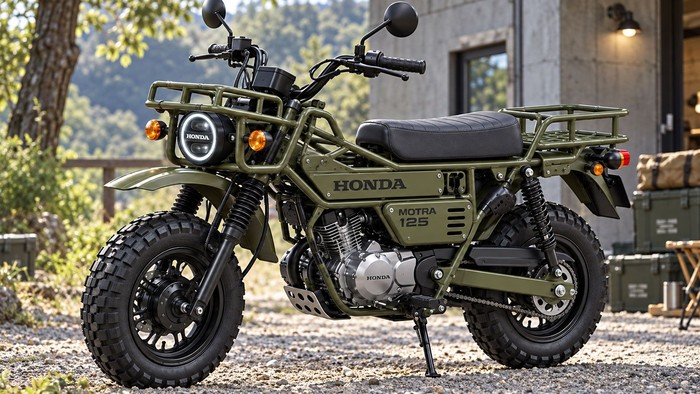
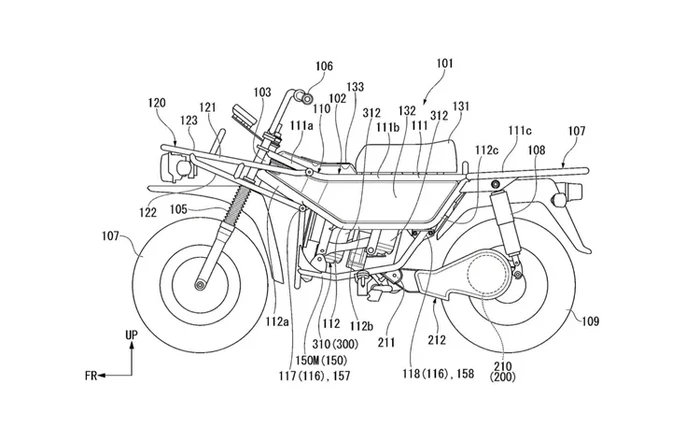
The revival rumors gained substantial momentum after newly uncovered patent imagery surfaced online. These official documents showcase a compact, boxy motorcycle silhouette that remains unmistakably faithful to the original Honda Motra design ethos. Prominent among the stylistic nods to the past are heavy-duty front and rear cargo racks, a utilitarian exposed steel frame, and a general aura of rugged functionality. However, the most groundbreaking aspect of these patent drawings is not merely their nostalgic aesthetic, but rather the underlying architecture designed to accommodate the modern mobility landscape.

According to the latest documentation, Honda has engineered a flexible vehicle platform specifically tailored to house two entirely distinct propulsion systems: a traditional internal combustion engine (ICE) and a modern electric motor. This progressive approach indicates that the automaker is developing a unified chassis capable of supporting both gasoline-powered variants and zero-emission electric setups. As urban mobility demands evolve and environmental regulations tighten worldwide, this dual-powertrain strategy positions Honda to cater simultaneously to traditional enthusiasts and eco-conscious city commuters.
Historical Roots: The Genesis of the Honda Motra in 1982
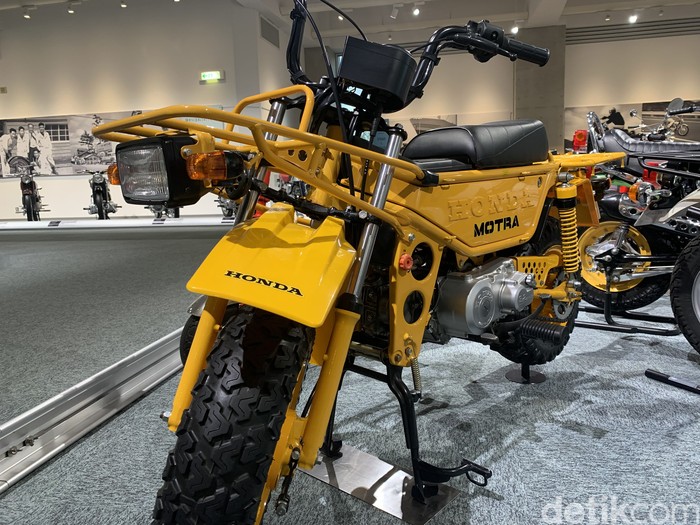
To fully appreciate the significance of Honda’s potential revival, one must examine the origins of the original Motra. Introduced to the Japanese domestic market in 1982, the Honda Motra—officially designated as the CT50—was conceptualized not merely as a recreational toy, but as a serious mini-cargo vehicle designed for utility and versatility.
During the early 1980s, Honda was a pioneer in experimenting with small-displacement, fun-to-ride motorcycles, having already achieved massive success with the iconic Z-Series (commonly known as the Monkey bike) and the CT series of trail bikes. The Motra, however, carved out a unique niche for itself through its uncompromisingly industrial design. Characterized by its rectangular sheet-metal frame, wide tires for enhanced stability over rough terrain, and massive cargo racks capable of hauling surprisingly heavy loads, the Motra was marketed as a compact packhorse for farmers, campers, and urban delivery workers.
One of the standout mechanical features of the original Motra was its robust sub-transmission system. Paired with a centrifugal clutch and a three-speed gearbox, the auxiliary sub-transmission allowed riders to select between high and low-range gearing. This engineering choice provided the tiny 50cc two-stroke-adjacent four-stroke engine with exceptional climbing power and low-end torque, enabling the mini-bike to conquer steep inclines despite its diminutive engine displacement and compact physical footprint.
Despite its innovative design and undeniable charm, the original Motra’s commercial run was relatively short-lived. Honda manufactured the model for a brief period before discontinuing it, largely due to shifting market trends and evolving safety and emissions standards of the era. Ironically, this brief production window has transformed the Motra into one of the most sought-after collector’s items in Honda’s historical catalog. Today, well-preserved examples fetch premium prices at auctions, and the model holds a revered place of honor inside the Honda Collection Hall at Twin Ring Motegi, cementing its status as a cult classic.
Decoding the Patent Filings: Engineering for a Dual Future
The recent emergence of patent documentation offers a rare glimpse into the future product planning of one of the world’s largest motorcycle manufacturers. Automotive and motorcycle industry analysts scrutinizing the blueprints have highlighted several key engineering breakthroughs that distinguish this new project from previous retro-revivals.
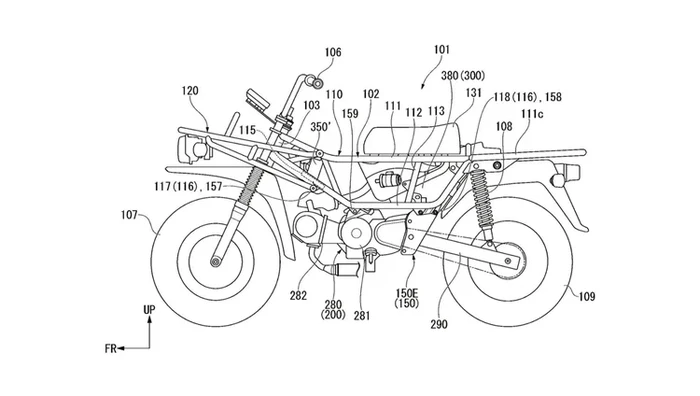
Most notably, the frame architecture depicted in the patent filings reveals a modular design philosophy. Rather than building a dedicated chassis exclusively for an electric battery pack or a traditional fuel tank and engine block, Honda’s engineers have crafted a versatile backbone frame. This central structure cleverly conceals mounting points and spatial provisions that can seamlessly transition from housing a small-displacement internal combustion engine to accommodating a compact electric motor and removable battery pack system.
This dual-path strategy reflects a pragmatic approach to the global transition toward electrification. While markets in North America and Europe are steadily embracing electric two-wheelers for urban environments, regions in Southeast Asia and parts of developing markets still heavily rely on internal combustion engines due to infrastructure limitations, refueling speeds, and cost considerations. By engineering a single chassis that supports both technologies, Honda can potentially manufacture the revived Motra at scale, tailoring the powertrain options to the specific regulatory and infrastructural demands of different global markets.
Furthermore, the design retains the boxy, utilitarian DNA that made the original machine a masterpiece of industrial design. The presence of integrated front and rear cargo racks suggests that the modern Motra will stay true to its heavy-duty cargo-hauling roots. In an era dominated by sleek, aerodynamic scooters and high-performance sportbikes, the unapologetically blocky aesthetic of the Motra provides a refreshing contrast, appealing directly to the booming market for lifestyle-oriented, quirky urban runabouts.
Industry Implications and Market Positioning
The decision by Honda to revisit its heritage portfolio is part of a broader, highly successful corporate strategy. In recent years, the motorcycle industry has witnessed a massive resurgence in retro-styled, small-to-mid-displacement motorcycles. Models like the Honda Super Cub, the Monkey 125, the Dax 125, and the Trail 125 (CT125) have proven that modern consumers possess a voracious appetite for machines that combine nostalgic styling with modern reliability, safety features, and fuel injection technology.
By introducing a modern interpretation of the Motra, Honda is strategically positioned to capture multiple demographics:
- Nostalgia-Driven Collectors and Enthusiasts: Riders who grew up with or admire the classic 1980s aesthetic will find the faithful retention of the boxy frame and cargo racks irresistible.
- Urban Commuters and Gig Economy Workers: The inclusion of heavy-duty utility racks and potential electric powertrain options makes the new Motra an exceptionally practical tool for last-mile delivery services, urban couriers, and city dwellers navigating congested streets.
- Outdoor and Camping Enthusiasts: The rugged tires, compact dimensions, and utility-focused build make it an ideal "pit bike" or recreational vehicle to be strapped to the back of an RV or loaded into a pickup truck for weekend adventures.
From a manufacturing standpoint, sharing a platform between ICE and EV variants also presents significant economic advantages. Research and development costs, tooling expenses, and component sourcing can be streamlined, allowing Honda to price the final production model competitively against rival mini-bikes from manufacturers like Kawasaki and Suzuki.
Timeline and What Lies Ahead
While Honda Motor Company has yet to issue an official, on-the-record press release confirming the exact commercial launch date of the production-ready Motra, the filing of detailed design patents strongly indicates that the project has moved past the initial conceptual brainstorming phase. In the automotive and motorcycle industries, patent submissions typically signal that a manufacturer is legally protecting proprietary designs ahead of prototype testing, trade show reveals, or eventual market introduction.
Industry insiders speculate that Honda may choose to unveil a near-production concept vehicle at major upcoming international motorcycle expositions, such as EICMA in Milan or the Osaka/Tokyo Motorcycle Shows in Japan. Such events would serve as a crucial barometer to gauge public reaction and media reception before finalizing the production specifications.
As urban environments continue to densify and the demand for sustainable, efficient, and characterful personal mobility solutions grows, the revival of the Honda Motra could not be timelier. By successfully bridging its illustrious past with a flexible, forward-looking powertrain strategy, Honda is demonstrating that classic utility never truly goes out of style—it simply evolves to meet the challenges of a new era.