 Socio Today
The quiet municipality of Ngawi, nestled in the western region of East Java, often evokes imagery of colonial-era fortifications like Benteng Pendem and serves as the celebrated hometown of the legendary campursari maestro, Didi Kempot. Yet, beyond its picturesque town square, locally known as the Alun-alun Ngawi, lies a profound historical narrative intricately tied to the development of Javanese Islamic architecture and nineteenth-century colonial administration. A recent historical expedition undertaken by local heritage enthusiasts has shed light on this overlooked past, offering a deeper understanding of the socio-religious foundations that shaped the region.
Unveiling the Origins of the Great Mosque of Ngawi
For travelers and locals alike, the Alun-alun Ngawi functions as the vibrant core of civic life, flanked on its western side by the prominent Masjid Agung Ngawi, historically referred to as Masjid Gedhe before its designation as Masjid Agung Baiturrahman in 2010. Although continuous modern renovations have transformed the structural integrity of the complex, historical artifacts embedded within the architecture silently bear witness to its colonial-era inception.
Historical documentation retrieved from a preserved wooden plaque above the main entrance reveals that the mosque was commissioned by Raden Tumenggung Brotodiningrat, who served as the Regent (Bupati) of Ngawi from 1877 to 1885. The foundation stone was laid on Tuesday Kliwon, November 25, 1879, corresponding to the 10th of Dhu al-Hijjah 1296 Hijriah.
Further inspection of the interior, specifically the mosque’s pulpit, uncovers intricate decorative motifs including floral tendrils, solar symbols, peacocks, and a distinctive three-headed fish motif locally termed iwak telu sirah sanunggal. According to historical analyses, this specific iconography links the religious site to the development and proliferation of the Syattariyah Sufi order within the Madiun residency.
The Brotodiningrat Affair and Colonial Tensions
The tenure of Regent Brotodiningrat was marked by significant political friction with the Dutch colonial administration, culminating in an episode historically documented as the Brotodiningrat Affair. Archival records and historical analyses, such as those detailed in Ong Hok Ham’s seminal work Madiun dalam Kemelut Sejarah, indicate that the charismatic leadership of Brotodiningrat drew the suspicion of the Resident of Madiun, J.J. Donner.

Colonial reports lodged by Resident Donner accused the regent of orchestrating underground resistance networks across Ngawi and Magetan. The colonial government subsequently targeted prominent spiritual figures connected to the regional elite, including Kiai Kasan Ngalwi, a spiritual mentor accused by Dutch authorities of imparting invulnerability rituals to local resistance groups and anti-colonial factions operating throughout the Madiun and Ngawi territories. This intersection of indigenous religious authority and political resistance underscores the complex power dynamics of nineteenth-century Java under Dutch hegemony.
Urban Planning and the Catur Gatra Concept
The spatial arrangement of Ngawi adheres to traditional Javanese urban design principles, frequently conceptualized through the framework of Catur Gatra. As outlined by cultural historian Denys Lombard in Nusa Jawa Silang Budaya, traditional urban planning in Java revolves around four interconnected pillars: the royal palace or administrative center (keraton or regency office), the central market (pasar), the central public square (alun-alun), and the principal mosque (masjid).
Adjacent to these administrative and religious focal points typically lies the Kauman district, a residential quarter historically inhabited by religious scholars, students, and mosque administrators. The existence of the Kauman settlement in Ngawi serves as a physical manifestation of this traditional urban typology, reflecting the institutionalization of Islam under the patronage of the regency elite.

The Purwodipradjan Cemetery and the Local Elite
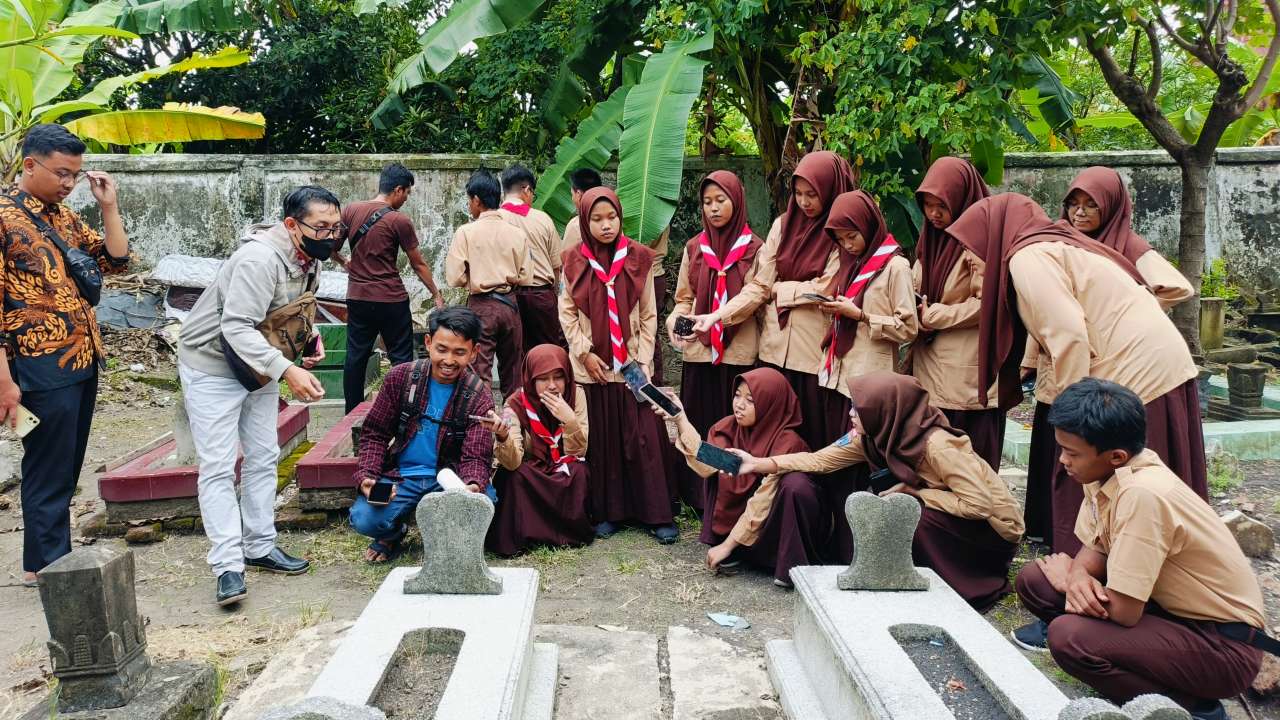
Adjacent to the religious core lies the Kauman cemetery, a site designated as Pesarean Purwodipradjan, which serves as the final resting place for nineteenth- and early twentieth-century regional administrators and priayi elites. Stone inscriptions in Javanese script (candrasengkala) and Arabic Pegon mark the gateways and tombs within the complex, chronicling the lineage of regional governance.
Among the prominent figures interred at the site is Raden Tumenggung Purwodiprodjo, a former patih (chief executive officer or prime minister to the regent) of Bojonegoro who was subsequently appointed Bupati of Ngawi under the recommendation of Resident I. Mullmeister, as recorded in the Dutch-language newspaper Het nieuws van den dag voor Nederlandsch-Indië on December 11, 1911.
The complex also houses the graves of other high-ranking indigenous officials, including Raden Ngabehi Prawirowinoto, the second Patih of Ngawi succeeding the first patih, Raden Pandji Pringgokusumo. Additionally, the cemetery contains the resting places of regional district heads (wedana) representing districts such as Pacitan and Sine, as well as colonial-era health officials, such as vaccination superintendents tasked with public health administration in Magetan. Historical studies by scholars such as Heather Sutherland, in Notes on Javanese Regent Families, indicate that during the early twentieth century, approximately 400 wedana positions administered districts across Java and Madura before the administrative restructuring following Indonesian independence.

Educational Implications and Heritage Preservation
The rediscovery and documentation of these historical layers have transitioned from academic archives into practical community education. Local heritage organizations, including the Sadar Lestari community, have actively collaborated with regional educational institutions, such as MAN 1 Ngawi, to integrate local history into youth education. By moving away from traditional, textbook-centric methodologies, educators have utilized the sites of the Great Mosque and the Kauman cemetery as open-air classrooms.
This experiential learning approach aims to foster historical consciousness among the younger generation, enabling students to contextualize the socio-cultural foundations of their hometown. By examining the interplay between indigenous leadership, religious institutions, and colonial administration, students gain a comprehensive understanding of how regional identity was forged through historical resilience and cultural synthesis.
Ultimately, the preservation of architectural landmarks and archival remains in Ngawi functions as a vital anchor for collective memory. These sites offer contemporary society an avenue to critically evaluate the historical trajectory of East Java, bridging the gap between colonial-era administrative shifts and modern civic identity.