Socio Today
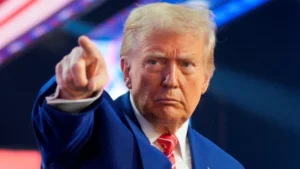
United States President Donald Trump has formally signaled a shift in Washington’s Middle East policy, declaring his administration’s intent to secure a "lasting" and "permanent" nuclear agreement with the Islamic Republic of Iran. Speaking to reporters on Thursday, April 23, 2026, President Trump emphasized that any future diplomatic framework must include ironclad provisions ensuring that Tehran is permanently barred from acquiring or developing nuclear weapons capabilities. The President’s remarks come at a precarious moment in international relations, following a series of military escalations, failed diplomatic summits, and the implementation of a rigorous naval blockade intended to cripple Iran’s maritime trade.
The President stated that while the United States currently possesses the leverage to facilitate a temporary agreement—estimated to last approximately 20 years—such a timeframe is insufficient for his administration’s long-term security goals. According to White House assessments, a 20-year window represents the time required for Iran to fully reconstruct its nuclear infrastructure and enrichment capabilities if left to its own devices. Trump clarified that his objective is not a "sunset clause" deal similar to previous iterations of the Joint Comprehensive Plan of Action (JCPOA), but rather a definitive cessation of Iran’s nuclear ambitions that would span generations.
The Path to Escalation: A Chronology of Conflict in 2026
The current crisis traces back to a significant military escalation earlier this year. On February 28, 2026, a joint military operation involving the United States and Israel launched a series of precision strikes against strategic targets within Iranian territory. While the Pentagon characterized the strikes as a defensive measure aimed at neutralizing imminent threats, the Iranian government reported significant damage to non-military infrastructure and confirmed several civilian casualties. The strikes marked the most direct and kinetic confrontation between the three nations in recent history, pushing the region to the brink of a full-scale war.
Following the February strikes, international mediators, led primarily by regional partners, attempted to de-escalate the situation. On April 7, 2026, Washington and Tehran reached a tentative agreement for a two-week ceasefire. This pause in hostilities was intended to provide a diplomatic window for high-level negotiations. The subsequent talks were held in Islamabad, Pakistan, involving senior diplomats from both nations. However, despite the efforts of the Pakistani mediators, the Islamabad summit concluded without a signed agreement or a formal roadmap for peace.
The failure of the Islamabad talks led to an immediate hardening of the U.S. position. As the ceasefire neared its expiration, the White House announced the commencement of a naval blockade. This strategy involves the deployment of U.S. Fifth Fleet assets to monitor and intercept vessels entering or departing key Iranian ports, including Bandar Abbas and Chabahar. The blockade is designed to exert "maximum economic pressure" by cutting off Iran’s ability to export petroleum products and import essential industrial goods, effectively isolating the nation from global maritime commerce.
Strategic Objectives and the 20-Year Capability Gap
The Trump administration’s insistence on a "permanent" deal is rooted in intelligence assessments regarding Iran’s nuclear breakout time. Military analysts in Washington suggest that if Iran were to resume its enrichment programs at full capacity, it would take roughly two decades to establish a fully integrated and weaponized nuclear arsenal, including the development of delivery systems such as Intercontinental Ballistic Missiles (ICBMs).

"I want the deal to be lasting," Trump told the press corps. "I want a deal where they will never have the chance to get [a nuclear weapon]." This stance represents a departure from the 2015 JCPOA, which contained various "sunset provisions" that allowed certain restrictions on Iran’s nuclear program to expire after 10 to 15 years. The current administration views these time-limited restrictions as a "delayed fuse" rather than a solution. By demanding a permanent ban, the U.S. is seeking to fundamentally alter Iran’s strategic posture in the Middle East.
Iranian Internal Dynamics and the Response from Tehran
The U.S. strategy has not gone unchallenged. In Tehran, the rhetoric from Washington has been met with a display of political unity. Following claims by President Trump that the Iranian leadership was fractured and facing internal collapse, the heads of Iran’s executive, legislative, and judicial branches issued a joint rebuttal. Mohammad Baqer Qalibaf, the Speaker of the Iranian Parliament, delivered a particularly sharp response, dismissing Trump’s assertions as "delusional" and "psychological warfare."
Iranian officials have maintained that their nuclear program is strictly for peaceful purposes, including energy production and medical research. However, the rhetoric from Tehran has grown increasingly defiant since the February strikes. The Iranian leadership has signaled that while they are open to dialogue, they will not negotiate under the "shadow of a blockade." The unified response from the Iranian government aims to signal to the international community that the regime remains stable despite the economic hardships imposed by U.S. sanctions and the recent naval maneuvers.
The Humanitarian and Economic Implications of the Blockade
The enforcement of a naval blockade on a nation of over 85 million people carries significant humanitarian and economic risks. International humanitarian organizations have expressed concern that the blockade could impede the flow of food, medicine, and other essential supplies. Although the U.S. State Department has clarified that "humanitarian channels" remain open, the logistical challenges of shipping into a blockaded zone often result in a de facto halt of even permitted goods.
On the economic front, the blockade has already sent ripples through the global energy markets. The Strait of Hormuz, a critical chokepoint for the world’s oil supply, remains a zone of high tension. Analysts warn that any Iranian attempt to retaliate by closing the Strait or targeting commercial tankers could lead to a spike in global oil prices, potentially disrupting the economic recovery of several Western and Asian nations.
Furthermore, the blockade places significant strain on Iran’s regional trade partners. Countries that rely on Iranian energy or use Iranian ports for transit—such as parts of Central Asia and Afghanistan—are finding themselves caught in the middle of the Washington-Tehran standoff. The U.S. has signaled that it will not grant waivers for the blockade, forcing these nations to seek alternative, and often more expensive, trade routes.
Future Outlook: The 36 to 72 Hour Window
As the initial two-week ceasefire expired, President Trump announced an extension of the truce, albeit one maintained alongside the ongoing naval blockade. In a move that surprised some diplomatic observers, Trump suggested that a breakthrough might be imminent. He indicated that peace talks could potentially resume within the next 36 to 72 hours, though he did not specify the location or the level of representation for these talks.

"We are extending the ceasefire while we continue the blockade," Trump stated, adding that "peaceful talks are possible" in the very near future. This dual-track approach—combining military-economic pressure with an open door for diplomacy—is a hallmark of the administration’s "Maximum Pressure 2.0" strategy. The administration believes that the physical reality of the blockade, combined with the memory of the February strikes, will compel Tehran to accept more stringent terms than they were previously willing to consider in Islamabad.
Geopolitical Analysis and International Reactions
The international community remains divided on the U.S. approach. Traditional European allies have called for a return to multilateral diplomacy, expressing concern that a total blockade could lead to a regional war that draws in neighboring states. The European Union has reportedly been attempting to revive a version of the "Swiss Channel" for humanitarian trade to mitigate the impact on Iranian civilians.
Conversely, Israel has voiced strong support for the U.S. position. Israeli officials have long argued that only a credible military threat and crippling economic pressure can prevent Iran from achieving nuclear threshold status. The joint operations in February demonstrated a high level of tactical coordination between Washington and Jerusalem, a partnership that continues to define the security architecture of the region.
China and Russia, both signatories to the original 2015 nuclear deal, have condemned the blockade as a violation of international law and maritime freedom. Beijing, a major purchaser of Iranian oil, has criticized the unilateral nature of the U.S. sanctions, arguing that they undermine global trade stability. The involvement of these global powers suggests that any "permanent" deal reached between Trump and Tehran would eventually require broader international endorsement to be truly effective and sustainable.
Conclusion
The coming days will be critical for the future of the Middle East. If the 36-to-72-hour window mentioned by President Trump results in a new round of negotiations, the world will be watching to see if the two sides can bridge the gap between "temporary restrictions" and a "permanent accord." For the Trump administration, the goal is clear: a legacy-defining agreement that removes the Iranian nuclear threat from the board indefinitely. For Iran, the challenge is to navigate an unprecedented economic siege while maintaining domestic stability and national sovereignty. As the U.S. Navy maintains its positions off the Iranian coast, the path to peace remains narrow, fraught with the potential for miscalculation and renewed conflict.