Socio Today
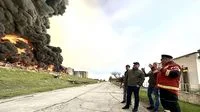
Firefighters in eastern Spain are currently engaged in a high-stakes battle against a fast-moving wildfire that has encroached upon the borders of the Sierra de Espadán Nature Park, one of the region’s most ecologically significant protected areas. As of Monday evening, emergency services have significantly escalated their presence on the ground and in the air, attempting to establish containment lines before worsening meteorological conditions further fuel the blaze. The fire, which originated in the province of Castellón, has rapidly transformed from a localized brush fire into a major environmental threat, prompting the mobilization of approximately 200 personnel and a fleet of 12 aerial firefighting units.
The situation remains critical as the fire advances through difficult, mountainous terrain, making access for ground crews particularly challenging. The Sierra de Espadán, located in the southern part of the Castellón province, is known for its steep slopes and dense vegetation, including rare cork oak forests that are highly flammable during the peak of the Mediterranean summer. Local authorities have expressed grave concern over the potential for the fire to devastate the park’s unique biodiversity, which serves as a vital corridor for numerous avian species and endemic flora.
Chronology of the Escalation
The fire was first detected in the early afternoon hours, initially appearing as a small plume of smoke in a rural area adjacent to the nature park. However, driven by erratic winds and parched vegetation, the flames quickly bypassed initial containment efforts. By Monday evening, the Generalitat Valenciana’s emergency coordination center upgraded the alert levels, signaling that the blaze had moved into the "high-intensity" category.
As the sun began to set on Monday, the fire’s perimeter expanded toward the heart of the Sierra de Espadán. This specific timing presented a tactical challenge for emergency responders, as aerial units—which are critical for water drops in inaccessible ravines—are generally restricted from flying after dark due to safety protocols. Consequently, the burden of containment shifted heavily toward ground crews, who worked through the night to create firebreaks and protect the periphery of nearby residential settlements.
By 9:00 PM local time, the 200 personnel on-site included units from the Provincial Firefighters Consortium of Castellón, the Valencian Government’s Forest Firefighting Service, and specialized forest brigades. These crews were supported by heavy machinery, including bulldozers, tasked with clearing vegetation to starve the fire of fuel.
Meteorological Warnings and the "30-30-30" Rule
The primary driver behind the fire’s rapid expansion is a set of extreme weather conditions that have gripped the Iberian Peninsula. The Spanish Meteorological Agency (AEMET) has issued a series of urgent warnings, noting that the region is currently facing a "perfect storm" of environmental factors. Forecasters have predicted that temperatures in the affected area will reach or exceed 35 degrees Celsius (95 degrees Fahrenheit) over the coming 48 hours.
Compounding the heat is a significant drop in relative humidity, which is expected to plummet below 20 percent. In such dry conditions, the moisture content in forest fuels—such as pine needles, dry grass, and scrub—reaches critically low levels, allowing even a small spark to ignite a massive conflagration. Furthermore, wind speeds are projected to reach up to 40 kilometers per hour, with the potential for even stronger gusts in the narrow valleys of the Sierra de Espadán.
Meteorologists and fire behavior analysts often refer to the "30-30-30" rule as a benchmark for extreme fire danger: temperatures above 30°C, humidity below 30%, and wind speeds above 30 km/h. The current conditions in Castellón exceed all three of these thresholds, creating a high-risk environment where fires can exhibit "extreme behavior," such as spotting (where wind carries embers ahead of the main fire front to start new blazes) and crown fires (where flames leap between the tops of trees).
Strategic Deployment and Resource Allocation
In response to the growing threat, the Spanish Ministry for the Ecological Transition and the Demographic Challenge has collaborated with regional authorities to coordinate a massive logistical operation. The 12 aerial units deployed include a mix of heavy "Canadair" amphibious planes, which can scoop water from nearby reservoirs or the Mediterranean Sea, and agile helicopters equipped with "Bambi buckets" for precision drops on active flame fronts.
On the ground, the strategy has focused on "defensive positioning." Firefighters are prioritizing the protection of critical infrastructure and small mountain villages that dot the landscape of the Sierra de Espadán. While no large-scale evacuations were immediately ordered on Monday night, local police have been placed on high alert to assist residents if the fire’s trajectory shifts toward populated zones.
The Military Emergencies Unit (UME), a specialized branch of the Spanish Armed Forces designed to assist during natural disasters, has been kept on standby. If the fire is not brought under control by Tuesday morning, it is highly likely that the UME will be formally requested to provide additional manpower and heavy logistical support.
Ecological Significance of Sierra de Espadán
The Sierra de Espadán Nature Park covers more than 31,000 hectares and is the second-largest protected space in the Valencian Community. Its ecological value cannot be overstated; it is one of the few places in the Mediterranean where cork oak (Quercus suber) forests thrive due to the unique sandstone soil of the region. These forests are not only a source of local economic activity through sustainable cork harvesting but also provide a habitat for the Bonelli’s eagle, the peregrine falcon, and various rare amphibians.
A wildfire of this magnitude threatens to reset the ecological clock of the park. While Mediterranean ecosystems are somewhat adapted to fire, the increasing frequency and intensity of these events—driven by climate change—prevent the forest from regenerating naturally. High-intensity fires can sterilize the soil, leading to severe erosion during the autumn rains, which in turn prevents the regrowth of native trees and allows invasive, more flammable species to take hold.
Official Statements and Public Safety
Regional officials have called for calm while urging the public to remain vigilant. A spokesperson for the emergency services emphasized that the next 24 to 48 hours would be "decisive" in determining whether the fire could be contained within the current perimeter.
"Our primary objective is the safety of our personnel and the protection of human life," the spokesperson stated during a press briefing. "The conditions are extremely hostile, with high temperatures and shifting winds making the fire’s path unpredictable. we ask that all residents and tourists avoid the forest tracks and mountain roads near the Sierra de Espadán to allow emergency vehicles clear passage."
Environmental groups have also reacted to the news, pointing to the blaze as a symptom of a broader crisis. Many advocates argue that while immediate firefighting efforts are essential, there must be a greater focus on year-round forest management and the creation of "resilient landscapes" that can withstand the hotter, drier summers that have become the new normal in Spain.
Broader Context: Spain’s Wildfire Crisis
This latest incident in the Sierra de Espadán is part of a worrying trend across Spain and Southern Europe. Over the last decade, the wildfire season has lengthened, starting earlier in the spring and extending well into the autumn. Data from the European Forest Fire Information System (EFFIS) shows that Spain is consistently among the European countries most affected by wildfires in terms of total hectares burned.
The abandonment of traditional agricultural practices in mountainous regions has led to "rural depopulation," leaving vast areas of land unmanaged. Without the grazing of livestock or the clearing of undergrowth for firewood, the forests have accumulated a massive "fuel load." When combined with the rising temperatures associated with global climate change, these areas become tinderboxes waiting for a trigger.
In 2022 and 2023, Spain experienced record-breaking heatwaves that resulted in some of the most destructive fire seasons in the country’s history. The current blaze in Castellón serves as a stark reminder that the threat remains ever-present.
Future Implications and Analysis
As the firefighting efforts continue, the immediate focus remains on containment. However, the implications of this fire will be felt long after the last ember is extinguished. If a significant portion of the Sierra de Espadán is lost, it will impact the local economy, particularly the burgeoning rural tourism sector that relies on the park’s pristine natural beauty for hiking, cycling, and birdwatching.
Furthermore, the cost of these emergency operations is substantial. Deploying hundreds of personnel and a dozen aircraft incurs massive expenses for the regional and national governments. There is an ongoing debate in the Spanish Parliament regarding the allocation of funds, with many experts calling for a shift in budget from "extinction" (fighting fires) to "prevention" (managing forests before they burn).
For now, the eyes of the nation are on the brave men and women working on the front lines in Castellón. With the thermometer set to rise and the winds expected to pick up, the battle for the Sierra de Espadán is far from over. The success of the current operation will depend on the ability of the ground crews to hold their lines during the night and the effectiveness of the aerial units once they return to the skies at daybreak.
The international community also watches closely, as Spain’s handling of these "megafires" provides critical lessons for other Mediterranean climates, from California to Australia, all of which are grappling with the escalating reality of a warming planet and the fiery consequences that follow.