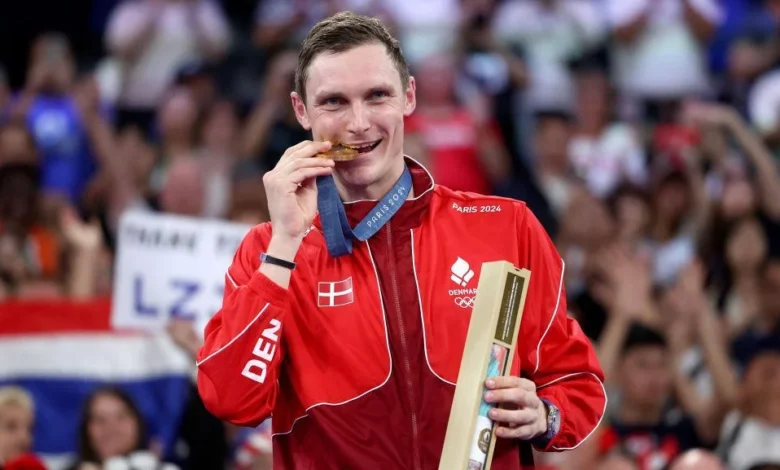
The international badminton community has been cast into a state of profound reflection following the announcement that Viktor Axelsen, the two-time Olympic gold medalist often referred to as "the Alien" for his otherworldly dominance, will retire from professional competition at the age of 32. The decision, which comes less than two years after his historic successful title defense at the Paris 2024 Olympic Games, marks the conclusion of one of the most storied careers in the history of the sport. While Axelsen’s technical prowess and physical stature remained formidable to the naked eye, the Danish legend revealed that a protracted and agonizing battle with a chronic back injury has finally rendered the demands of elite-level badminton unsustainable.
The announcement was made following extensive consultations with medical specialists and the surgical team that performed a procedure on Axelsen’s spine in 2025. According to the former world number one, the current level of pain and the risk of permanent neurological damage have left him with no viable path forward in professional sports. Medical professionals warned that continuing to train and compete at his current intensity would necessitate further invasive surgeries, with no guarantee of a successful recovery and the looming possibility of more severe long-term mobility issues.
The Pathology of a Career-Ending Injury: Understanding the L4-L5 Herniation
The genesis of Axelsen’s physical decline can be traced back to 2018, a year that should have been the prime of his physical development. During a routine training session involving heavy back squats, Axelsen experienced a significant spinal incident. While he was able to manage the symptoms for several years through rigorous physiotherapy and load management, the underlying structural damage to his lumbar spine remained a ticking time bomb.
In clinical terms, Axelsen was diagnosed with a severe herniated disc at the L4-L5 level. The L4 and L5 are the two lowest vertebrae in the lumbar spine, and the disc between them is responsible for absorbing the impact of jumping, lunging, and the explosive rotational movements that define modern badminton. When this disc herniates, the soft inner material of the disc protrudes through the tougher exterior, often compressing the adjacent nerve roots. For Axelsen, this resulted in radiculopathy—a condition where nerve pressure causes intense, shooting pain, numbness, and weakness to radiate from the lower back down into the legs.
The physical demands of badminton are uniquely taxing on the lumbar region. Players must execute deep lunges that require extreme spinal stability, coupled with high-impact jumps and rapid trunk rotations during smashes. For a player of Axelsen’s height—standing at 194 cm (6’4")—the biomechanical leverage exerted on the spine is significantly greater than that of shorter competitors. This height, which provided him with a peerless reach and steep smash angles, also served as a catalyst for the accelerated wear and tear on his spinal discs.
The Road to Paris 2024: Triumph Over Agony
The full extent of Axelsen’s suffering was largely hidden from the public during his run to the gold medal in Paris. However, internal reports and recent disclosures from his camp suggest that his participation in the 2024 Olympics was a medical miracle achieved through sheer willpower. Six weeks prior to the Games, while competing at the Singapore Open, Axelsen’s back condition flared up to a debilitating degree. The stress of the upcoming Olympics, combined with the physical collapse of his lower back, forced him into a desperate medical regimen.
To remain mobile enough to compete, Axelsen was reportedly reliant on targeted corticosteroid injections and epidural blocks to manage the inflammation around his spinal nerves. His father and manager, Henrik Axelsen, recounted the emotional toll of watching his son struggle during the 2024 season. He noted that at the All England Open earlier that year, Viktor was "moving like a clumsy person" on the court, a jarring sight for a player known for his fluid, balletic movement. The cognitive dissonance of being the world’s best player while inhabiting a body that was failing him created an immense psychological burden.
Despite these hurdles, Axelsen’s performance in Paris was a masterclass in efficiency and mental fortitude. He secured his second consecutive Olympic gold without dropping a single set, a feat that cemented his legacy as the greatest European player to ever pick up a racket. Yet, the cost of that glory was an irreversible decline in his physical health. Post-Olympics, the "high" of competition faded, leaving behind a reality of daily reliance on high-dosage painkillers and neuropathic medications.
Surgical Intervention and the Final Setback
In April 2025, in a final attempt to salvage his career, Axelsen underwent an endoscopic spinal procedure in Germany. The goal of the surgery was to decompress the L4-L5 nerve root by removing the protruding disc material. While the surgery was initially deemed a success and allowed him a brief return to the court, the reprieve was short-lived.
By October 2025, Axelsen suffered a major setback. The pain returned, not just during the explosive movements of a match, but during the mundane activities of daily life. This recurrence indicated that the structural integrity of his spine could no longer support the rigors of professional training. The medical consensus was clear: the "alien" was human after all, and his body had reached its absolute limit. In his retirement statement, Axelsen acknowledged the difficulty of the decision but expressed a profound sense of gratitude, stating that while the conclusion felt "unfair," he felt privileged to have achieved what very few in the history of the sport ever could.
Statistical Dominance and the Legacy of the "Alien"
Viktor Axelsen’s departure leaves a massive void in the Men’s Singles category. His career statistics paint a picture of a player who bridged the gap between the era of the "Big Four" (Lin Dan, Lee Chong Wei, Chen Long, and Peter Gade) and the modern generation.
Key achievements of his career include:
- Two Olympic Gold Medals (Tokyo 2020, Paris 2024) and one Olympic Bronze (Rio 2016).
- Two BWF World Championship titles (2017, 2022).
- Multiple BWF World Tour Finals titles and over 30 individual tournament victories.
- A record-breaking stint as World Number One, including a period where he went undefeated for nearly an entire season.
Axelsen was also a pioneer off the court. His decision to move his training base to Dubai and establish an independent training camp—inviting top-tier sparring partners from around the world—revolutionized how elite players manage their careers outside of national federation structures. This "Dubai Camp" became a hub for excellence, helping to elevate the level of players like Loh Kean Yew and Lakshya Sen.
The Future of Men’s Singles Without Axelsen
The retirement of Axelsen signals a paradigm shift in the BWF World Tour. For the past several years, the narrative of every major tournament revolved around "who can beat Axelsen?" With his departure, the field is now wide open. Current stars such as Shi Yuqi of China, Kunlavut Vitidsarn of Thailand (the 2023 World Champion), and Indonesia’s Jonatan Christie and Anthony Sinisuka Ginting will now vie for the vacuum of power at the top of the rankings.
Analysts suggest that the game may become more balanced and less predictable. Axelsen’s height and power forced the entire world to adapt their defensive strategies. Without him, we may see a return to a more varied style of play, focusing on speed and technical deception rather than the sheer physical imposition that Axelsen mastered.
Official Reactions and Global Tributes
The Badminton World Federation (BWF) issued a statement praising Axelsen as a "true ambassador of the game" and a "titan of the sport whose impact transcends borders." Former rivals also weighed in. Lee Chong Wei, in a social media tribute, noted that Axelsen’s "professionalism and dedication to perfection" were an inspiration even to those who came before him.
In Denmark, the news has been met with a mixture of sadness and immense pride. The Danish Badminton Association (Badminton Danmark) credited Axelsen with maintaining Denmark’s status as a global badminton powerhouse. "Viktor didn’t just win medals; he inspired a generation of Danish children to believe they could take on the best in Asia and win," a spokesperson for the association stated.
Conclusion: A Graceful Exit
Viktor Axelsen’s retirement at 32 is a poignant reminder of the physical toll of greatness. While he could have continued to play at a lower level, Axelsen’s commitment to excellence meant that if he could not be the best, he would rather not be on the court at all. He leaves the sport at a time of his choosing, decorated with every major honor available, and with his health as his new priority.
As he moves into the next chapter of his life—likely involving his various business ventures and a potential role in coaching—the "Alien" leaves behind a legacy of dominance, a blueprint for independent professional success, and a reminder that even the strongest of champions must eventually listen to the quiet warnings of their own body. The smashes may have stopped, but the echoes of his impact on the court will be felt for decades to come.