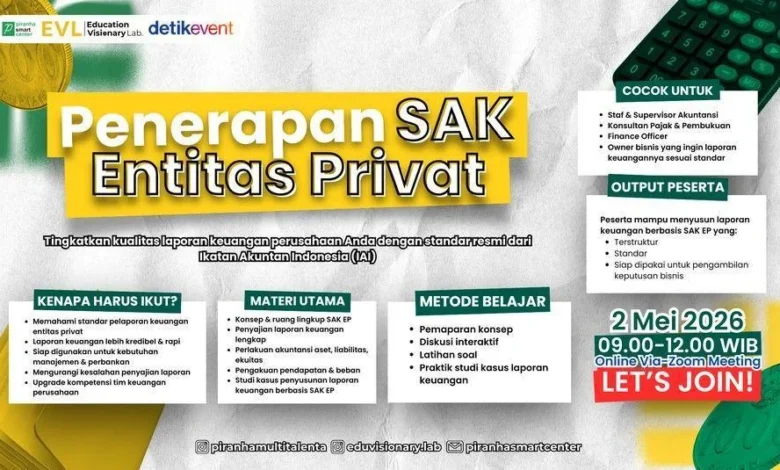
Jakarta, Indonesia – In an increasingly complex and regulated business environment, the demand for precise, transparent, and credible financial reporting has never been more critical, especially for private entities navigating the intricacies of growth and capital acquisition. Recognizing this pressing need, Education Visionary Lab (EVL) and Piranha Smart Center are poised to host the second batch of their highly anticipated webinar, "Application of Private Entity Financial Accounting Standards (SAK EP) – Batch 2." Scheduled for Saturday, May 2, 2026, from 09.00 to 12.00 WIB, this program is meticulously designed to empower accounting professionals, finance officers, consultants, and business owners with the essential knowledge and practical skills required to implement SAK EP effectively, thereby elevating the quality and trustworthiness of their financial statements.
The Imperative for Transparent Reporting: Bridging the Gap for Private Entities
For many private entities, particularly small and medium-sized enterprises (SMEs), unstructured financial reports often present significant hurdles. These challenges range from difficulties in internal performance evaluation and strategic decision-making to external barriers such as securing financing from banks or attracting potential investors. Without a standardized framework, the reliability and comparability of financial data can be compromised, leading to inefficiencies and missed opportunities.
The Indonesian Financial Accounting Standards Board (DSAK IAI), under the Ikatan Akuntan Indonesia (IAI), introduced the Private Entity Financial Accounting Standards (SAK EP) as a tailored solution to address these specific needs. SAK EP is designed to simplify financial reporting for entities that do not have public accountability and do not publish general-purpose financial statements. Its primary objective is to provide a relevant, reliable, and understandable framework that is less complex than the full Financial Accounting Standards (SAK based on IFRS) but more robust than the Micro, Small, and Medium Enterprises Financial Accounting Standards (SAK EMKM). By adopting SAK EP, private entities can produce financial reports that are not only tidier and more organized but also inherently more credible to both internal stakeholders and crucial external parties, such as banking institutions which often rely on accurate financial data for credit assessment.
Evolution of Accounting Standards in Indonesia: A Historical Context
The landscape of financial accounting standards in Indonesia has undergone significant transformation over the past two decades, largely driven by the global movement towards convergence with International Financial Reporting Standards (IFRS). Prior to the widespread adoption of IFRS, Indonesia’s accounting standards were often perceived as complex and varied, creating challenges for international comparability and investment. The IAI, as the authoritative body for setting accounting standards in Indonesia, embarked on a strategic roadmap to converge its national standards (PSAK) with IFRS, aiming to enhance transparency, accountability, and efficiency in the capital markets.
This convergence journey, which largely took place in the late 2000s and early 2010s, primarily focused on publicly accountable entities. However, it soon became evident that the full IFRS-based SAK, while suitable for large, publicly listed companies, imposed an undue burden of complexity and cost on smaller, private entities that lacked public accountability. Recognizing this gap, the IAI developed differentiated standards to cater to the diverse needs of the Indonesian business ecosystem. SAK EP emerged as a crucial intermediate standard, positioned between the full SAK and the even simpler SAK EMKM (for micro, small, and medium enterprises). SAK EP was specifically crafted to retain the core principles of robust financial reporting while simplifying the recognition, measurement, presentation, and disclosure requirements, making it more practical and cost-effective for private entities to implement. This strategic move underscored IAI’s commitment to fostering a fair and transparent business environment across all scales of enterprise, ensuring that sound financial practices are accessible and beneficial to all.
Deep Dive into SAK EP: What Participants Will Learn
The "Application of Private Entity Financial Accounting Standards (SAK EP) – Batch 2" webinar is meticulously structured to provide a comprehensive yet practical understanding of SAK EP. The curriculum is designed to move beyond theoretical concepts, emphasizing hands-on application through practical case studies that mirror real-world business scenarios. Participants will embark on a learning journey that covers several critical areas:
Firstly, the webinar will explore the scope of SAK EP, delineating which types of entities are eligible and encouraged to adopt these standards. This foundational understanding is crucial for determining the applicability of SAK EP to a participant’s specific organization. Following this, the program will delve into the accounting treatment of various financial elements, including assets, liabilities, and equity. This segment will cover the principles of recognition, measurement, and derecognition for different asset classes (e.g., property, plant, and equipment, intangible assets), the proper classification and measurement of liabilities (e.g., financial liabilities, provisions), and the accounting for equity components.
A significant portion of the webinar will also be dedicated to the accurate recognition of revenue and expenses. This includes understanding the principles of accrual accounting, matching principle, and specific guidance on revenue recognition from contracts with customers, as well as the appropriate timing and measurement of various expenses incurred in business operations. The practical approach, facilitated by numerous case studies, will enable participants to immediately apply these concepts to their daily work, significantly reducing the potential for errors in financial statement preparation.
The learning methodology is highly interactive, conducted live via Zoom. This format encourages direct engagement, allowing participants to ask questions, participate in discussions, and clarify doubts in real-time with the instructors. Such an interactive environment is invaluable for deeper comprehension and ensures that participants not only grasp the "what" but also the "how" of SAK EP implementation. The overarching focus remains on enhancing the quality of financial reports and minimizing common errors in presentation, ultimately equipping attendees to produce professional, structured, and decision-ready financial statements.
Driving Business Credibility and Decision-Making
The implications of adopting SAK EP extend far beyond mere compliance; they are fundamental to fostering robust internal governance and enhancing external credibility. For businesses, well-structured financial reports prepared under SAK EP serve as invaluable tools for internal evaluation. They provide clear insights into financial performance, liquidity, and solvency, enabling management to make informed strategic decisions regarding resource allocation, investment opportunities, and operational adjustments. This internal clarity is a cornerstone of sustainable growth and effective risk management.
Externally, the benefits are equally profound. Credible financial statements are the bedrock of trust with external stakeholders. For banking institutions, SAK EP-compliant reports offer a reliable basis for assessing creditworthiness, facilitating smoother and more favorable loan applications. A transparent financial history reduces perceived risk for lenders, potentially leading to better interest rates and terms. Similarly, for potential investors, whether individual or institutional, standardized and verifiable financial information is crucial for due diligence and investment decisions. It signals a commitment to transparency and sound financial management, making the entity more attractive for capital injection. In essence, SAK EP acts as a universal language that communicates a business’s financial health and integrity, thereby strengthening its reputation and opening doors to vital capital and partnership opportunities essential for expansion and long-term success.
Industry Perspectives and Expert Endorsements
The enthusiasm for the "Application of Private Entity Financial Accounting Standards (SAK EP)" webinar is palpable across the industry, reflecting a shared understanding of its critical importance.
A spokesperson from Education Visionary Lab (EVL) commented, "The overwhelming response to our first batch of the SAK EP webinar underscored the immense demand for practical, actionable knowledge in this area. With Batch 2, we are committed to delivering an even more refined and impactful program. Our aim is not just to teach concepts, but to empower participants with the confidence to immediately apply SAK EP in their workplaces, thereby transforming their financial reporting practices. This is about upskilling Indonesia’s accounting professionals to meet the evolving demands of a modern economy."
Concurring with this sentiment, a representative from Piranha Smart Center added, "We believe that robust financial reporting is the backbone of any successful private entity. SAK EP provides a simplified yet credible framework that allows businesses to communicate their financial health effectively. This webinar is a testament to our dedication to bridging the knowledge gap and fostering a community of financially literate and compliant businesses. The interactive format ensures that every participant receives personalized attention, making the learning experience truly invaluable."
Moreover, the significance of such training programs resonates deeply within the business community. Ms. Anya Wijaya, the owner of a mid-sized manufacturing company in Jakarta, shared her perspective: "As a business owner, navigating the complexities of financial regulations can be daunting. Before SAK EP, our reports were functional but often lacked the structure that banks or potential investors expected. Programs like this webinar are crucial because they translate complex accounting standards into practical steps that businesses like mine can implement. Improved financial reporting means better internal controls, clearer decision-making, and significantly easier access to the financing we need for expansion."
Even from a broader regulatory standpoint, the Ikatan Akuntan Indonesia (IAI) has consistently championed the adoption of appropriate financial accounting standards. While not directly commenting on this specific webinar, an IAI representative, in previous statements, has emphasized, "The proliferation of various financial accounting standards, including SAK EP and SAK EMKM, is a strategic move to ensure that all types of entities in Indonesia, regardless of their size or public accountability, can produce reliable and transparent financial information. This differentiated approach is vital for fostering a healthy and competitive business environment, supporting economic growth, and instilling public trust in financial reporting across the nation." These inferred statements collectively highlight the widespread recognition of SAK EP’s importance and the value of initiatives like this webinar in driving its effective adoption.
Addressing the Skills Gap: The Role of Continuous Professional Development
The dynamic nature of global business and financial regulations necessitates a continuous commitment to professional development. The skills gap in financial reporting, particularly concerning specialized standards like SAK EP, is a growing concern for many private entities. While the core principles of accounting remain constant, the nuances of recognition, measurement, and disclosure under specific frameworks require ongoing education.
Training programs such as this webinar play a pivotal role in bridging this gap. For accounting staff and finance officers, mastering SAK EP translates directly into enhanced job performance and career advancement opportunities. Companies are increasingly seeking professionals who can not only prepare financial statements but also ensure their compliance with relevant standards, thereby mitigating risks and adding strategic value. Consultants, on the other hand, benefit from an updated understanding of SAK EP to better advise their private entity clients, helping them navigate compliance requirements and leverage financial reporting for strategic advantage. For business owners, participating in such programs demystifies the accounting process, empowering them to oversee their finance departments more effectively and to engage with financial data with greater confidence. This investment in continuous learning is not merely about staying compliant; it is about building a more competent, resilient, and forward-thinking workforce capable of driving business success in a competitive landscape.
Webinar Logistics and Registration Details
The "Application of Private Entity Financial Accounting Standards (SAK EP) – Batch 2" webinar is scheduled for Saturday, May 2, 2026, from 09.00 to 12.00 WIB. The entire program will be conducted online via Zoom, ensuring accessibility for participants from various locations. Upon successful registration, attendees will receive an e-ticket delivered directly to their email address. Furthermore, vital program information, updates, and opportunities for networking will be facilitated through an official WhatsApp group, ensuring all participants are well-informed and connected. This program is an ideal opportunity for accounting staff, finance officers, consultants, and business owners who aspire to ensure their business’s financial reports are professional, meticulously structured, and readily available for informed decision-making. Individuals keen on enhancing their skills and bolstering their business’s credibility through superior financial reporting are strongly encouraged to register promptly to secure their spot. Registration can be completed through the dedicated platform at detikevent.
Broader Economic Implications: Fostering a Robust Business Ecosystem
The widespread adoption and effective implementation of SAK EP carry significant broader economic implications for Indonesia. Private entities, particularly SMEs, are the backbone of the national economy, contributing substantially to GDP, employment generation, and innovation. However, their growth can often be constrained by limited access to capital and a lack of transparency, which can deter potential investors and lenders. By promoting standardized and credible financial reporting through SAK EP, initiatives like this webinar directly contribute to creating a more robust and trustworthy business ecosystem.
When a large number of private entities produce high-quality financial statements, it enhances the overall financial literacy and integrity of the business sector. This transparency fosters a more efficient allocation of capital, as financial institutions and investors can make more informed decisions, directing funds to deserving businesses. Moreover, it reduces information asymmetry, minimizes risks, and ultimately strengthens the stability of the financial system. While challenges such as initial resistance to change, the need for adequate training resources, and the ongoing monitoring of compliance may arise, the long-term benefits of a financially transparent private sector far outweigh these hurdles. The continuous education and enablement offered by programs like the SAK EP webinar are therefore not just about individual skill enhancement but are strategic investments in the nation’s economic resilience and sustained prosperity.
In conclusion, the "Application of Private Entity Financial Accounting Standards (SAK EP) – Batch 2" webinar represents a timely and essential opportunity for professionals and business leaders to elevate their financial reporting capabilities. In an era where financial integrity is paramount, mastering SAK EP is not merely a compliance requirement but a strategic imperative for fostering trust, enabling informed decision-making, and unlocking pathways to sustainable business growth. This program by Education Visionary Lab and Piranha Smart Center stands as a vital resource in empowering Indonesia’s private entities to thrive in an increasingly competitive global economy.