Joan Laporta Unleashes Fury After Barcelona’s Champions League Exit, Blaming Refereeing Decisions

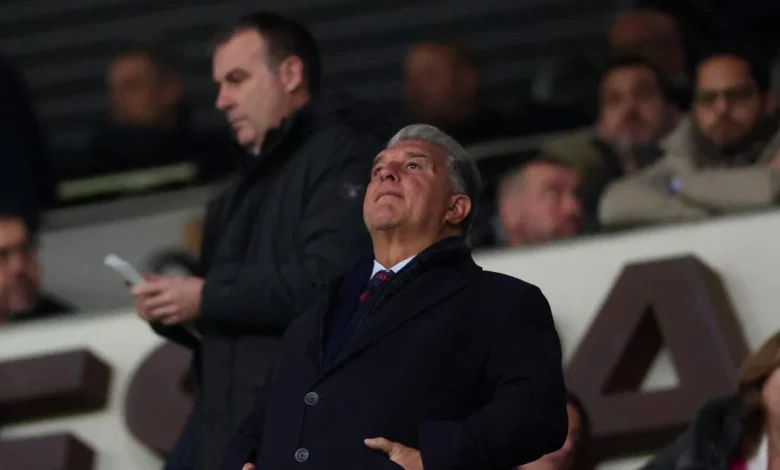
Madrid – Barcelona President Joan Laporta expressed his profound anger and frustration following his club’s elimination from the UEFA Champions League quarter-finals, directly accusing the match officials of significantly influencing the outcome of their tie against Atlético Madrid. The Catalan giants were defeated 3-2 on aggregate, succumbing to a 2-1 loss in the second leg at the Wanda Metropolitano on Wednesday, April 15th, after a narrow 1-0 defeat in the first leg at home.
The second leg encounter proved to be a contentious affair, with Barcelona struggling to break down a resolute Atlético defense despite creating numerous opportunities. The match took a significant turn in the second half when Barcelona’s Eric Garcia was shown a red card for a foul on Atlético’s Alexander Sorloth, reducing the visitors to ten men. This was not an isolated incident, as Barcelona had also received a red card in the first leg, with Pau Cubarsí being sent off for a challenge on Giuliano Simeone.
Laporta’s scathing critique was aimed at the officiating in both legs, specifically mentioning the referees Istvan Kovacs (first leg) and Clément Turpin (second leg). He described their performances as "shameful" and directly responsible for Barcelona’s downfall in Europe’s premier club competition.
A Pattern of Perceived Injustice
The Barcelona president detailed a series of incidents that he believes were pivotal in the tie’s narrative. In the first leg, Laporta argued that Barcelona was denied a clear penalty for a handball by Atlético’s Marc Pubill and that Cubarsí’s red card was unduly harsh. He contended that the initial yellow card for Cubarsí was sufficient, especially given that Giuliano Simeone did not appear to be in possession of the ball. Laporta lamented the intervention of the Video Assistant Referee (VAR) in overturning the initial decision, asserting that it "completely damaged our chances."
The controversy continued into the second leg under the stewardship of referee Clément Turpin. Laporta specifically pointed to the red card shown to Eric Garcia, suggesting that Barcelona’s Jules Koundé was in a position to potentially intercept the ball, implying Garcia was not the last man. He again highlighted VAR’s involvement, stating that after an initial yellow card, the technology intervened to issue a red.
Furthermore, Laporta contested the decision to disallow a goal scored by Ferran Torres, which he believed should have stood as it was onside. He also raised concerns about two other incidents: a penalty appeal for a foul on Dani Olmo and a particularly rough challenge on Fermín López, which left the young midfielder with a visibly torn lip. Laporta expressed disbelief that the challenge on López did not even warrant a yellow card.
Historical Context and Precedent
This is not the first time Barcelona has found itself embroiled in controversy regarding refereeing decisions in crucial European encounters. The club has a history of expressing strong opinions on officiating, particularly when they feel unfairly treated. The Champions League, with its high stakes and intense scrutiny, often amplifies such sentiments.
In the current season, Barcelona’s journey in the Champions League had already been marked by significant moments. Their progression to the quarter-finals itself was a testament to their resilience, having navigated a challenging group stage and a tightly contested Round of 16 tie against Napoli. However, the nature of their elimination, coupled with the perceived officiating errors, has undoubtedly left a bitter taste.
Detailed Chronology of Controversial Incidents
To provide a clearer picture of Laporta’s grievances, a chronological breakdown of the perceived officiating errors in the tie against Atlético Madrid can be reconstructed:
First Leg (Camp Nou):
- Alleged Denied Penalty: Barcelona believed they should have been awarded a penalty for a handball by an Atlético Madrid player (Marc Pubill) in the box.
- Pau Cubarsí Red Card: The young defender was shown a red card for a foul on Giuliano Simeone. Laporta argues this should have been a yellow card, with the VAR intervention being crucial in the escalation to a red.
Second Leg (Wanda Metropolitano):
- Eric Garcia Red Card: Garcia was sent off for a foul on Alexander Sorloth. Laporta contends that Garcia was not the last defender and that VAR’s involvement was unwarranted after an initial yellow card.
- Disallowed Ferran Torres Goal: A goal scored by Ferran Torres was ruled out for offside, a decision Laporta disputes.
- Penalty Appeal for Dani Olmo: Barcelona felt a penalty should have been awarded for a challenge on Dani Olmo.
- Fermín López Foul: A robust tackle on Fermín López, resulting in a significant lip injury, did not lead to any card for the Atlético player, which Laporta found unacceptable.
Supporting Data and Statistical Context
While direct statistical data on refereeing decisions in this specific tie is not publicly available in granular detail, the fact that Barcelona received two red cards in two crucial matches against the same opponent in a single knockout tie is noteworthy. The aggregate score of 3-2 in favor of Atlético highlights how closely contested the tie was, making perceived pivotal refereeing decisions even more impactful. Barcelona’s inability to convert their chances, particularly in the second leg where they outshot Atlético (14 shots to 8, according to Opta data), further emphasizes the narrative of a game decided by fine margins, including those influenced by officiating.
Official Responses and Potential Repercussions
Following Laporta’s strong statements, the footballing world awaits potential responses from UEFA and the match officials involved. UEFA typically reviews such strong public criticisms, especially when they question the integrity of their competitions. It is plausible that Barcelona, as indicated by Laporta, will formally lodge a protest with UEFA, seeking explanations and potentially requesting a review of the decisions.
While such protests are common in the aftermath of contentious matches, the likelihood of overturning a result or influencing future disciplinary actions based solely on a president’s public outburst is generally low. However, persistent complaints and documented evidence can sometimes lead to increased scrutiny of officials in future matches.
Broader Impact and Implications
Joan Laporta’s vocal criticism serves multiple purposes. Firstly, it aims to rally Barcelona’s fanbase and deflect some of the responsibility for the Champions League exit away from the players and coaching staff, placing it squarely on external factors. This can be a common tactic employed by club presidents to manage public perception during difficult periods.
Secondly, it puts pressure on UEFA to address perceived officiating inconsistencies. In a sport where VAR has been introduced to minimize errors, high-profile incidents like these reignite debates about its implementation and effectiveness.
The implications for Barcelona extend beyond this season’s Champions League campaign. The financial impact of failing to progress further in the competition is significant, affecting revenue streams crucial for club operations and transfer market activities. Furthermore, the psychological impact on the squad, having felt wronged by officiating, could linger as they refocus on domestic competitions.
For Atlético Madrid, this victory represents a significant achievement, propelling them into the semi-finals and keeping their hopes of European glory alive. Their tactical discipline and ability to capitalize on key moments, coupled with Barcelona’s struggles, ultimately proved decisive.
However, the lingering shadow of the refereeing controversies will undoubtedly accompany Barcelona’s exit, providing a narrative that will be discussed and debated within the footballing community for some time to come. Laporta’s strong stance ensures that the club’s grievances will not go unheard, setting the stage for potential further actions and discussions regarding officiating standards in elite European football. The club’s intention to file a formal protest with UEFA signifies a commitment to pursuing these concerns through official channels, seeking accountability and clarity in the aftermath of their European disappointment.