Socio Today
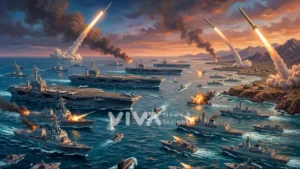
The Islamic Revolutionary Guard Corps (IRGC) of Iran confirmed on Thursday, July 23, 2026, that an oil tanker was severely damaged by a naval mine in the southern reaches of the Strait of Hormuz. The incident, which occurred during a high-stakes confrontation in one of the world’s most critical maritime chokepoints, involved three tankers allegedly supported by the United States. According to official statements released via Press TV, one vessel struck a mine and caught fire, prompting the remaining two ships to abort their transit and retreat from the area. This escalation marks a significant deterioration in regional security and has sent shockwaves through global energy markets.
The July 23 Incident: A Calculated Display of Force
According to the IRGC’s military communique, the three tankers were attempting to navigate a restricted zone in the southern sector of the Strait of Hormuz. The IRGC had previously warned that these waters had been seeded with explosives as a deterrent against foreign naval presence and unsanctioned commercial transit.
"Three oil tankers supported by the United States attempted to cross a route that had been mined south of the Strait of Hormuz," the IRGC statement read. "After one of the tankers exploded and caught fire, the other two immediately turned around and retreated."
The IRGC has asserted a total blockade on the passage, stating that no oil tankers are currently permitted to enter or exit the Strait without direct coordination with Tehran. The rhetoric from the Iranian military leadership suggests that the mining is not merely a defensive measure but a proactive enforcement of sovereignty over the waterway. The IRGC warned that any vessel attempting to bypass their protocols would face a "similar fate," characterizing the attempt to transit as being "trapped in American deception."
Preemptive Warnings and the Mining Strategy
The explosion on Thursday was not an isolated event but the culmination of warnings issued by Iranian officials earlier in the week. On Wednesday, July 22, IRGC spokesperson Hossein Mohebbi explicitly stated that the southern shipping lanes of the Strait of Hormuz had been weaponized.
"The southern route of the Strait of Hormuz, which has been mined, will destroy your investments," Mohebbi cautioned in a public address. "Do not be trapped by the deceptions of the United States."
The use of naval mines represents a "denial of access" strategy that targets the economic vulnerabilities of Iran’s adversaries. Unlike direct missile strikes, mines provide a level of deniability and create a persistent, invisible threat that significantly inflates insurance premiums for shipping companies and complicates international naval patrols. By targeting the southern route, Iran is effectively squeezing the primary channel used by deep-draft tankers carrying crude oil from the Persian Gulf to markets in Asia, Europe, and North America.

Geopolitical Context: The Strait of Hormuz as a Global Chokepoint
The Strait of Hormuz is arguably the most important maritime transit point in the world. At its narrowest, the strait is only 21 miles wide, with shipping lanes consisting of two-mile-wide channels for inbound and outbound traffic, separated by a two-mile buffer zone.
Approximately 20% to 30% of the world’s total oil consumption passes through this waterway daily. This includes nearly all the petroleum exported by Saudi Arabia, the United Arab Emirates, Kuwait, and Iraq, as well as the vast majority of Qatar’s Liquefied Natural Gas (LNG) exports. Any disruption to this flow has immediate and catastrophic implications for the global economy.
The 2026 crisis mirrors the "Tanker War" of the 1980s during the Iran-Iraq conflict, where both sides targeted commercial shipping to undermine each other’s economies. However, the current standoff is defined by the direct confrontation between Tehran and Washington. Iran has long maintained that if it is prevented from exporting its own oil due to international sanctions, it will ensure that no other nation can utilize the Strait for the same purpose.
The American Response: Trump’s Retaliatory Doctrine
The response from the United States has been swift and combative. President Donald Trump, speaking from Washington on Wednesday, issued a direct ultimatum to the Iranian leadership. The U.S. administration has adopted a "proportional infrastructure" retaliation policy, moving away from traditional naval skirmishes toward a doctrine of strategic bombardment.
President Trump threatened that for every attack launched by Iran against vessels in the Strait of Hormuz, the United States would destroy a significant piece of Iranian infrastructure. This includes targets such as major bridges, power plants, and industrial hubs, even within the capital city of Teheran.
"If Iran continues to harass and destroy ships in international waters, they will pay a price at home," the President stated. "Every strike on a tanker will result in the loss of a bridge or a power station in their country. We will not allow the global economy to be held hostage by Tehran’s aggression."
This "eye-for-an-eye" strategy marks a significant shift in U.S. engagement rules, signaling a willingness to strike deep within Iranian territory in response to maritime incidents. Military analysts suggest this is intended to create an internal political cost for the IRGC’s external military actions.
Economic Implications: Energy Markets and Shipping Risks
The immediate aftermath of the tanker explosion saw Brent Crude prices surge by over 7% within hours of the report. Energy analysts warn that if the Strait remains closed or if the mining makes transit too risky, oil prices could easily exceed $150 per barrel, triggering a global inflationary spiral.

The shipping industry is already feeling the impact. The London-based Joint War Committee (JWC), which advises marine insurance underwriters on hull premiums, has expanded the "high-risk zone" in the Persian Gulf. Insurance rates for tankers transiting the region have reportedly tripled, with some insurers refusing to provide coverage for vessels without armed escorts or specialized mine-clearing support.
Major shipping conglomerates, such as Maersk and Euronav, are reportedly considering rerouting vessels around the Cape of Good Hope. While this provides safety, it adds thousands of miles and weeks of travel time to the journey, significantly increasing fuel costs and delaying the delivery of essential energy supplies to East Asian refineries.
Timeline of Escalation (July 2026)
- July 15: Iran accuses the U.S. of intercepting an Iranian fuel shipment in international waters.
- July 18: The IRGC announces large-scale naval exercises in the Persian Gulf, involving "suicide drones" and fast-attack craft.
- July 20: The U.S. Fifth Fleet, based in Bahrain, announces it will provide increased escorts for commercial tankers.
- July 22: IRGC Spokesperson Hossein Mohebbi confirms that the southern route of the Strait of Hormuz has been mined.
- July 22 (Evening): President Trump issues a warning to destroy Iranian infrastructure in retaliation for maritime attacks.
- July 23 (Morning): Three tankers attempt transit; one strikes a mine and catches fire; the IRGC declares a total blockade of the southern route.
Technical Analysis: The Threat of Naval Mines
The use of naval mines in the Strait of Hormuz is a "force multiplier" for Iran. The IRGC possesses a vast arsenal of mines, ranging from older contact mines to sophisticated "smart" mines that can be triggered by the acoustic or magnetic signature of a specific type of vessel.
- Moored Mines: These are anchored to the seabed and float at a predetermined depth. They are difficult to detect with standard commercial radar.
- Bottom Mines: These rest on the seafloor and are triggered by the pressure change or magnetic field of a passing ship. They are particularly effective in shallow waters like those found in parts of the Strait.
- Limpet Mines: While not "planted" in the water in the traditional sense, these are attached to the hulls of ships by divers or via drones.
The challenge for the U.S. Navy and its allies lies in the time-consuming nature of mine countermeasures (MCM). Clearing a path through a mined area requires specialized sonar, unmanned underwater vehicles (UUVs), and minesweeping vessels. During the clearing process, these slow-moving ships are highly vulnerable to shore-based Iranian missile batteries and swarm attacks by IRGC fast-attack boats.
International Reactions and Diplomatic Stalemate
The international community has reacted with deep concern, though a unified response remains elusive. The United Nations Security Council has called for an emergency session to address the freedom of navigation.
- China: As a major importer of Iranian oil and a primary consumer of Persian Gulf energy, Beijing has called for "maximum restraint." While not explicitly condemning Iran, China has emphasized that the stability of the Strait is essential for the global recovery.
- The European Union: EU officials have condemned the mining as a violation of international law (UNCLOS), which guarantees the right of "transit passage" through international straits. However, the EU has also urged the U.S. to avoid strikes on Iranian infrastructure to prevent a full-scale regional war.
- Saudi Arabia and the UAE: These regional rivals of Iran have placed their militaries on high alert. Both nations rely on the Strait for their economic survival and have called for a more robust international maritime coalition to secure the waterway.
Conclusion: A Precarious Future for Global Trade
The explosion on July 23, 2026, represents more than a localized military skirmish; it is a direct challenge to the established order of international maritime trade. By weaponizing the Strait of Hormuz, Iran has demonstrated its ability to project power far beyond its borders, using the global energy supply as leverage.
The "infrastructure for tankers" doctrine introduced by the Trump administration creates a volatile environment where a single naval incident could lead to the destruction of major cities’ power grids or transportation networks. As the smoke clears from the burning tanker in the southern Strait, the world watches to see if diplomacy can navigate a path through the literal and metaphorical mines, or if the region is on the brink of an unprecedented conflict that could redefine the 21st-century energy landscape.
For now, the Strait of Hormuz remains a "no-go zone" for many, and the cost of this standoff is being calculated in every gas station and boardroom across the globe. The IRGC’s insistence on "coordination" with Tehran for passage suggests that the blockade will continue until a significant political or military concession is reached, leaving the global economy in a state of perilous uncertainty.