Socio Today
Jakarta — In a sweeping demonstration of political organization and nationwide community engagement, the Golkar Party has announced an extensive series of events leading up to its 61st anniversary. Centered around the core theme "Golkar Solid Indonesia Maju" (Solid Golkar, Advanced Indonesia), the upcoming commemoration is designed to bridge the gap between party structures and the everyday economic realities faced by the Indonesian populace. Moving away from purely celebratory political jamborees, the leadership has consciously structured the milestone to prioritize grassroots solidarity, charitable distribution, and cultural preservation on a national scale.
The announcement was officially detailed by the Chairman of the 61st HUT (Hari Ulang Tahun) Golkar Committee, Muhidin Mohamad Said, during a press briefing held at the Golkar Central Executive Board (DPP) office in West Jakarta. According to Muhidin, the party’s overarching strategy for this milestone is to align political activities directly with the socio-economic demands and needs of the citizens. By mobilizing millions of cadres across various administrative tiers—ranging from provincial legislatures down to municipal, sub-district, and village levels—Golkar aims to project a unified front dedicated to national progression and social welfare.
Background Context and Strategic Significance
Founded during a pivotal era in modern Indonesian political history, the Golkar Party has historically positioned itself as a developmentalist party focused on stability, economic growth, and structural continuity. As the party approaches its seventh decade of existence, political analysts note that maintaining grassroots relevance is essential, particularly in a dynamic post-election landscape where public scrutiny of political elites remains high.
The emphasis on social solidarity during the 61st anniversary is not merely philanthropic; it serves as a strategic public relations mechanism to reinforce party cohesion following national political consolidation. Muhidin emphasized that in the current socioeconomic climate, fostering the traditional Indonesian values of gotong-royong (mutual cooperation) and collective empathy is more critical than ever. The mobilization of millions of cadres from Sabang to Merauke is intended to demonstrate that the party’s administrative machinery remains deeply embedded within local communities.
Chronology and Detailed Event Roadmap

The expansive commemorative calendar officially kicks off on October 20, 2025, setting a reflective and structured tone before expanding into mass public engagements and culminating in a grand national celebration in December 2025.
The chronological roadmap of the primary events includes:
-
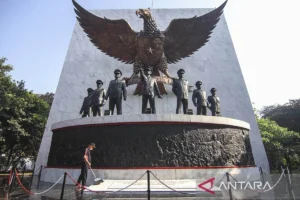
October 20, 2025: The anniversary proceedings commence early in the morning with a solemn pilgrimage and wreath-laying ceremony at the Kalibata Heroes Cemetery (Taman Makam Pahlawan – TMP) in Jakarta. This traditional ritual honors the sacrifices of national founders and fallen veterans. The observance will transition by evening to the DPP Golkar office for an official thanksgiving ritual (tasyakuran), marking the formal inauguration of the anniversary month.
-
October 22, 2025: Marking one of the largest humanitarian logistics operations undertaken by the party for this anniversary, Golkar will execute a simultaneous nationwide distribution of basic food packages (sembako). More than half a million packages are scheduled to be handed out to underprivileged families across the archipelago, addressing immediate cost-of-living pressures.
-
October 25, 2025: Shifting toward cultural and spiritual observances, the party will host a grand Maulid Nabi (Prophet Muhammad’s Birthday) celebration at the Velodrome Rawamangun complex in East Jakarta. This event is expected to draw thousands of religious leaders, local figures, and metropolitan cadres.
-
November 14, 2025: Emphasizing indigenous Indonesian heritage and community education, Golkar will stage a traditional wayang kulit (shadow puppet) performance at the courtyard of the DPP Golkar office. The cultural event will feature prominent young shadow puppet artist and singer Niken Salindri, serving as both entertainment and a cultural preservation initiative.
-
December 2025: The culmination of the months-long festivities will take place through synchronized nationwide prayers and traditional tumpeng (cone-shaped yellow rice) cutting ceremonies held across all provincial, regency, and municipal party chapters simultaneously.

Grassroots Mobilization and Tailored Regional Programs
A defining characteristic of Golkar’s 61st anniversary strategy is decentralization paired with central coordination. While high-profile events are concentrated in the capital, the true weight of the commemoration lies in localized execution. Muhidin pointed out that regional chapters have been granted the autonomy to tailor their outreach programs according to the specific geographic, economic, and cultural demands of their constituents.
Consequently, alongside the distribution of the half-million basic food packages, regional offices have been directed to organize localized initiatives such as subsidized cheap markets (pasar murah), mass blood donation drives, health clinics, and infrastructure-focused community service projects. This localized flexibility ensures that the party’s outreach does not feel uniform or disconnected from regional realities, but rather directly answers the localized economic pressures reported by residents in outer islands, agrarian centers, and dense urban enclaves alike.
Implications and Political Outlook
Political observers evaluating the rollout of Golkar’s 61st anniversary note several key takeaways regarding the party’s long-term trajectory. By projecting an image of stability, internal discipline, and structured community service, Golkar is actively consolidating its structural foundation ahead of future legislative and regional electoral cycles.
Furthermore, the dual focus on high-visibility cultural events—such as wayang performances and religious celebrations—coupled with material aid like food subsidies, allows the party to appeal across generational and demographic divides. Older voters respond to traditional markers of nationalism and heritage, while economically vulnerable demographics benefit directly from the material distribution programs.
As the anniversary proceedings march toward their December finale, the success of the 61st milestone will ultimately be measured by the efficacy of its logistical execution across remote regions and the sustained engagement of its expansive cadre network. Through careful planning led by figures like Muhidin Mohamad Said, the Golkar Party seeks to reinforce its historical identity as a pillar of Indonesian political stability while adapting its operational ethos to meet contemporary societal needs.