Socio Today
Jakarta (ANTARA) – Her Majesty Queen Máxima of the Netherlands has successfully concluded a significant working visit to Indonesia, spanning from Monday, November 24, to Thursday, November 27, 2025. The visit underscored her crucial role not as the reigning monarch of the Netherlands, but in her esteemed capacity as the United Nations Secretary-General’s Special Advocate (UNSGSA) for Inclusive Finance for Development, a position she has held since 2009. Her mission during this tour was deeply focused on promoting financial health and inclusive financial services as fundamental pillars for sustainable economic development and societal well-being across Indonesia.
The intensive four-day itinerary, with active engagements from Tuesday to Thursday, saw Queen Máxima traversing diverse regions, from the industrial heartlands of Sragen and the cultural city of Solo in Central Java, to the bustling metropolis of Jakarta, and the rapidly developing regency of Bekasi in West Java. This marked her fifth visit to the archipelagic nation, demonstrating a sustained commitment to Indonesia’s financial inclusion journey. Previous visits in her UNSGSA role occurred in 2012, 2016, and 2018, while her state visit as Queen, accompanying King Willem-Alexander, took place in 2020. Born on May 17, 1971, Queen Máxima married King Willem-Alexander in Amsterdam in 2002, embarking on a life dedicated to public service, both domestically and on the global stage through her UN advocacy.
The Enduring Mandate of the UNSGSA
Queen Máxima’s role as UNSGSA is a testament to her profound belief in the transformative power of financial inclusion. In this capacity, she works globally to advance universal access to affordable, effective, and safe financial services. Her advocacy focuses on empowering individuals and small businesses, particularly women, rural populations, and low-income communities, to better manage their finances, invest in their futures, and build resilience against economic shocks. The visit to Indonesia aligns perfectly with her mandate, as the country, with its vast and diverse population, presents both significant opportunities and complex challenges in achieving comprehensive financial inclusion.
Indonesia has made notable strides in financial inclusion over the past decade. According to the World Bank’s Global Findex database, the percentage of adults with an account at a financial institution or with a mobile money provider rose significantly, from just 20% in 2011 to 52% in 2021. However, despite this progress, a substantial portion of the population, particularly in remote areas and among vulnerable groups, remains unbanked or underserved. The government, through institutions like the Financial Services Authority (OJK), Bank Indonesia (BI), and the Ministry of Finance (Kemenkeu), has been actively implementing the National Strategy for Financial Inclusion (SNKI), aiming to achieve 90% financial inclusion by 2024. Queen Máxima’s visit serves to bolster these national efforts, offering international perspective, facilitating knowledge exchange, and highlighting successful models.
Chronology of a High-Impact Tour
The detailed itinerary of Queen Máxima’s visit provided a comprehensive look into various facets of Indonesia’s financial landscape and development priorities:
Tuesday, November 25: Focus on Grassroots Empowerment and SMEs
Queen Máxima commenced her active engagements in Central Java, a region pivotal to Indonesia’s industrial and cultural heritage. Her first stop was a garment factory in Sragen Regency. This visit was strategic, aiming to understand the financial needs of industrial workers, many of whom are migrants or come from low-income households. Discussions likely centered on access to digital payroll, savings accounts, micro-insurance, and responsible lending practices that can enhance the financial health and stability of employees. Such services are crucial for workers to manage daily expenses, save for emergencies, and plan for their families’ futures, thereby reducing their vulnerability to predatory lending and economic shocks.
Following this, the Queen traveled to Solo, a city renowned for its rich cultural traditions, particularly batik. Here, she visited Kampung Batik Laweyan, a historic batik village that serves as a vibrant hub for small and medium-sized enterprises (SMEs). The discussions focused on how financial services can support these traditional craftspeople and entrepreneurs. Topics likely included access to microcredit for business expansion, digital payment solutions for sales and supply chains, and financial literacy programs tailored for artisans to manage their revenues and invest wisely. The interaction with batik entrepreneurs highlighted the critical role of financial inclusion in preserving cultural heritage while fostering economic growth at the community level.
The day concluded with a significant event at Pura Mangkunegaran in Solo, where Queen Máxima attended a session organized by Women’s World Banking. This platform allowed her to engage directly with young people, university students, and female entrepreneurs. The conversations delved into their personal experiences with various financial products and services, exploring challenges and successes in utilizing banking, digital payments, and credit facilities. This direct interaction provided invaluable insights into the practical impact of financial inclusion initiatives on different demographic segments, particularly empowering women and fostering youth entrepreneurship, which are key drivers of economic development.
Wednesday, November 26: Policy Dialogues and Innovative Housing Solutions
The second day of active engagements brought Queen Máxima to Jakarta and Bekasi, shifting the focus towards policy-level discussions and innovative solutions for affordable housing. The morning began with a roundtable discussion at the local United Nations office in Jakarta. This gathering convened various development organizations, allowing for a broader dialogue on coordinated efforts to advance financial inclusion within Indonesia. The session likely addressed strategies for enhancing inter-agency collaboration, sharing best practices, and aligning initiatives with national development goals and the Sustainable Development Goals (SDGs).
Subsequently, Queen Máxima visited the International Finance Corporation (IFC), a member of the World Bank Group. The discussions here focused on the critical role of private sector financing in expanding financial inclusion, particularly through the development of innovative lending products that contribute to economic growth and financial health. Topics may have included green finance initiatives, impact investing, and strategies to de-risk private sector involvement in underserved markets, ensuring that financial capital flows towards sustainable and inclusive development projects.
A highlight of the day was her visit to the Gran Harmoni Cibitung subsidized housing complex in Bekasi Regency, West Java. This complex is notable for providing low-emission homes to low and middle-income communities, aligning with Indonesia’s commitment to sustainable development and affordable housing. Queen Máxima visited a resident’s home, engaging in personal interaction and understanding the direct impact of such housing initiatives. She also met with representatives of first-time homebuyers, gaining insights into their journey towards homeownership.
Crucially, the visit included an inspection of a waste bank (bank sampah) operating within the community. This innovative program allows residents to pay their house installments using sorted waste, an ingenious solution that simultaneously promotes environmental sustainability and financial responsibility. The Queen observed the process of waste collection, sorting, and conversion into financial value, appreciating how such creative mechanisms can enhance financial accessibility for vulnerable groups. She also witnessed the signing ceremony for dozens of prospective homeowners, a powerful symbol of financial empowerment and secure tenure. This particular initiative, often facilitated by state-owned banks like Bank Tabungan Negara (BTN), exemplifies how financial institutions can adapt their services to local contexts and needs, making homeownership more attainable for a wider segment of the population. The integration of environmental consciousness with financial mechanisms like waste-for-mortgage schemes resonated strongly with her advocacy for sustainable development.
In the afternoon, Queen Máxima concluded her engagements in Jakarta with a visit to Deloitte Indonesia. Here, she engaged in discussions with employers about their potential contributions to the financial health of their employees and clients. This interaction likely covered topics such as employee financial wellness programs, responsible lending practices by corporate entities, and the broader role of the private sector in fostering a financially literate and resilient workforce. The dialogue underscored the idea that financial health is not solely the responsibility of individuals or financial institutions but is also a shared concern that can be significantly influenced by employers through supportive policies and programs.
Thursday, November 27: High-Level Policy Engagement and Presidential Meeting
The final day of Queen Máxima’s visit was dedicated to high-level policy dialogues and a crucial meeting with Indonesia’s head of state. She participated in a significant financial literacy agenda alongside key Indonesian financial authorities: the Financial Services Authority (OJK), Bank Indonesia (BI), and the Ministry of Finance (Kemenkeu). This collaborative session likely focused on accelerating national financial literacy programs, strengthening regulatory frameworks for consumer protection, promoting digital financial services, and discussing strategies to bridge the financial knowledge gap among various segments of the population. The collective presence of these institutions highlighted Indonesia’s comprehensive approach to financial sector development and consumer empowerment.
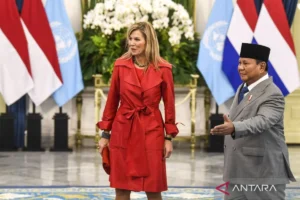
The culmination of her visit was a meeting with President Prabowo Subianto at the Merdeka Palace in Jakarta. This high-level engagement provided Queen Máxima with the opportunity to convey her observations, findings, and impressions from her extensive tour across Indonesia. The meeting, which included a private session and a luncheon, was expected to cover the progress of financial inclusion in Indonesia, challenges encountered, and potential recommendations for future policy directions. It also served to reinforce the strong bilateral ties between the Netherlands and Indonesia, even as the Queen visited in her UN capacity. The President’s reception of Queen Máxima underscored Indonesia’s commitment to international cooperation in achieving its financial inclusion goals and its appreciation for her global advocacy.
Broader Impact and Implications
Queen Máxima’s repeated visits to Indonesia as UNSGSA are not merely ceremonial; they carry significant weight and potential for tangible impact. Her advocacy helps to:
- Elevate the Profile of Financial Inclusion: By bringing global attention to Indonesia’s efforts, her visits reinforce the importance of financial inclusion as a national development priority and a key enabler for achieving the Sustainable Development Goals.
- Facilitate Knowledge Exchange and Best Practices: Her interactions with various stakeholders, from grassroots communities to high-level policymakers, foster a rich exchange of ideas and highlight successful models that can be scaled or replicated. The waste-for-mortgage scheme in Bekasi is a prime example of an innovative solution gaining international recognition through her visit.
- Influence Policy and Regulatory Frameworks: Her recommendations, informed by global best practices and local observations, can provide valuable input to OJK, BI, and Kemenkeu in refining policies that promote responsible innovation, consumer protection, and broader access to financial services.
- Strengthen International Partnerships: The visit reinforces Indonesia’s collaboration with the United Nations and other international bodies in addressing global development challenges, particularly in the financial sector.
- Empower Vulnerable Groups: By directly engaging with women, youth, small entrepreneurs, and low-income communities, Queen Máxima amplifies their voices and draws attention to their specific needs, encouraging tailor-made solutions that truly empower them.
Indonesia’s journey towards comprehensive financial inclusion is ongoing, characterized by both progress and persistent challenges such as digital literacy gaps, infrastructure disparities, and the need for more tailored financial products. Queen Máxima’s latest visit serves as a powerful reminder of the international community’s commitment to supporting these efforts, fostering a future where every Indonesian citizen has the opportunity to participate fully in the formal economy and build a more secure and prosperous life. Her steadfast dedication as UNSGSA continues to inspire and drive progress towards a more financially inclusive world.