Socio Today
According to reports from the Ukrainian Air Force and international observers, the Russian Federation launched a massive coordinated attack involving 98 combat drones targeting various locations across Ukrainian territory. Ukrainian air defense units, which have been on high alert throughout the holiday period, reportedly managed to intercept and destroy 87 of these unmanned aerial vehicles (UAVs). Despite the high interception rate, the sheer volume of the "swarm" attack managed to overwhelm defenses in specific sectors.
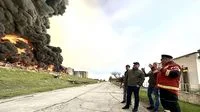
A critical infrastructure facility in the Dnipropetrovsk region of east-central Ukraine was confirmed to have been struck during the early hours of Monday morning. Local authorities are currently assessing the extent of the damage and clarifying information regarding potential casualties. Dnipropetrovsk, a vital logistical and industrial hub for the Ukrainian defense effort, has remained a frequent target for Russian long-range strikes, and this latest incident underscores the persistent vulnerability of the nation’s energy and transport networks.
The Resumption of Hostilities: A Statistical Overview
The scale of the post-ceasefire escalation is reflected in the official data released by both belligerents. On the Russian side, the Ministry of Defense claimed that their air defense systems were equally active during the same period. Moscow reported that on April 13, its units intercepted and destroyed 33 Ukrainian drones that were allegedly targeting Russian border regions and occupied territories. This "tit-for-tat" drone warfare has become the primary mode of engagement as both sides seek to conserve traditional artillery and manned aircraft while maintaining pressure on the enemy’s rear-guard infrastructure.
The Ukrainian military noted that while the ceasefire was technically in effect from 4:00 PM on Saturday, April 11, until Sunday night, the reality on the ground was far from peaceful. Although Kyiv acknowledged that there were no major missile or "Gerbera/Shahed" type drone strikes during the actual hours of the truce, the 1,200-kilometer front line remained a theater of constant friction.
Timeline of the Easter Truce
The agreement for a temporary cessation of hostilities was brokered last week, with both Kyiv and Moscow agreeing to respect the sanctity of the Orthodox Easter holiday. The timeline of the event is as follows:
- Mid-week, April 2026: Diplomatic channels, through intermediaries, establish a framework for a short-term humanitarian and religious pause.
- Saturday, April 11, 16:00 (Local Time): The ceasefire officially commences. Heavy weaponry is reported to have quieted in several sectors of the Donbas and Zaporizhzhia fronts.
- Sunday, April 12: Orthodox Easter Sunday. Religious services are held in bunkers and damaged cathedrals. Both sides report "relative calm," though infantry skirmishes continue.
- Sunday night/Monday morning, April 13: The ceasefire expires. Russia initiates a 98-drone launch. Ukraine responds with a 33-drone counter-offensive.
The failure of the ceasefire to hold in a meaningful way mirrors similar attempts in 2024 and 2025. Military analysts suggest that these brief windows of "peace" are often utilized by both sides for tactical repositioning rather than genuine de-escalation.
Allegations of Mass Violations
The end of the truce was accompanied by a flurry of mutual recriminations. The Ukrainian General Staff reported that it had documented over 10,000 violations by Russian forces during the 32-hour window. These violations primarily consisted of small-arms fire, mortar shelling, and tactical maneuvers along the line of contact. Kyiv emphasized that while the "strategic" weapons (missiles and heavy drones) were silent, the "tactical" war never truly stopped.
Conversely, the Russian Ministry of Defense accused the Ukrainian Armed Forces of nearly 2,000 violations. Moscow claimed that Ukrainian snipers and reconnaissance teams used the cover of the ceasefire to probe Russian defensive lines. These conflicting narratives highlight the deep-seated mistrust that makes any long-term diplomatic solution elusive. The "10,000 vs. 2,000" discrepancy in reported violations also points to a broader information war, where each side seeks to paint the other as the primary aggressor and breaker of solemn agreements.
The Evolution of Drone Technology: Shahed and Gerbera
A notable detail in the Ukrainian military’s report was the specific mention of "Shahed" and "Gerbera" type drones. By 2026, the technology of loitering munitions has evolved significantly. The "Shahed" drones, originally of Iranian design and later localized for Russian production, remain the backbone of Moscow’s long-range harassment campaign. However, the mention of the "Gerbera" drone points to a newer class of cheaper, plywood-bodied or composite UAVs designed to act as decoys or to saturate air defense systems.
These "Gerbera" drones are often launched in tandem with more lethal munitions to force Ukrainian air defense batteries to deplete their expensive interceptor missiles. The fact that Ukraine shot down 87 out of 98 drones suggests that their multi-layered defense—comprising electronic warfare, Gepard anti-aircraft guns, and mobile fire groups—remains effective, but the cost-to-kill ratio continues to favor the attacker in this war of attrition.
Strategic Impact on Dnipropetrovsk and Beyond
The strike on Dnipropetrovsk is particularly significant. As a central-eastern hub, the region serves as a gateway for supplies moving toward the eastern front in the Donbas. Any disruption to its infrastructure—be it power grids, rail yards, or fuel depots—has a direct "ripple effect" on the frontline soldiers’ ability to hold their positions.
While the immediate casualties in Dnipropetrovsk are still being verified, the psychological impact of resuming strikes immediately after a religious holiday cannot be overstated. For the civilian population, the return to air raid sirens after a mere 32 hours of quiet reinforces the grim reality that the conflict has no clear end in sight.
Broader Implications and International Context
The resumption of hostilities after the Easter ceasefire also carries weight on the international stage. Western allies, including the United States and the European Union, have been closely monitoring the sustainability of Ukraine’s air defenses. The 89% interception rate reported on Monday will likely be used by Kyiv to advocate for further shipments of interceptor missiles and advanced radar systems.
Furthermore, the timing of the strikes coincides with ongoing debates in global capitals regarding the efficacy of "limited ceasefires." Some diplomats argue that these pauses provide essential humanitarian windows, while military hardliners suggest they only prolong the inevitable by allowing an exhausted enemy to rotate troops and fortify positions.
The mention of President Zelensky’s support for other global military actions, such as U.S. and Israeli operations in the Middle East, suggests that Ukraine continues to view its struggle as part of a larger global realignment. By framing the Russo-Ukrainian war within the context of a wider struggle against an "axis of instability," Kyiv seeks to ensure that Western attention and military aid do not waver, even as the war enters its fifth year since the 2022 invasion.
Fact-Based Analysis: The War of Attrition in 2026
As we analyze the events of April 13, 2026, several key factors emerge:
- Air Superiority remains elusive: Neither side can claim total control of the skies. The reliance on drones indicates that manned flights over the 1,200km front line remain too risky due to dense anti-aircraft coverage.
- Infrastructure as a Front Line: The Russian strategy continues to prioritize the degradation of the Ukrainian "rear." By hitting Dnipropetrovsk, Moscow aims to break the will of the civilian population and the efficiency of the military supply chain.
- Ceasefire Futility: The massive number of reported violations (12,000 combined) suggests that local commanders on the ground often ignore high-level diplomatic agreements, or that the agreements themselves are too vague to be enforceable.
- Technological Saturation: The use of nearly 100 drones in a single night shows that production capacities for UAVs have reached industrial scales on both sides, turning the conflict into a "war of factories."
The end of the Easter ceasefire marks the beginning of what many expect to be a violent spring offensive season. With the ground drying and the weather improving, the transition from drone strikes to larger mechanized maneuvers may be the next phase in this ongoing tragedy. For now, the people of Ukraine and the soldiers on both sides of the trenches return to a state of high alert, as the brief "calm" of the holiday fades into the smoke of renewed explosions.