Socio Today
Located in the heart of Bengkulu City, a region affectionately known as the "Land of the Rafflesia," stands a silent witness to the formative years of the Indonesian independence movement. The residence of Soekarno, affectionately known as Bung Karno, during his period of internal exile by the Dutch colonial administration from 1938 to 1942, remains one of the most significant historical landmarks in Sumatra. Situated on Jalan Soekarno Hatta, the house serves not only as a museum but as a testament to the resilience of a leader who refused to be silenced despite being physically isolated from the political epicenter of Java.
Today, the site is managed as a vital cultural heritage site (Cagar Budaya) under the auspices of the Indonesian Ministry of Culture. For a modest entrance fee of five thousand rupiahs, visitors are granted access to a meticulously preserved estate that offers a rare glimpse into the private and intellectual life of the man who would eventually become Indonesia’s first president. The house, characterized by its expansive grounds and distinct colonial-era architecture, continues to draw historians, students, and tourists alike, serving as a cornerstone of Bengkulu’s historical tourism.

Historical Chronology: From Ende to the Land of the Rafflesia
To understand the significance of the Bengkulu residence, one must look at the broader timeline of Soekarno’s revolutionary activities. The journey to Bengkulu was the culmination of years of systemic repression by the Dutch East Indies government. In the early 1930s, Soekarno’s leadership of the Indonesian National Party (PNI) made him a primary target for the colonial authorities. Following his arrest, he was incarcerated in the Banceuy and Sukamiskin prisons in Bandung.
Upon his release in December 1931, Soekarno resumed his agitation for independence, leading to a more severe response from the Dutch. In 1934, he was sent into exile in Ende, on the island of Flores. The period in Ende was particularly grueling; the isolated environment and the lack of intellectual stimulation led to a decline in Soekarno’s mental and physical health. It was during this time that he contracted malaria, a condition that eventually prompted the colonial government to relocate him.
In February 1938, the Dutch administration decided to move Soekarno to Bengkulu. The transition was not merely a change of scenery but a strategic move by the Dutch to keep him in a location that was considered more "controllable" yet less life-threatening than the harsh conditions of Flores. Upon arrival in Bengkulu, the government rented a house owned by a prominent Chinese merchant, Lion Bwe Seng. This house would serve as Soekarno’s home for the next four years, until the arrival of Japanese forces in 1942 effectively ended Dutch colonial rule and paved the way for Soekarno’s return to the political forefront in Jakarta.

Architectural Integrity and the Interior of the Exile Home
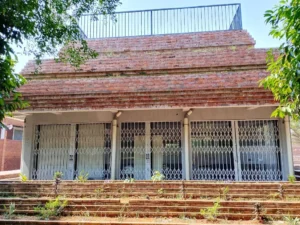
The residence is a quintessential example of early 20th-century colonial architecture, often referred to as the "Indische Empire" style. It features high ceilings, large windows for natural ventilation, and a sturdy structure designed to withstand the tropical climate. Upon entering the gates, visitors are greeted by a well-manicured garden featuring a circular pedestrian path that leads to the main building. A marble plaque at the entrance, though weathered by time, notes that the building underwent significant restoration during the tenure of Professor Dr. Fuad Hassan, the former Minister of Education and Culture.
The layout of the house is divided into several functional areas that reflect Soekarno’s daily life. To the right of the main entrance is a distinctive curved wing which houses Soekarno’s private workroom. This architectural feature is one of the most recognizable aspects of the house, providing a panoramic view of the grounds and allowing ample light for reading and writing.
The main living room, while modest in scale, is arranged to resemble a gallery. High on the walls hang framed portraits of the Proclamator, while the center of the room is occupied by a vintage wooden furniture set—a table and four chairs that evoke the domestic atmosphere of the late 1930s. Displayed prominently on the table are several books, including a biography of Fatmawati Sukarno, and a miniature Indonesian flag. A notable artifact in this room is Soekarno’s original bicycle (sepeda ontel), preserved within a glass casing. This bicycle was his primary mode of transport, allowing him to navigate the streets of Bengkulu and interact with the local populace.

Life in Exile: Social Integration and Cultural Resistance
The arrival of Soekarno in Bengkulu was initially met with skepticism and suspicion by the local community. The colonial authorities had spread rumors to frame him as a radical whose presence would bring unwanted trouble. However, Soekarno’s charismatic nature and genuine interest in the welfare of the people quickly dismantled these barriers.
Over time, the residence became a hub for social and religious discourse. Locals began to seek Soekarno’s counsel on a variety of matters, ranging from political philosophy and religious interpretation to personal family issues. His integration into Bengkulu society was further cemented through his contributions to the city’s physical and cultural landscape.
As a trained architect, Soekarno left a tangible mark on the city by designing the renovation of the Masjid Jamik (Great Mosque) of Bengkulu. His sketches for the mosque, which blended traditional Indonesian elements with modern colonial influences, remain visible in the structure today. Beyond architecture, Soekarno utilized the arts as a vehicle for nationalist propaganda. He took over a local musical troupe known as "Monte Carlo" and transformed it into a "tonil" (drama) group.

Soekarno was deeply involved in every aspect of Monte Carlo, from writing scripts to designing costumes and stage sets. These performances were not merely entertainment; they were sophisticated tools for spreading ideas of independence and unity under the watchful eyes of Dutch censors. Today, the costumes and promotional materials for Monte Carlo are displayed in the museum, particularly in the rooms once occupied by his guests and his adopted daughter, Ratna Djuami.
Personal Chambers and the Presence of Inggit Garnasih
The museum also preserves the private quarters of Soekarno and his first wife, Inggit Garnasih, who accompanied him throughout his exiles in both Ende and Bengkulu. Their bedroom contains a simple iron bed frame and a wardrobe containing replicas of their attire. One of the most poignant items in the room is a dressing table, which historical records indicate was handcrafted by Soekarno himself.
These personal spaces highlight the domestic sacrifices made by the couple during their years of displacement. It was also in Bengkulu that Soekarno first met Fatmawati, the daughter of a local Muhammadiyah leader, who would later become his wife and the first First Lady of Indonesia. The intersection of these personal narratives within the walls of the Bengkulu house adds a layer of human complexity to the historical figure of the Proclamator.

Supporting Data and Heritage Preservation
The preservation of the Bung Karno residence is governed by Law No. 11 of 2010 concerning Cultural Heritage. This legal framework ensures that the site is protected from commercial encroachment and that any restoration work maintains historical authenticity. According to data from the Bengkulu Provincial Tourism Office, the residence is one of the most visited historical sites in the province, playing a crucial role in the local economy and educational curriculum.
Statements from local historians suggest that the house serves as a "living laboratory." Unlike textbooks, the physical presence of the artifacts—the books he read, the desk where he wrote his speeches, and the bicycle he rode—provides a sensory connection to the past. The Ministry of Culture has emphasized the importance of digitalizing the archives found within the home, including the letters of correspondence between Soekarno and the colonial administration, to ensure their survival for future generations.
Broader Impact and Implications for National Identity
The residence of Bung Karno in Bengkulu is more than a relic of the colonial past; it is a symbol of the "periphery" contributing to the national center. Soekarno’s time in Bengkulu demonstrates that the struggle for Indonesian independence was not confined to the elite circles of Batavia (Jakarta). It was a movement built on the ground, through interaction with diverse communities across the archipelago.

The famous quotes displayed on the museum walls—such as his call for ten young men to "shake the world"—continue to resonate with visitors. Another striking inscription reminds visitors of the internal challenges of nation-building: "My struggle was easier because it was to expel the invaders. Your struggle will be more difficult because it is against your own people."
In a contemporary context, the preservation of such sites is vital for fostering national identity. As Indonesia navigates the complexities of the 21st century, the Bengkulu exile home stands as a reminder of the intellectual rigor, cultural adaptability, and unwavering determination required to build a nation from the ground up. It serves as a call to modern Indonesians to adopt the same spirit of resilience and "gotong royong" (mutual cooperation) that Soekarno championed during his four years in the Land of the Rafflesia.