William Heinrich Unveils ‘HIPMI 8%’ Strategic Concept to Accelerate National Economic Growth and Combat Middle-Income Trap

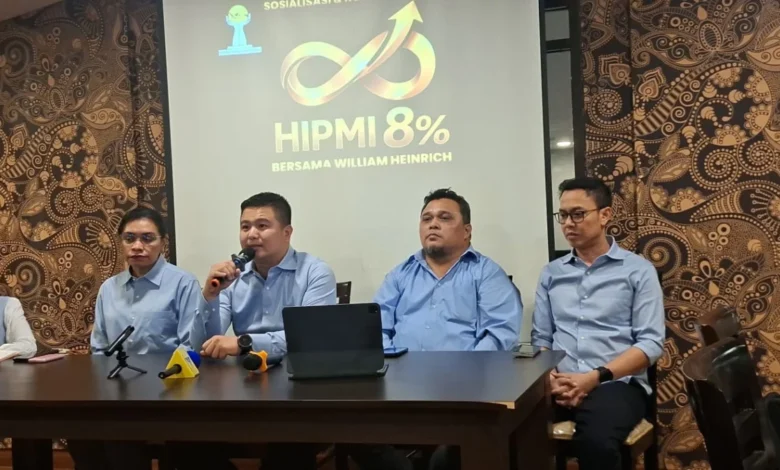
In a significant move poised to reshape the discourse on national economic development, William Heinrich, a prominent candidate for the chairman position of the Indonesian Young Entrepreneurs Association (BPP HIPMI), on Wednesday, April 15, 2026, presented a comprehensive strategic framework dubbed ‘HIPMI 8%’. Unveiled during a high-profile press conference held at the bustling SCBD district in South Jakarta, Heinrich’s ambitious proposal outlines concrete contributions from the young entrepreneurial sector to drive the national economy towards an 8 percent annual growth target, aligning closely with and actively supporting the economic policies championed by President-elect Prabowo Subianto’s incoming administration.
Heinrich’s presentation underscored that the aspiration for an 8 percent economic growth rate is far from a mere rhetorical flourish; rather, it represents a fundamental imperative for Indonesia to decisively escape the perennial challenge of the middle-income trap. This economic predicament, characterized by a nation’s inability to transition from a middle-income economy to a high-income one due to various structural rigidities and inefficiencies, has long loomed over Indonesia’s long-term development trajectory. Heinrich articulated a clear vision that the current demographic bonus – a period characterized by a disproportionately large working-age population – must be strategically leveraged through concerted efforts involving all societal segments, with young entrepreneurs at the vanguard as vital movers of the real sector.
The Middle-Income Trap: A Persistent Challenge for Indonesia
Indonesia, currently classified as an upper-middle-income country with a Gross National Income (GNI) per capita hovering around USD 4,580 as of recent estimates, finds itself at a critical juncture. The middle-income trap is a well-documented phenomenon where countries achieve a certain level of economic prosperity but then struggle to sustain high growth rates necessary to join the ranks of high-income nations. This often occurs due to a loss of competitiveness in labor-intensive manufacturing (as wages rise) without developing the innovation capacity and high-value-added industries that characterize advanced economies. For Indonesia, escaping this trap would require sustained economic growth rates significantly higher than the average 5% observed in recent years, potentially for several decades. An 8% growth target, while highly ambitious, reflects a determination to accelerate this transition and avoid stagnation. Historically, only a handful of nations, predominantly in East Asia, have successfully navigated this trap, emphasizing the scale of the challenge and the need for bold, innovative strategies.
Leveraging the Demographic Bonus: A Window of Opportunity
Indonesia is currently in the midst of its demographic bonus period, projected to last until around 2040. This demographic dividend presents an unparalleled opportunity for economic acceleration, provided the large working-age population can be productively employed and equipped with the necessary skills. However, if not properly managed, this demographic bulge can turn into a burden, leading to high unemployment and social instability. Heinrich’s ‘HIPMI 8%’ concept recognizes this critical window, proposing that young entrepreneurs are uniquely positioned to convert this demographic potential into tangible economic output. By fostering entrepreneurship, particularly in sectors that absorb significant labor and drive innovation, HIPMI aims to transform a large workforce into a powerful engine of growth, creating jobs and stimulating demand.
HIPMI’s Transformed Role: From Facilitator to Economic Catalyst
Heinrich critically assessed the existing framework, stating that the government’s fiscal constraints necessitate a collaborative approach, where the state cannot shoulder the burden of economic growth alone. Consequently, he argued, HIPMI must adopt a far more proactive stance, evolving beyond its traditional role as a mere facilitator of entrepreneurial networking to become a formidable engine of economic growth itself. This envisioned transformation entails HIPMI becoming a productive force capable of generating substantial added value, rather than primarily depending on government-issued projects or tenders. The emphasis shifts towards self-reliance, innovation, and market-driven initiatives that foster sustainable business ecosystems.
The Indonesian Young Entrepreneurs Association (HIPMI) has historically played a crucial role in nurturing young business leaders and advocating for policies conducive to entrepreneurial growth. Founded in 1972, it has served as a platform for networking, mentorship, and collective action for generations of Indonesian entrepreneurs. Under Heinrich’s proposed leadership, HIPMI would undergo a significant strategic pivot, moving from an organization that primarily supports individual entrepreneurs to one that actively shapes and influences national economic outcomes through collective entrepreneurial action. This includes developing programs that not only train but also empower young entrepreneurs to launch and scale businesses that contribute directly to GDP and employment figures.
Addressing Economic Inefficiency: The ICOR and TFP Challenge
A central tenet of Heinrich’s proposal addresses the persistent issue of national economic inefficiency, highlighted by Indonesia’s relatively high Incremental Capital Output Ratio (ICOR). ICOR measures the additional capital or investment required to generate an additional unit of output. A high ICOR signifies inefficient capital utilization, meaning that more investment is needed to achieve a given level of economic growth compared to countries with lower ICORs. Indonesia’s ICOR has historically hovered around 6 to 7, significantly higher than the 3-4 often seen in more developed or highly efficient developing economies. This inefficiency directly impedes the nation’s ability to achieve higher, sustained growth rates, as a substantial portion of investment yields suboptimal returns.
To counter this, Heinrich articulated that HIPMI would position itself as a key agent in reducing the national ICOR through a concerted focus on enhancing Total Factor Productivity (TFP). TFP measures the efficiency with which capital and labor inputs are utilized in the production process. Improvements in TFP are typically driven by technological advancements, innovation, better management practices, and human capital development, rather than simply increasing the quantity of inputs. Heinrich’s strategy emphasizes several critical interventions:
- Digitalization of Businesses: Encouraging and facilitating the adoption of digital technologies across all scales of entrepreneurial ventures, from micro to large enterprises. This includes e-commerce platforms, digital marketing, cloud computing, and automated business processes, which can significantly reduce operational costs and expand market reach.
- Utilization of Advanced Technology: Promoting the integration of cutting-edge technologies such as artificial intelligence, big data analytics, blockchain, and automation in production and service delivery. This would not only enhance productivity but also drive innovation and competitiveness in global markets.
- Supply Chain Efficiency: Implementing strategies to optimize supply chains, reducing waste, improving logistics, and fostering better coordination among various actors. This could involve leveraging digital platforms for supply chain management, promoting local sourcing, and investing in infrastructure improvements.
By systematically addressing these areas, Heinrich projects that investments will yield substantially larger and more sustainable outputs, thereby reducing the ICOR and accelerating overall economic growth. This focus on TFP growth is crucial because it represents sustainable, qualitative growth, rather than merely quantitative expansion driven by increasing inputs.
Strengthening State Revenue Through Entrepreneurial Growth
Beyond efficiency, Heinrich also offered innovative solutions for bolstering state revenue. Acknowledging the government’s delicate balance of maintaining public purchasing power, exemplified by the decision to keep the Value Added Tax (PPN) rate at 11 percent, Heinrich underscored the critical importance of broadening the tax base through the creation of formal employment opportunities. The current PPN rate, while a significant source of government income, is carefully managed to avoid unduly burdening consumers. In this context, expanding the pool of taxpayers becomes paramount.
Under the ‘HIPMI 8%’ concept, HIPMI would be strategically repurposed as a central incubator for developing young entrepreneurs who are not only capable of sustained growth and profitability but also committed to making tangible contributions to national revenue. This involves fostering businesses that formalize their operations, employ a growing workforce, and comply with tax regulations, thereby expanding the government’s tax collection capacity organically.
As a testament to this commitment, William Heinrich set an ambitious target: the nurturing and successful establishment of 10,000 new productive entrepreneurs. These entrepreneurs would be equipped not only to survive market challenges but also to generate consistent profits and, crucially, to absorb local labor, creating a virtuous cycle of economic activity. Furthermore, Heinrich plans a significant reform of HIPMI’s organizational Key Performance Indicators (KPIs), shifting the focus from purely ceremonial activities to measurable, real-world economic impacts. If this multifaceted strategy is executed optimally, the collective contributions of HIPMI members are projected to generate an additional economic output of up to Rp20 trillion in the domestic market, a substantial boost to the national economy. This quantitative target underscores the practical, results-oriented approach Heinrich intends to instill within the organization.
Financing the Future: Leveraging New Economic Architectures
In the critical aspect of financing, William Heinrich noted that the evolving architecture of the national economy presents significant new opportunities for young entrepreneurs. He specifically highlighted the emergence or strengthening of investment institutions, referencing ‘Danantara’ as a pivotal momentum for enhancing access to funding. While details of ‘Danantara’ would require further official clarification, it likely alludes to new state-backed investment vehicles, specialized venture capital funds, or reforms in existing state-owned financial institutions like PT Danareksa, designed to channel capital more efficiently into productive sectors, particularly those driven by young entrepreneurs.
Access to capital remains one of the most formidable barriers for aspiring entrepreneurs in Indonesia. Traditional banking institutions often impose stringent collateral requirements and have a low appetite for risk associated with nascent businesses. Heinrich’s vision emphasizes leveraging these new financial mechanisms to bridge the funding gap, ensuring that promising young enterprises have the necessary resources to scale their operations, innovate, and contribute to the 8% growth target. This includes advocating for more accessible and tailored financing products, fostering partnerships between entrepreneurs and investors, and potentially establishing dedicated HIPMI-led investment platforms or incubators that facilitate seed funding and growth capital.
Reactions and Implications: A Path Forward
The ‘HIPMI 8%’ concept has drawn attention from various stakeholders, including economic analysts and, implicitly, government circles given its alignment with the Prabowo Subianto administration’s stated economic goals. Economic experts largely laud the focus on improving Total Factor Productivity (TFP) and reducing the Incremental Capital Output Ratio (ICOR) as fundamental to Indonesia’s long-term sustainable growth. Many economists have consistently advocated for structural reforms that enhance efficiency and innovation, rather than relying solely on capital accumulation. Heinrich’s detailed plan to achieve this through digitalization, technology adoption, and supply chain optimization is seen as a pragmatic approach to tackling deep-seated economic challenges.
However, analysts also caution that achieving an 8% economic growth rate is an extremely ambitious undertaking, requiring not only the concerted efforts of entrepreneurs but also robust government support, a stable macroeconomic environment, and continued investment in infrastructure and human capital. The target of nurturing 10,000 new productive entrepreneurs, while commendable, will necessitate significant resources for mentorship, training, and access to markets. The projected Rp20 trillion additional economic output underscores the potential impact but also highlights the scale of the organizational and logistical challenge for HIPMI.
From a government perspective, the ‘HIPMI 8%’ initiative is likely to be welcomed as a vital private-sector contribution to national development objectives. The Prabowo administration has articulated a strong commitment to accelerating economic growth and empowering the youth, making Heinrich’s proposals highly congruent with official policy directions. A robust partnership between the government and organizations like HIPMI will be crucial for translating ambitious targets into tangible results, especially in areas like job creation, SME development, and innovation.
In conclusion, William Heinrich’s ‘HIPMI 8%’ strategic concept represents a bold and detailed blueprint for HIPMI’s role in Indonesia’s economic future. By focusing on critical areas such as escaping the middle-income trap, leveraging the demographic bonus, enhancing economic efficiency through TFP growth, broadening the tax base via formal job creation, and improving access to finance, the proposal outlines a transformative agenda. If successfully implemented, this strategy could significantly elevate HIPMI’s influence, empower a new generation of entrepreneurs, and provide a substantial impetus towards achieving Indonesia’s aspiration of becoming a high-income nation, thereby cementing its position as a major economic force in Southeast Asia and beyond. The coming months will reveal the extent to which this vision can be translated into concrete action and measurable impact, setting a new precedent for the role of young entrepreneurs in national development.