Donald Trump Sparks Controversy by Sharing and Deleting AI-Generated Image Depicting Himself in Messianic Pose Amid Feud with Pope Leo XIV

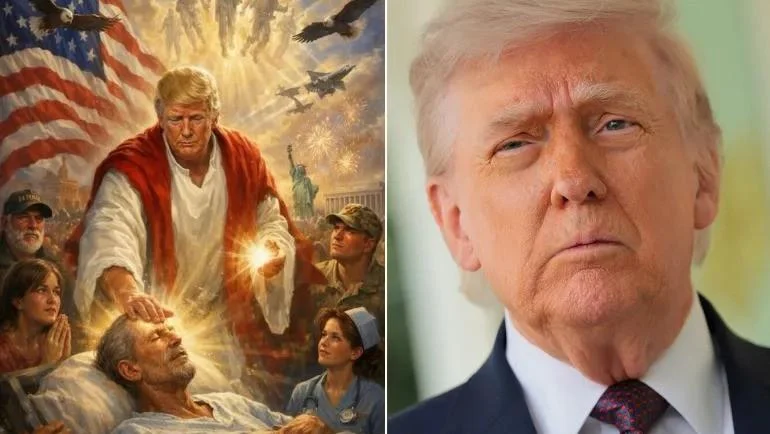
In a move that has reignited debates over the intersection of religion, technology, and political imagery, former United States President Donald Trump has drawn intense scrutiny for a series of social media activities involving artificial intelligence and high-level ecclesiastical disputes. The controversy centers on an AI-generated image shared on Trump’s proprietary social media platform, Truth Social, which depicted the former president in a manner strikingly similar to traditional iconographic representations of Jesus Christ. The post, which appeared on a Sunday and was abruptly removed the following Monday, has triggered a wave of condemnation from religious leaders, political opponents, and even some conservative allies, further complicating Trump’s complex relationship with the American electorate and global religious institutions.
The visual content of the post was an elaborate, Americana-style digital painting created through generative artificial intelligence. It featured a figure with Donald Trump’s likeness clad in a flowing white robe and a red sash—attire historically and culturally synonymous with depictions of Jesus Christ in Western art. In the image, the Trump figure was shown placing a hand upon the head of another man in a gesture clearly intended to evoke acts of divine healing. The background of the piece further blended religious and nationalist themes, featuring American fighter jets streaking across the sky alongside angelic figures watching from above. A prominent United States flag anchored the scene, while a crowd of onlookers surrounded the central figure, some gazing up in awe and others with hands clasped in prayerful supplication.
Chronology of the Truth Social Incident
The timeline of the event suggests a calculated, if brief, attempt to project a specific narrative of divine endorsement or messianic leadership. On the evening of Sunday, April 12, the image was uploaded to Trump’s Truth Social account without an extensive caption, allowing the visual metaphors to speak for themselves. This timing is significant, as it followed a weekend of heightened rhetoric from the Trump camp regarding international relations and religious authority.
By Monday morning, April 13, the post had been deleted from the platform. The removal occurred without an official explanation from the Trump campaign or the Truth Social administrative team. However, by the time of its deletion, the image had already been widely circulated via screenshots and shared across other social media platforms like X (formerly Twitter) and Facebook, ensuring that the visual remained a central point of public discourse. The White House, when approached for comment on the matter, declined to provide an official statement, maintaining a distance from the former president’s social media maneuvers.
The Backdrop of Geopolitical Tension and Ecclesiastical Dispute
The controversial post did not occur in a vacuum. It was shared amidst an escalating war of words between Donald Trump and Pope Leo XIV, the head of the Catholic Church. The friction between the two figures stems from a fundamental disagreement over foreign policy in the Middle East, specifically regarding the ongoing conflict involving the United States, Israel, and Iran. This conflict, which reports indicate was exacerbated by a joint US-Israeli military operation against Iranian targets in late February, has become a focal point for international calls for peace.
Pope Leo XIV, in his capacity as a global moral leader, recently issued a series of pleas for immediate de-escalation and a return to diplomatic negotiations. Trump, however, took umbrage at the Pontiff’s stance. In a message preceding the AI image post, Trump labeled the Pope as "weak on crime" and "bad at foreign policy," accusing the Vatican of "playing games" with a nation—Iran—that he claims is actively pursuing nuclear weapons. Trump’s rhetoric went as far as to suggest that the Vatican’s college of cardinals only elected Leo XIV because of his American nationality, concluding his critique by stating he was "not a big fan" of the current Pope.
The Pope’s response, delivered to journalists aboard the papal plane en route to Algiers, was one of measured detachment. He emphasized that the Church’s mission is rooted in the Gospel’s call for peacemaking rather than the technicalities of secular foreign policy. "We are not politicians," the Pope stated, asserting that the Church has a moral obligation to speak clearly against the horrors of war and in favor of reconciliation, regardless of the political administration in power.
Public and Political Backlash
The reaction to the AI-generated image was swift and overwhelmingly critical, spanning the political and religious spectrum. Many observers viewed the depiction as a bridge too far, crossing from political theater into the realm of religious sacrilege.
Brilyn Hollyand, the former co-chair of the Republican National Committee’s Youth Advisory Council, was among the first prominent conservative voices to denounce the image. Hollyand characterized the post as "massive blasphemy," arguing that faith should not be used as a political prop. She noted that a leader’s record should speak for itself without the need to adopt the persona of a savior. This sentiment was echoed by Megan Basham, a columnist for the conservative outlet Daily Wire, who described the imagery as "EXTREMELY BLASPHEMOUS," reflecting a concern among some evangelical and traditionalist circles that the conflation of a political figure with a deity undermines the sanctity of religious belief.
From the legislative side, Senator Bernie Sanders, a long-time critic of the former president, used the incident to highlight what he described as Trump’s "egomaniacal" tendencies. Sanders pointed out the irony of Trump attacking the Pope for promoting peace while simultaneously projecting himself as a messianic figure. According to Sanders, such behavior is not merely offensive but indicative of a "delusional" approach to leadership that prioritizes personal ego over the stability of democratic and religious institutions.
Trump’s Defense and the "Red Cross" Reinterpretation
Following the backlash, Donald Trump addressed the controversy, though his explanation offered a sharp departure from the visual cues present in the image. Despite the white robes, the red sash, and the healing pose—all of which are standard tropes of Christological art—Trump claimed that the image was intended to depict him as a "doctor" or a "Red Cross worker."
In a statement defending the post, Trump asserted that the image was meant to show his support for the Red Cross and healthcare workers. He dismissed the widespread interpretation of the image as Jesus-like as a product of "fake news" media outlets. "And it has to do with the Red Cross as a Red Cross worker, which we support. And only the fake news could make an image like that," Trump remarked during a brief interaction with the press. This defense, however, has been met with skepticism, as the image lacked any official Red Cross branding and instead relied on traditional religious symbolism.
Analysis of AI as a Tool for Political Myth-Making
The incident underscores a burgeoning trend in modern politics: the use of artificial intelligence to craft hyper-stylized narratives that bypass traditional media gatekeepers. AI allows political campaigns and figures to generate high-quality, emotionally resonant imagery at a low cost, often blurring the lines between reality and symbolic fiction. In this instance, the use of AI to place Trump in a divine context serves to reinforce a "strongman" or "savior" narrative that appeals to a specific segment of his base, even if it alienates others.
Furthermore, the "post and delete" strategy observed in this case serves a dual purpose. It allows the provocative content to enter the public consciousness and go viral, while the subsequent deletion provides a layer of plausible deniability. By the time the image is removed, its symbolic message has already been received by millions, and the resulting controversy keeps the figure at the center of the news cycle.
Implications for the Future of Religious and Political Discourse
The friction between Trump and the Vatican, coupled with the use of messianic imagery, highlights a deepening rift in how religious authority is perceived in the United States. For many, the Pope remains the ultimate moral arbiter on issues of war and peace. For others, particularly within the populist wing of American politics, nationalist leaders are seen as the primary protectors of values, sometimes eclipsing traditional religious figures.
This event also raises significant questions about the ethics of AI in political communication. As generative tools become more sophisticated, the potential for creating misleading or inflammatory content increases. The ease with which a political figure can be inserted into sacred or historical contexts poses a challenge to public literacy and the maintenance of shared cultural boundaries.
As the political landscape continues to evolve ahead of future elections, the intersection of AI-generated mythology and high-stakes international diplomacy will likely remain a volatile frontier. The brief appearance of the "Messianic Trump" image on Truth Social may have been a fleeting social media moment, but it reflects deeper, more permanent shifts in the way power, faith, and technology are being negotiated in the 21st century. Whether viewed as a doctor, a savior, or a political tactician, Trump’s use of such imagery ensures that the conversation around his persona remains as polarizing as it is unavoidable.