Socio Today
The geopolitical landscape of the Middle East has shifted into a state of high-alert following a stern warning from United States President Donald Trump, who on Monday declared that any Iranian naval vessels attempting to breach or harass a newly established U.S. naval blockade in the Strait of Hormuz would be "immediately removed" from existence. This ultimatum comes as the administration in Washington moves to solidify a maritime chokehold on Iranian ports, a move that threatens to dismantle a fragile two-week ceasefire and send global energy markets into a tailspin. Speaking via social media and official briefings, President Trump asserted that while a significant portion of Iran’s conventional naval capabilities had been neutralized in the opening weeks of the conflict, the U.S. military remains prepared to engage and destroy any remaining "fast attack craft" that Teheran might deploy to challenge American supremacy in the region.
The blockade, which the Pentagon officially scheduled to commence at 14:00 GMT on Monday, April 13, 2026, marks a significant escalation in the conflict that began earlier this year. According to military communiqués, the enforcement action applies to all vessels attempting to depart from or dock at Iranian maritime facilities. While early reports following the 14:00 GMT deadline indicated a tense silence with no immediate reports of kinetic engagement, the rhetoric from the White House suggests that the rules of engagement have been drastically loosened. The President’s declaration follows the return of a high-level diplomatic delegation led by Vice President JD Vance, which failed to secure a peace treaty during secret negotiations held in Pakistan over the weekend.
The Collapse of the Islamabad Summit
The current crisis is rooted in the failure of diplomatic efforts that many hoped would provide an off-ramp for the hostilities that erupted on February 28, 2026. Vice President JD Vance had traveled to Pakistan to meet with high-ranking Iranian officials in a bid to formalize a permanent end to the war. These talks, mediated by Pakistani and Qatari officials, were intended to build upon a fourteen-day ceasefire agreement reached the previous Wednesday. However, the delegation returned to Washington on Sunday without a signed agreement, citing Iran’s refusal to meet specific U.S. demands regarding its regional proxy network and maritime conduct.
Immediately following the return of Vice President Vance, President Trump announced the decision to impose a total blockade on the Strait of Hormuz. The administration’s logic appears to be centered on "maximum pressure," intended to starve the Iranian economy of its remaining oil revenue and prevent the re-arming of its military forces. President Trump’s social media posts emphasized that the U.S. had already "decimated" the bulk of Iran’s traditional navy and that the blockade served as a final warning to the remnants of the Islamic Revolutionary Guard Corps (IRGC) naval wing. "If they have any of those little fast boats left and they get near our ships, they will be erased," the President stated, using language that suggests a policy of pre-emptive destruction.
A Chronology of the 2026 Conflict
To understand the gravity of the current blockade, one must look at the rapid escalation of hostilities over the past six weeks. The conflict began on February 28, 2026, when a series of coordinated, high-intensity strikes were launched by U.S. and Israeli forces against strategic targets within Tehran and other major Iranian cities. The strikes were characterized by the Pentagon as a "necessary response" to imminent threats against regional stability and allied interests.
The initial phase of the war saw a massive aerial and naval campaign. Within the first 72 hours, the U.S. Navy’s Fifth Fleet, supported by additional carrier strike groups, targeted Iranian naval bases at Bandar Abbas and Bushehr. Analysts suggest that over 60% of Iran’s major surface combatants were disabled or sunk during this period. However, Iran’s asymmetric capabilities—specifically its fleet of hundreds of small, agile, and missile-equipped fast attack craft—remained a persistent concern for U.S. naval planners.
On the Wednesday preceding the current blockade, both nations had agreed to a temporary cessation of hostilities. This window was intended to facilitate the humanitarian movement of goods and allow diplomats to negotiate terms of surrender or a lasting truce. The failure of the Vance mission in Pakistan effectively closed that window, leading directly to the Sunday proclamation of the blockade.
Global Economic Fallout and Oil Market Volatility
The immediate impact of the blockade announcement was felt in the global financial markets. The Strait of Hormuz is the world’s most important oil transit point, with approximately 20 to 30 percent of the world’s total oil consumption passing through the narrow waterway daily. On Monday, oil prices surged by approximately 8 percent as traders factored in the risk of a total cessation of exports from the Persian Gulf.
Market analysts noted that while prices had dipped significantly during the brief ceasefire, the return to a "state of siege" has reintroduced a massive risk premium. Brent Crude and West Texas Intermediate (WTI) both saw spikes that could lead to increased inflationary pressure in Western economies if the blockade persists. Shipping insurance rates for tankers operating in the Gulf of Oman and the Persian Gulf have also reportedly tripled overnight, as many commercial operators now fear being caught in the crossfire of a naval engagement.
Furthermore, the blockade creates a complex dilemma for global trade. Iran has responded by stating it will only allow "friendly" nations to transit the waters it controls. Specifically, Teheran has signaled that vessels serving China—a major purchaser of Iranian crude and a strategic partner—will be granted safe passage, while ships from "hostile" nations will be barred. This creates a bifurcated maritime environment that challenges the fundamental principles of international law.
International Legal and Diplomatic Responses
The international community has reacted with profound concern to the U.S. blockade, with many officials questioning its legality under international maritime law. Arsenio Dominguez, the Secretary-General of the International Maritime Organization (IMO), issued a statement emphasizing that no sovereign state has the right to impede the "innocent passage" or "freedom of navigation" through international straits used for international transit. Under the United Nations Convention on the Law of the Sea (UNCLOS), the Strait of Hormuz is considered an international waterway where transit passage cannot be suspended.
Regional mediators have also pleaded for restraint. Qatari Prime Minister and Minister of Foreign Affairs, Sheikh Mohammed bin Abdulrahman Al Thani, urged both Washington and Tehran to maintain open channels of communication. He warned against using critical maritime corridors as "tools of political or military pressure," noting that the entire global economy depends on the stability of the Strait.
In Pakistan, Prime Minister Shehbaz Sharif addressed his cabinet on Monday, stating that the ceasefire should theoretically still be in effect. "As I speak, full efforts are being made to resolve the outstanding issues through diplomacy," Sharif said, indicating that despite the U.S. blockade, mediators have not yet abandoned hope for a negotiated settlement. The Pakistani government, which has close ties to both the U.S. and Iran, remains a central figure in the attempt to prevent a full-scale regional conflagration.
Tactical Analysis: Fast Attack Craft vs. Naval Blockade
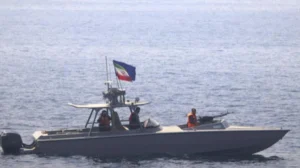
The specific threat mentioned by President Trump—the "fast attack craft"—refers to the IRGC Navy’s doctrine of "swarming" tactics. These small, highly maneuverable boats are often armed with anti-ship missiles, torpedoes, or mines. While they lack the durability of a U.S. destroyer, their strength lies in numbers and their ability to operate in the shallow, cluttered waters of the Strait of Hormuz.
Military analysts suggest that a U.S. blockade would involve a "layered defense" strategy. This would likely include the use of unmanned aerial vehicles (UAVs) for constant surveillance, backed by Aegis-equipped destroyers and littoral combat ships capable of engaging multiple small targets simultaneously. By threatening to "remove" these craft, President Trump is signaling that the U.S. will not wait for an overt act of aggression but may engage any Iranian military vessel that enters a predetermined exclusion zone around the blockade fleet.
The effectiveness of such a blockade depends on the U.S. Navy’s ability to distinguish between commercial traffic and disguised military threats. The IRGC has a history of using civilian-looking vessels for reconnaissance and minelaying, which increases the risk of a miscalculation that could lead to civilian casualties and further international condemnation.
Broader Implications and Strategic Uncertainty
The imposition of the blockade marks a definitive end to the "strategic patience" era of U.S. foreign policy toward Iran. By moving from targeted strikes to a total maritime siege, the Trump administration is signaling that it seeks a total capitulation of the Iranian government or a fundamental change in the country’s leadership structure.
However, the risks are substantial. A cornered Iranian leadership may feel it has little to lose by attempting a breakout maneuver, which could trigger a wider conflict involving other regional powers. There is also the "China factor" to consider. If the U.S. Navy attempts to stop a tanker bound for China, it could trigger a diplomatic or even military confrontation with Beijing, which has consistently called for the respect of Iranian sovereignty and the maintenance of open trade routes.
As of Monday evening, the world remains in a state of anxious anticipation. The 14:00 GMT deadline has passed, and while the blockade is technically in effect, the first test of President Trump’s "removal" policy has yet to occur. Whether this move will force Iran back to the negotiating table or ignite a larger fire in the world’s most volatile energy corridor remains the defining question of the 2026 conflict. The coming days will be critical as the U.S. Fifth Fleet takes up its positions and the remnants of the Iranian Navy decide whether to challenge the most powerful maritime force on the planet.