Socio Today
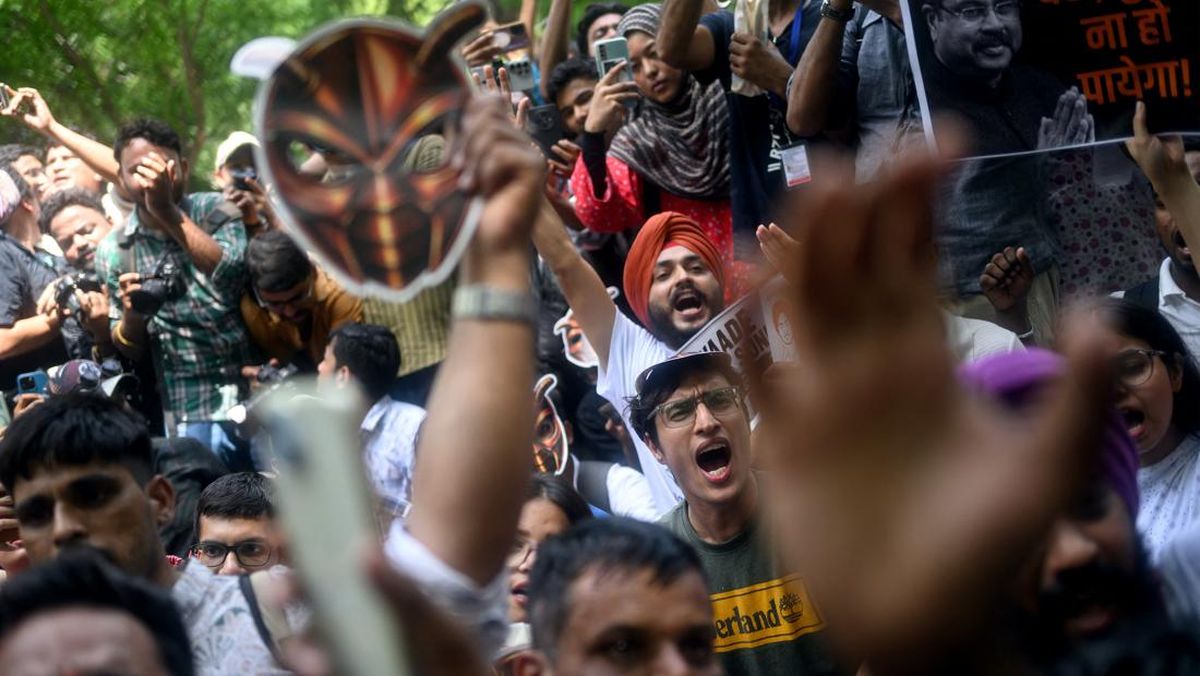
The streets of India’s capital, New Delhi, became the stage for a unique and highly symbolic demonstration as hundreds of young activists and students donned cockroach masks to voice their outrage over a series of high-profile examination leaks and the country’s worsening unemployment figures. This satirical movement, which has culminated in the formation of the "Cockroach Janata Party" (CJP), represents a direct and biting critique of the ruling Bharatiya Janata Party (BJP) led by Prime Minister Narendra Modi. The protesters are demanding the immediate resignation of Union Education Minister Dharmendra Pradhan, holding his ministry accountable for what they describe as a systemic failure in the national examination infrastructure that has jeopardized the futures of millions of students.
The choice of the cockroach as a symbol is deeply intentional. Organizers of the protest explained that the insect represents the resilience of the common youth who, despite being treated as "pests" or "insignificant" by the political elite, continue to survive and multiply in the face of systemic neglect. However, it also serves as a metaphor for the "decay" and "infestation" that the protesters claim has permeated the National Testing Agency (NTA) and the broader bureaucratic apparatus responsible for conducting competitive exams. By mimicking the name and branding of the BJP through the "Cockroach Janata Party," the youth have utilized satire to highlight the perceived disconnect between the government’s rhetoric of national progress and the reality of administrative incompetence.
The Catalyst: The NEET and UGC-NET Examination Scandals
The immediate trigger for this wave of unrest is a series of controversies surrounding the National Eligibility cum Entrance Test (NEET-UG) and the University Grants Commission-National Eligibility Test (UGC-NET). The NEET exam, which is the sole gateway for admission to undergraduate medical programs in India, saw nearly 2.4 million candidates participate this year. However, the results, announced in early June, sparked nationwide suspicion when an unprecedented 67 students achieved a perfect score of 720/720, with several of these top scorers reportedly originating from the same examination center.
Compounding the crisis was the revelation of "grace marks" being awarded to over 1,500 students due to time loss at certain centers, a move that critics argued lacked transparency and distorted the merit list. Shortly after the NEET controversy broke, the Ministry of Education was forced to cancel the UGC-NET exam—required for teaching positions in universities and for PhD fellowships—just one day after it was conducted, citing reports that the integrity of the exam had been compromised on the "dark web."
These incidents have created a sense of profound betrayal among the student community. For many in India, competitive exams are the only path to upward social mobility. Students often spend years in intensive coaching hubs like Kota, Rajasthan, living in cramped conditions and under immense psychological pressure, only to find that the papers they worked so hard for were leaked to those willing to pay exorbitant sums. The protesters in New Delhi argue that these leaks are not isolated incidents but indicative of a deeper "paper leak mafia" that operates with impunity.
Chronology of the New Delhi March and Police Escalation
The protests reached a fever pitch on Monday when thousands of students and members of the newly formed CJP attempted a "long march" toward the Parliament House. The demonstration began peacefully, with participants carrying placards and chanting slogans against the NTA and the Ministry of Education. However, as the crowd approached the heavy police cordons near central Delhi, the situation turned volatile.
Law enforcement agencies had prepared for the march by erecting multi-layered barricades and deploying water cannons. According to eyewitness accounts and statements from protest leaders, the police response was disproportionately aggressive. When the marchers attempted to bypass the barricades, security forces reportedly used batons (lathis) to disperse the crowd. The ensuing chaos resulted in a significant number of casualties among the protesters.
Abhijeet Dipke, the founder of the Cockroach Janata Party, issued a somber statement following the clash, expressing deep regret for the injuries sustained by his fellow activists. "I apologize to all our supporters, especially to the women who were brutally beaten by male police officers," Dipke stated on Monday. He lamented the inability of the leadership to shield the participants from what he described as the "inhumane actions" of the Delhi Police. Dipke further noted that at least one participant remained in critical condition due to head injuries sustained during the lathi charge.
Current reports indicate that approximately 180 individuals were injured during the crackdown, with 70 others taken into custody. The CJP has pledged to provide comprehensive legal assistance to those who were "arbitrarily arrested," asserting that the right to peaceful protest is being systematically dismantled by the state.
The Broader Socio-Economic Context: Unemployment and the Job Crisis
While the exam leaks provided the spark, the underlying fuel for the protest is the chronic issue of youth unemployment in India. The protesters have linked the failure of the examination system to the broader failure of the economy to generate sufficient high-quality jobs. Despite India’s status as one of the world’s fastest-growing major economies, the "demographic dividend"—the economic growth potential resulting from a large working-age population—is increasingly being viewed as a "demographic time bomb."
According to the Periodic Labour Force Survey (PLFS) and data from the Centre for Monitoring Indian Economy (CMIE), the unemployment rate among youth (aged 15-24) remains alarmingly high, often hovering between 20% and 45% depending on the educational qualification level. Graduate unemployment is particularly high, leading to a situation where thousands of overqualified candidates apply for low-level government positions, such as peons or sanitation workers.
"The exam leaks are the final straw," said Ashutosh Ranka, a spokesperson for the CJP. "First, they don’t create jobs. Then, when there are a few thousand seats available, they allow the papers to be leaked to the highest bidder. We are not just fighting for a re-exam; we are fighting for our right to a future." The protesters argue that the government’s focus on mega-infrastructure projects and corporate incentives has failed to address the immediate needs of the youth entering the workforce every year.
Government Response and Official Statements
In response to the growing backlash, Education Minister Dharmendra Pradhan has maintained that the government is committed to maintaining the integrity of the examination process. While initially denying that any widespread leaks had occurred in the NEET-UG exam, the ministry eventually acknowledged "irregularities" in certain regions and handed over the investigation to the Central Bureau of Investigation (CBI).
The government has also enacted the "Public Examinations (Prevention of Unfair Means) Act, 2024," which carries strict penalties, including up to 10 years in prison and fines of up to 10 million rupees for those involved in organized paper leaks. However, the protesters dismiss these measures as "too little, too late." They argue that a new law cannot fix a broken culture and that accountability must start at the very top—specifically with the resignation of the Minister and a complete overhaul of the NTA.
The Delhi Police have yet to issue a detailed official statement regarding the allegations of excessive force used during Monday’s march. Standard police narratives in such instances typically cite the need to maintain public order and prevent the breach of prohibited zones near sensitive government buildings. However, the images of injured students circulating on social media have already sparked a fresh wave of condemnation from opposition political parties and civil society groups.
Analysis of Implications and the Path Forward
The "cockroach" protests signify a shift in the nature of youth activism in India. By using satire and digital-first organizing strategies, the CJP has managed to capture national attention in a way that traditional student unions sometimes struggle to do. This movement also highlights the increasing political consciousness of a generation that feels ignored by the mainstream political discourse.
For the Modi administration, the optics of "beating students" are particularly damaging as the government attempts to project an image of a "Viksit Bharat" (Developed India). The controversy has also provided significant ammunition to the opposition, led by Rahul Gandhi and the INDIA bloc, who have used the exam leaks to question the government’s "meritocracy" and "governance" models.
The implications of these events extend beyond politics; they touch upon the credibility of the Indian education system on a global scale. As India seeks to position itself as a global hub for talent and innovation, the repeated failure to conduct secure and fair national examinations threatens to undermine the value of Indian qualifications.
As the situation develops, the CJP has indicated that it will not back down. "The Delhi Police must clearly explain how many people are still being detained," Ranka demanded, signaling that the focus of the movement is now expanding to include civil liberties and the right to dissent. With more protests planned across various state capitals, the "Cockroach Janata Party" may have started as a satirical jab, but it has evolved into a serious challenge for a government grappling with the aspirations and frustrations of its largest demographic.
The coming weeks will be crucial. If the CBI investigation fails to produce significant arrests or if the government continues to ignore the demand for ministerial accountability, the "infestation" of protests is likely to spread, further complicating the political landscape for the newly formed third-term government. For now, the cockroach masks remain on, a stark and eerie reminder of a youth population that refuses to be swept under the rug.