Socio Today
Indonesia has officially entered a transformative era in natural resource management, marking a definitive shift from its historical role as a mere exporter of raw commodities to becoming a strategic player in the global industrial supply chain. This paradigm shift, spearheaded by the state-owned mining holding company MIND ID, is centered on the principle of mineral security—the ability to harness domestic resources to fuel national industrial growth, foster economic sovereignty, and insulate the economy from the volatility of global commodity markets. Central to this strategy is the systematic integration of upstream extraction with downstream processing and refining, a move that is reshaping the nation’s economic landscape.
The copper sector serves as the primary engine for this transformation. As the global economy pivots toward massive electrification, decarbonization, and the integration of renewable energy systems, copper has transitioned from a standard industrial metal into a critical strategic asset. It is the indispensable material for electrical grids, high-tech electronic components, and the burgeoning electric vehicle (EV) sector. By securing majority control over PT Freeport Indonesia (PTFI) through MIND ID, the Indonesian government has moved to reclaim agency over its mineral wealth, ensuring that the fruits of these extractive activities are reinvested into the nation’s own industrial infrastructure.
The Evolution of Downstream Processing: Beyond Copper
The strategy of "hilirisasi" (downstream industrialization) pursued by Indonesia is not merely about increasing mining output; it is about capturing the full value chain of mineral products. A pivotal development in this journey is the establishment of the Precious Metal Refinery (PMR) in Gresik, East Java. While the primary smelter focuses on copper, the PMR addresses the untapped potential within the "anode slime"—a byproduct of the copper concentrate refining process that is rich in precious metals such as gold and silver.
The PMR facility represents a state-of-the-art advancement in domestic refining capabilities, boasting an annual production capacity of approximately 50 tons of gold and 200 tons of silver. By processing these byproducts domestically, PTFI effectively closes the loop on its production chain, ensuring that high-value minerals are refined within the country’s borders rather than being shipped as raw sludge to overseas facilities.
Chronology of Integration and Strategic Milestones
The integration of these mining assets into a cohesive value chain did not occur overnight. It is the culmination of years of regulatory shifts and corporate restructuring.
- 2018: The Indonesian government, through MIND ID (then known as Inalum), officially acquired a 51% majority stake in PT Freeport Indonesia, ending decades of foreign majority control over the massive Grasberg mining operation.
- 2023: Completion and commissioning of the large-scale copper smelter in Gresik, designed to increase domestic processing capacity significantly.
- 2024: Finalization of the Precious Metal Refinery (PMR) construction, marking the transition toward refined precious metal output.
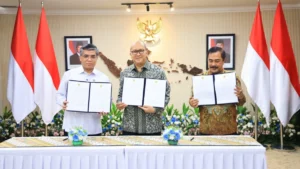
- February 2025: The first major delivery of 125 kilograms of 99.99% pure gold bullion from PTFI to PT Aneka Tambang Tbk (ANTAM), signaling the operational success of the integrated supply chain.
This recent transaction between PTFI and ANTAM is a milestone in the "Holding Company" synergy model. By linking the producer (PTFI) directly with the downstream refiner and marketer (ANTAM), MIND ID is reducing logistics costs, minimizing reliance on international intermediaries, and ensuring that the gold supply stays within the domestic financial system.
Data-Driven Economic Impact
The economic rationale behind this integration is supported by robust market data. According to the World Gold Council, Indonesia’s domestic demand for gold is substantial. In 2025, total demand for gold bullion and coins was recorded at 31.6 tons, while gold consumption for jewelry reached 16.6 tons. Combined, this creates a domestic market requirement of approximately 48.2 tons of gold annually.
With the PMR capable of producing 50 tons of gold per year, the domestic supply is now poised to meet nearly 100% of the national demand. This shift has profound implications for Indonesia’s balance of payments. By producing and refining gold locally, the nation reduces its dependence on imported gold to satisfy local jewelry and investment demand, thereby strengthening the Rupiah and reducing the outflow of foreign exchange. Furthermore, the agreement between PTFI and ANTAM—which includes a commitment to supply up to 30 tons of gold annually—provides a stable, predictable supply chain that shields domestic gold prices from excessive exposure to international market shocks.
Official Perspectives on Synergy
Selly Adriatika, Head of Institutional Relations at MIND ID, emphasizes that the success of this integration lies in the abandonment of the "silo mentality" that previously plagued state-owned enterprises.
"MIND ID does not view each asset or member company as an entity that stands alone," Adriatika stated. "We are integrating the resources and capabilities of all holding members so that they can mutually support one another. This allows us to develop mineral processing results into a robust part of the national industrial supply chain, ensuring that every stage of production adds value within our own borders."
She noted that the current strategy is not just about increasing tonnage of raw material but about optimizing the connectivity between extraction, processing, refining, and the final stages of industrial manufacturing. This, according to MIND ID, is the essence of a "sovereign mining industry"—one where the country’s natural wealth is managed to provide both immediate economic growth and a durable foundation for future generations.
Implications for the Global Mineral Market
The success of Indonesia’s downstream strategy has sent ripples through the global mineral market. As nations grapple with "mineral security," Indonesia is positioning itself as a critical supplier that controls its own destiny. By mandating domestic processing, Indonesia is essentially forcing global manufacturers to look at Indonesia not just as a quarry, but as a manufacturing hub.
However, the strategy is not without challenges. The environmental and energy demands of large-scale smelting and refining are significant. The shift toward higher value-added processes requires massive investments in energy infrastructure, particularly in transitioning these industrial hubs to renewable energy sources to meet the ESG (Environmental, Social, and Governance) standards demanded by global investors.
Furthermore, the expansion of the Grasberg mine’s production and the optimization of the Gresik smelter are essential components of the nation’s long-term economic plan. These facilities act as anchors for the local economy, creating thousands of high-skilled jobs and fostering the growth of secondary industries that utilize copper byproducts.
A Foundation for Future Sovereignty
As Indonesia looks toward the next decade, the integration of PTFI and ANTAM serves as a blueprint for other minerals. Whether in the nickel sector, which is already a pillar of the global battery supply chain, or in the exploration of rare earth elements, the government’s focus remains on keeping the value chain domestic.
The strategic integration of mining, refining, and manufacturing is a direct manifestation of Indonesia’s effort to move up the global value chain. By capturing the value from anode slimes, gold, and copper, the nation is effectively ensuring that its mineral resources are not merely exported for others to enjoy, but are used to build a sophisticated industrial base.
In conclusion, the partnership between PTFI and ANTAM represents more than just a business transaction; it is a policy success story that validates the state-led approach to resource nationalism. By ensuring that gold and copper circulate within the domestic economy, MIND ID is creating a buffer against global economic uncertainty while simultaneously building a legacy of industrial capability that will benefit the Indonesian economy for decades to come. The era of the raw material exporter is fading, replaced by an era of industrial integration that places Indonesia at the heart of the global energy and manufacturing transition.