Socio Today
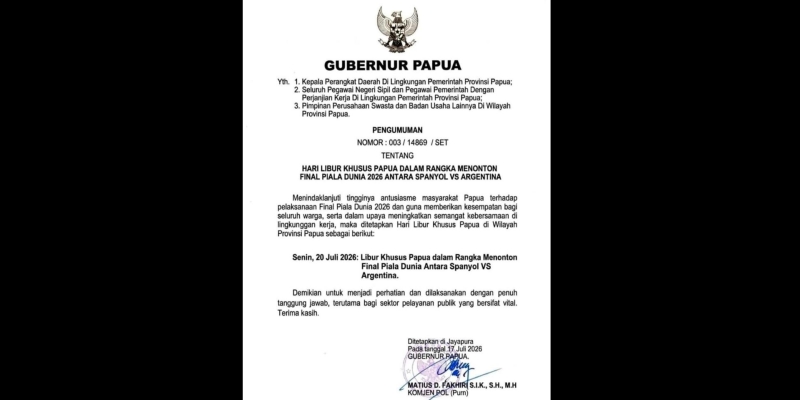
Jayapura, Papua – In an unprecedented move reflecting the profound cultural significance of football in the region, the Governor of Papua, Matius D. Fakhiri, has officially declared Monday, July 27, 2026, as a special public holiday. The decision aims to allow the entire community of Papua to collectively witness the highly anticipated final match of the FIFA World Cup 2026, featuring a clash between European football giants Spain and South American powerhouse Argentina. This declaration, outlined in Governor’s Announcement Number 003/14869/SET and issued from Jayapura on July 17, 2026, underscores the extraordinary level of public excitement surrounding the quadrennial global football spectacle.
Official Decree and Rationale
The official announcement explicitly states: "Monday, July 27, 2026: Special Holiday for Papua in the context of watching the World Cup Final between Spain Vs Argentina." This decree highlights the provincial government’s recognition of football as a powerful unifying force and a source of immense national and regional pride. Governor Fakhiri’s administration clarified that the decision was a direct response to the "tingginya antusiasme masyarakat Papua" (the high enthusiasm of the Papuan community) for the pinnacle event of the 2026 World Cup. The holiday is mandated for all regional government apparatus, including civil servants (ASN) and government employees with work agreements (PPPK). Furthermore, it serves as a strong recommendation ("imbauan") for leaders of private companies and other business entities operating within the Papua region to also observe the special holiday, thereby ensuring widespread participation in the communal viewing experience.
Governor Matius D. Fakhiri articulated that this unique moment is expected to strengthen the spirit of togetherness and solidarity, both within professional environments and across the broader community. However, the Governor also issued a crucial caveat, emphasizing the importance of maintaining responsibility for essential public services during the holiday period. The announcement concluded with a stern reminder: "Thus, for attention and to be implemented with full responsibility, especially for vital public service sectors. Thank you." This directive, signed by Governor Fakhiri, a retired police general with the last rank of Commissioner General, underscores the delicate balance between celebrating a cultural phenomenon and ensuring the continuity of critical government functions.
The FIFA World Cup 2026: A Global Spectacle
The 2026 FIFA World Cup is set to be a landmark event in the history of global football. Co-hosted by Canada, Mexico, and the United States, it marks the first time three nations will share hosting duties. More significantly, it will be the first World Cup to feature an expanded format, increasing the number of participating teams from 32 to 48. This expansion promises a broader geographical representation and an even more extensive schedule of matches, culminating in what is anticipated to be a fiercely contested final. The choice of Spain versus Argentina as the hypothetical final pairing in the Governor’s decree itself reflects a dream matchup for many football enthusiasts – a clash between European technical prowess and South American flair, embodying the very best of international football.
The expanded tournament structure, with 104 matches played across 16 host cities, is designed to generate unprecedented levels of engagement and viewership worldwide. For nations like Indonesia, where football transcends mere sport to become a significant cultural and social fabric, the World Cup is an event of immense collective importance. The final, regardless of the participating teams, invariably draws billions of viewers globally, making it one of the most-watched sporting events on the planet. For a region like Papua, where football passion runs exceptionally deep, the allure of the final match is particularly potent.
Football’s Pervasive Influence in Indonesia, Especially Papua
The decision by Governor Fakhiri is not merely an administrative decree; it is a profound acknowledgment of football’s unparalleled cultural and social significance in Indonesia, particularly within Papua. Football in Indonesia is more than a game; it is a national obsession, a unifying language spoken by millions across the archipelago. From the bustling urban centers to the remote villages, the sport captivates hearts and minds, providing a common ground for diverse communities.
In Papua, this passion reaches an even more fervent level. The region is renowned as a hotbed of football talent, consistently producing some of Indonesia’s most gifted players. Legends like Boaz Solossa, Eduard Ivakdalam, and many others who have graced the Indonesian national team (Timnas Indonesia) hail from Papua. Their natural athleticism, speed, and innate understanding of the game have made Papuan footballers iconic figures in the national sporting landscape. Local clubs in Papua, despite often facing significant logistical and financial challenges, command fiercely loyal fan bases, with matches drawing massive crowds and igniting passionate rivalries.
The popularity of football in Papua is deeply intertwined with its social fabric. It provides avenues for youth development, offering a path to national recognition and personal success. Beyond professional aspirations, football pitches in every village and town serve as vital community hubs, where people gather, connect, and share a collective identity. World Cup tournaments, in particular, transform these local hubs into global villages, as communities unite to support their favorite teams, irrespective of geographical distance or cultural background. The communal viewing of matches, especially the final, becomes a powerful ritual of shared experience, fostering bonds that extend beyond the pitch. This deep-seated cultural reverence for football provides the essential context for Governor Fakhiri’s decision, explaining why such a measure is deemed not just desirable, but necessary, to honor the community’s collective spirit.
Anticipation and Global Viewership Data
The anticipation for the FIFA World Cup Final is unparalleled. Historically, the final match consistently breaks viewership records. For instance, the 2018 FIFA World Cup Final between France and Croatia attracted an average live audience of 517 million viewers worldwide, with a total reach of 1.12 billion people tuning in for at least one minute of the final match. The 2022 World Cup Final between Argentina and France saw similar, if not higher, figures, with an estimated global reach exceeding 1.5 billion viewers. These statistics underscore the immense global appeal of the event and provide a quantitative basis for the "high enthusiasm" cited by Governor Fakhiri.
In Indonesia, viewership numbers for major football tournaments are consistently among the highest in Southeast Asia. During the 2022 World Cup, despite time differences, millions of Indonesians stayed up late or woke up early to catch the matches, with the final drawing immense attention across all demographics. For Papua, where football is practically a religion, it is safe to infer that the projected viewership for the 2026 final will be exceptionally high, likely encompassing a significant majority of the province’s population. The collective desire to witness history unfold, particularly if it involves beloved teams like Spain and Argentina, creates an atmosphere ripe for a communal celebration, making the public holiday a pragmatic response to a widespread societal demand.
Economic and Social Implications
The declaration of a special public holiday, while driven by cultural and social considerations, inevitably carries economic implications. On one hand, a public holiday typically results in a temporary decrease in economic productivity across various sectors, as offices, factories, and non-essential businesses close or operate at reduced capacity. This loss in direct output could be a point of concern for some economic analysts. However, the Governor’s explicit recommendation for private companies to follow suit suggests a broader acceptance of this temporary trade-off.
Conversely, public holidays often stimulate consumer spending in specific sectors. For instance, food and beverage establishments, sports merchandise retailers, and entertainment venues might experience a surge in business as people gather to watch the match and celebrate. The communal aspect of the holiday could lead to increased spending on shared meals, snacks, and World Cup-related paraphernalia. This shift in spending patterns could provide a localized economic boost, particularly for small and medium-sized enterprises catering to social gatherings.

Beyond economics, the social implications are overwhelmingly positive. The holiday offers a unique opportunity for community bonding and the strengthening of social cohesion. In a region as diverse as Papua, football often serves as a powerful equalizer, transcending ethnic, religious, and socio-economic differences. Gathering to watch a global event like the World Cup final can foster a sense of shared identity and collective pride, reinforcing community ties and creating lasting memories. Governor Fakhiri’s emphasis on "semangat kebersamaan" (spirit of togetherness) directly addresses this crucial social benefit.
Navigating Challenges: Essential Services and Public Responsibility
While the enthusiasm for the holiday is palpable, Governor Fakhiri’s reminder about maintaining essential public services highlights a critical administrative challenge. Sectors deemed "vital public services" — which typically include healthcare, emergency services, security, transportation, and certain utilities — cannot afford to cease operations. The provincial government will need to ensure that robust contingency plans are in place to guarantee the continuity of these critical functions. This often involves staggered shifts, skeleton crews, or special remuneration for employees working on holidays.
The Governor’s explicit mention of "pelayanan publik yang bersifat vital" (vital public service sectors) indicates a proactive approach to mitigating potential disruptions. It also places a responsibility on both public institutions and individual citizens to ensure that the celebration does not compromise safety, health, or essential infrastructure. This aspect of the decree reflects a mature governance approach, balancing the desire to celebrate with the imperative to maintain societal order and well-being. The public’s understanding and cooperation will be crucial in ensuring that the holiday proceeds smoothly without undue strain on critical services.
Broader Context and Precedent
Papua’s decision, while specific to its unique cultural context, is not entirely without precedent globally. Other nations and regions have occasionally declared special holidays for major sporting events, especially when their national teams are involved in finals or when a host nation hosts a significant event. For example, some countries have declared holidays for Olympic opening ceremonies or when their football teams reach World Cup finals. However, declaring a holiday for a final match where neither a national team nor the host nation is involved is somewhat less common and underscores the sheer depth of football passion in Papua.
This move by Governor Fakhiri could potentially set a precedent within Indonesia, prompting other provinces or even the national government to consider similar measures for future major global events. It also signals to the international community the profound cultural value placed on global sporting events in this part of the world. It serves as a testament to how globalized culture, particularly through sports, can influence local governance and societal practices.
In conclusion, Governor Matius D. Fakhiri’s declaration of a special public holiday in Papua for the 2026 FIFA World Cup Final is a powerful testament to the unifying and culturally significant role of football in the region. Rooted in an overwhelming wave of public enthusiasm, the decision aims to foster community spirit and allow collective celebration of a global spectacle. While posing minor economic and logistical considerations, the decree is carefully balanced with a strong emphasis on maintaining vital public services, reflecting a thoughtful approach to governance that prioritizes both societal well-being and cultural expression. As the world gears up for the 2026 World Cup, Papua stands ready to embrace the final match with unparalleled zeal, turning a global sporting event into a unique regional celebration.