Socio Today
The journey to uncover the historical footprint of the legendary Soka tile enterprise, famously known as the Aboe Ngamar company in Dukuh Soka, Pejagoan district, Kebumen regency, begins with a three-and-a-half-hour drive from Yogyakarta. Traversing the scenic southern coast of Java via Daendels Road, flanked by expansive rice fields and rural plantations, travelers arrive at the historical crossroads of Jalan Ronggowarsito and Jalan Soka Petanahan. This route serves as a modern-day gateway into a forgotten industrial landscape that once supplied high-grade terracotta building materials to global markets during the Dutch colonial era.
Historical Foundations and Regional Evolution
Archival research and historical documents, including the Regeering Almanak 1884 shared by local historian Sigit Asmodiwongso, reveal that Soka—historically spelled Sokka—was once an administrative sub-district (kawedanan) within the Pejagoan district of Karanganyar regency, under the residency of Kedu. Situated approximately 13 kilometers west of central Kebumen, this region underwent profound administrative and economic transformations over the late 19th and early 20th centuries.
According to colonial records such as Aanvragen voor de oprichting van de Suikerfabriek op Java, a significant land concession was proposed on March 10, 1908. Following approval from the Resident of Kedu, J.C.L.J. van Deun secured rights to establish a 600-bahu sugar plantation in the Soka kawedanan. Historians deduce that this permit actually authorized the lease, clearing, and management of Soka lands for sugarcane cultivation to supply the Kebumen Sugar Factory, located near the Kebumen railway station on Jalan Pemuda.
While the ambitious sugarcane enterprise faced limitations regarding local infrastructure, the region’s transportation network thrived. The establishment of the Soka Halte—later upgraded to a transit station—became a critical catalyst for the unprecedented success of the Soka tile industry. By 1935, regional administrative restructuring dissolved the Karanganyar regency status, transforming it into a standard sub-district under Kebumen regency. Simultaneously, the Soka kawedanan was reclassified as Dukuh Soka within Kedawung village. Despite these administrative shifts, indigenous and local enterprises, most notably the Aboe Ngamar tile works, demonstrated remarkable resilience and continued operations well past the colonial era.
The Rise of Soka’s Industrial Peak
The zenith of Soka’s ceramic industry arrived around 1917, propelled largely by the explosive growth of the Aboe Ngamar tile company. At its peak, the enterprise achieved a staggering production output of 500,000 roof tiles and one million bricks per week. This industrial-scale production relied heavily on the rich alluvial clay deposits found in the surrounding paddy fields of Soka—the exact quality of soil that had earlier attracted sugar plantation developers.

International trade networks soon recognized the superior quality of Soka’s terracotta output. An advertisement in the September 5, 1918, edition of Het Nieuws van den Dag voor Nederlandsch-Indië, titled Vereenigde Steenfabrieken Keboemen Soka S.S.W.L., highlighted L.Th. Haasman as the official agency in Kebon Sirih, Batavia, distributing Soka tiles and bricks under the supervision of the director of the Ambachtschool Keboemen (Kebumen Technical School). The technical school operated under the stringent motto, "werkt niet langer met dure en slechte bouwmaterialen"—advocating against the use of cheap and inferior construction supplies.
By September 4, 1920, the colonial government formalized its industrial reach through the establishment of the Vereenigde Indische Tilewerken (United Indies Tile Works Company), as documented in Algemeen Handelsblad. Headed by an industrialist named Schoon, the conglomerate sought to centralize and expand tile manufacturing across Soka, Kebumen, and Moeara Ogan in Palembang.
Strategic expansion plans included constructing specialized manufacturing plants near the Surabaya-Gundik railway line and Rangkasbitung. The unified Soka operation alone was targeted to produce two million tiles and one million bricks monthly, destined for export markets as far-flung as Australia, British India, and the United Kingdom. Architectural firms across these nations routinely signed long-term supply contracts to secure authentic Soka terracotta for major public and residential infrastructure projects.

This export boom generated substantial economic dividends. Beyond enriching factory owners and institutional shareholders, colonial-era records explicitly noted—using the phrase "bij dat bedrijf zijn ook vele inlanders, als deelende in winst, betroken"—that indigenous workers and local stakeholders directly shared in the corporate profits under formal partnership agreements.
Hadji Aboe Ngamar: The Indigenous Industrialist
The driving force behind Soka’s domestic and international prominence was Hadji Aboe Ngamar, affectionately known to local residents as Kaji Abu. According to profiles published in the Bataviasche Nieuwsblad on October 17, 1920, Kaji Abu inherited the family enterprise from his father, who had founded a modest home-scale tile workshop on the family compound approximately three decades prior.
To accommodate surging demand and streamline logistics, Kaji Abu relocated the manufacturing plant directly behind the Soka railway station. This strategic placement optimized production oversight and accelerated shipping times. Under his leadership, the company underwent an "enorme uitbreiding"—a massive expansion that penetrated markets across the outer islands of the Dutch East Indies, including Deli and Maluku, as well as international destinations like Japan.

The enterprise’s primary domestic clients included the network of sugar factories spanning the Kedu Residency, which frequently acted as financial backers, alongside major railway conglomerates such as Staatsspoorwegen (SS) and Nederlandsch-Indische Spoorweg Maatschappij (NISM). The Soka railway station served as the literal economic lifeline of the operation. Daily logistics operations involved dispatching up to 200 dedicated freight cars loaded with tiles and bricks, which were transported northward to the Port of Semarang for global export.
Under specific contractual agreements, the enterprise offered competitive shipping incentives, including franco wagon Soka—free delivery of goods directly to railway freight cars. This seamless integration with the Staatsspoorwegen network reinforced the company’s business ethos of speed, safety, and cost-efficiency.
Economic Implications and Contemporary Legacy
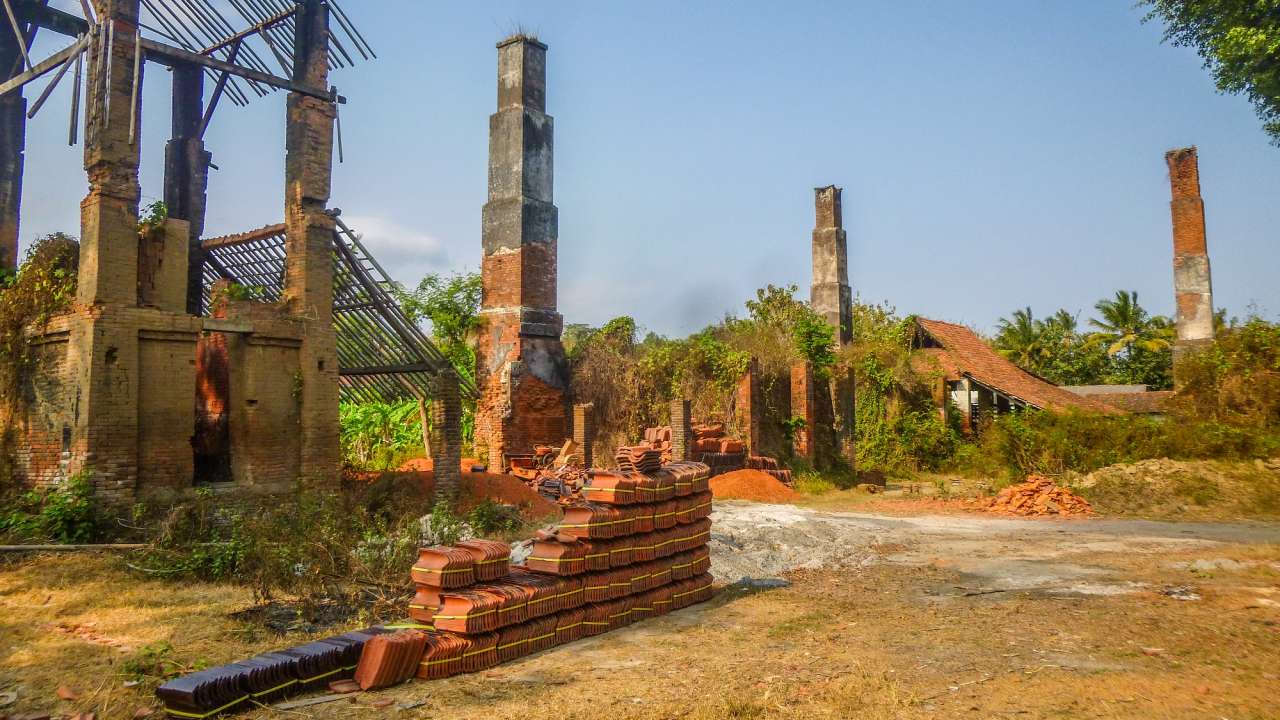
The eventual decline of the Soka tile empire was not precipitated by a single catastrophic event, but rather by the gradual erosion of the local skilled workforce as veteran artisans aged, compounded by the rise of modern competitors within the regional construction market. Although the Aboe Ngamar factory eventually reduced its operations to a small-scale output, the physical remnants of its historic infrastructure still punctuate the landscape of Dukuh Soka.

Today, fields of wild grass and overgrowth envelop the crumbling masonry of the massive brick kilns and the foundations of towering industrial chimneys. Despite the silence that has replaced the roar of 19th-century furnaces, these ruins stand as a testament to a pioneering era of Javanese industrialization. The legacy of Hadji Aboe Ngamar and the Soka tile works remains a vital historical milestone, illustrating how a rural indigenous enterprise successfully integrated local natural resources into global maritime trade routes and international architecture.