Socio Today
In a significant escalation of maritime hostilities, President Donald Trump has issued a direct command to the United States Navy to utilize lethal force against any Iranian naval assets caught deploying mines within the strategically vital Strait of Hormuz. The directive, announced on Friday, April 24, 2026, marks a hardening of the American military posture in the Middle East following months of friction that have disrupted global energy markets and brought the region to the brink of a broader conflict.
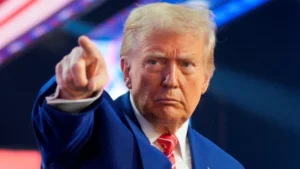
President Trump articulated this new policy through his Truth Social platform, making it clear that the United States would no longer tolerate what he characterized as Iranian "sabotage" in international shipping lanes. The President stated that the U.S. Navy has been authorized to "shoot and kill" any Iranian vessel, regardless of its size, if it is observed planting mines in the waterway. He further asserted that many of Iran’s smaller naval crafts are already "at the bottom of the sea" and emphasized that there should be no doubt regarding the resolve of the U.S. military.
Beyond the authorization of lethal force, the White House has also mandated a massive expansion of minesweeping operations. President Trump indicated that U.S. naval assets are currently active in clearing the strait of existing explosives, and he has ordered these efforts to be increased threefold. This surge in naval activity is designed to ensure that the primary artery for global oil and gas remains navigable, despite Tehran’s attempts to restrict access.
The Strategic Significance of the Strait of Hormuz
The Strait of Hormuz is widely considered the world’s most important oil transit chokepoint. Located between Oman and Iran, it connects the Persian Gulf with the Gulf of Oman and the Arabian Sea. In the years preceding the current conflict, approximately 20 percent of the world’s total petroleum liquids consumption—nearly 21 million barrels per day—passed through this narrow passage. Furthermore, it is the primary route for the liquefied natural gas (LNG) exported by Qatar, one of the world’s largest LNG producers.
The geography of the strait makes it uniquely vulnerable. At its narrowest point, the shipping lanes are only two miles wide in either direction, separated by a two-mile buffer zone. This narrowness allows even a small number of naval mines to effectively paralyze global trade. The deployment of mines is a classic "asymmetric warfare" tactic used by smaller navies to counter the technological superiority of larger fleets like that of the United States. By threatening to sink commercial tankers, Iran can exert immense pressure on the global economy and Western political stability.
Chronology of the Escalation: From Ceasefire to Sea Siege
The current crisis did not emerge in a vacuum but is the result of a multi-stage escalation involving regional powers and international alliances. To understand the gravity of the April 24 announcement, it is necessary to examine the events of the past several months:
- The Outbreak of Hostilities: Following a series of regional skirmishes involving Israel and various paramilitary groups, the United States increased its military footprint in the Persian Gulf. Iran responded by threatening to close the Strait of Hormuz, claiming it as sovereign territory under its control.
- The Initial Blockade: Iran officially moved to restrict passage through the strait earlier this year, citing the "hostile presence" of U.S. and Israeli naval forces. This move immediately triggered a spike in global energy prices and prompted a military response from the U.S. Central Command (CENTCOM).
- The Two-Week Ceasefire: Last month, a fragile two-week ceasefire was brokered. This agreement followed the inclusion of Lebanon in a broader diplomatic framework. During this period, Tehran briefly reopened the strait to commercial traffic.
- The U.S. Sea Siege: Despite the reopening of the strait, President Trump announced a "sea siege" or maritime blockade targeting Iranian ports. Washington maintained that while the strait might be open, Iranian petroleum exports would remain sanctioned and physically blocked to prevent the funding of regional proxies.
- The Breakdown of Negotiations: Iran has set the total lifting of the maritime blockade as a non-negotiable prerequisite for continuing diplomatic talks. While the U.S. extended the ceasefire that was due to expire on Wednesday, it simultaneously reinforced the blockade, leading to the current standoff.
Economic Repercussions: The Global Energy Crisis
The impact of the instability in the Strait of Hormuz has been felt most acutely at the gas pump. In the United States, the average price of gasoline has surged past $4 per gallon, a sharp increase from the $3 per gallon average recorded before the onset of the maritime conflict. This 33 percent increase in fuel costs has become a major political liability for the administration, fueling inflation and complicating domestic economic policy.
Global markets have reacted with extreme volatility. Brent Crude and West Texas Intermediate (WTI) prices have both seen double-digit percentage increases as traders price in the "risk premium" of a potential total closure of the strait. Analysts warn that if the conflict transitions from a blockade to an active combat zone involving the destruction of tankers, oil prices could easily surpass $150 per barrel, potentially triggering a global recession.
The shipping industry has also been hit by skyrocketing insurance premiums. War-risk insurance for tankers navigating the Persian Gulf has reached historic highs, forcing some shipping companies to reroute their vessels around the Cape of Good Hope. This detour adds thousands of miles and significant costs to the transport of energy and goods between the Middle East and Europe.
Iran’s Response and Defensive Posture
Teheran has remained defiant in the face of the "shoot and kill" order. The Iranian Ministry of Foreign Affairs and high-ranking officials within the Islamic Revolutionary Guard Corps (IRGC) have repeatedly stated that they possess the sovereign right to defend their territorial waters. Iran views the presence of the U.S. Navy in the Persian Gulf as an illegal foreign intrusion.
"We will not hesitate to defend our security and our maritime interests," an Iranian military spokesperson stated in response to the latest threats from Washington. "Any act of aggression against our vessels or our territory will be met with a decisive and overwhelming response."
Iran’s strategy relies heavily on its "mosquito fleet"—hundreds of small, fast-attack boats equipped with missiles and mine-laying capabilities. These vessels are difficult to track and can swarm larger destroyers. Additionally, Iran possesses a significant arsenal of land-based anti-ship missiles stationed along its rugged coastline, which overlooks the narrowest parts of the strait.
Pentagon Operations and the Enforcement of the Blockade
While the President’s rhetoric has been focused on offensive action, the Pentagon is actively engaged in the logistical realities of the blockade. On Thursday, April 23, the Department of Defense confirmed that U.S. naval forces conducted an "interdiction and inspection" of a tanker suspected of carrying Iranian crude oil in the Indian Ocean.
This operation illustrates the reach of the U.S. military beyond the immediate confines of the Persian Gulf. By intercepting tankers in the open ocean, the U.S. aims to choke off Iran’s economic lifelines before they can reach international markets. The Pentagon has stated that these inspections are conducted in accordance with international law to enforce standing sanctions, though Tehran has labeled them as "acts of piracy."
The tripling of minesweeping efforts, as ordered by the President, will involve the deployment of additional Avenger-class mine countermeasures ships and MH-53E Sea Dragon helicopters. These assets use sophisticated sonar and mechanical "sweeps" to locate and neutralize underwater explosives. The process is slow and dangerous, requiring the Navy to operate in close proximity to the Iranian coast, further increasing the risk of an accidental or intentional skirmish.
Geopolitical Analysis: The Risks of Direct Engagement
The shift from "maximum pressure" to "direct engagement" represents a gamble for the Trump administration. The primary objective is to restore deterrence; by threatening to sink any boat involved in mining, the U.S. hopes to discourage Iran from using its most effective asymmetric weapon. However, military analysts warn of several potential pitfalls:
- Miscalculation: In the high-tension environment of the Strait of Hormuz, a misunderstood maneuver by a small Iranian boat could lead to a lethal response from a U.S. destroyer, triggering a chain reaction that neither side can easily de-escalate.
- The Proxy Factor: If Iran feels backed into a corner in the Gulf, it may activate its network of proxies in Iraq, Syria, and Yemen to strike U.S. interests elsewhere, broadening the theater of war.
- International Isolation: While many nations rely on the strait for energy, there is significant international concern regarding the unilateral use of force. Traditional allies in Europe and Asia may find it difficult to support a policy that risks a total shutdown of the world’s energy supply.
As of late April 2026, the situation remains a stalemate of high-stakes brinkmanship. The U.S. Navy is now operating under rules of engagement that prioritize the immediate destruction of perceived threats, while Iran maintains its right to use every tool at its disposal to break the American blockade. With gas prices climbing and the threat of naval combat looming, the coming weeks will determine whether the Strait of Hormuz remains a functional trade route or becomes the graveyard of modern international diplomacy.