Donald Trump Announces China Agreement to Halt Arms Supplies to Iran Amid Diplomatic Push for Permanent Reopening of the Strait of Hormuz

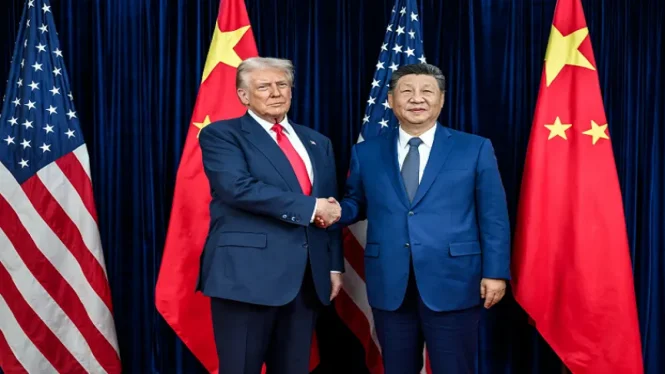
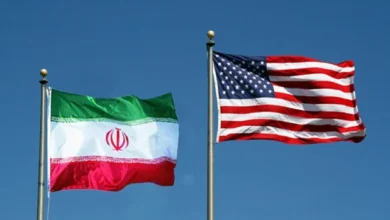
In a series of statements that have sent ripples through global diplomatic circles, United States President Donald Trump announced on Wednesday, April 15, 2026, that the People’s Republic of China has formally agreed to cease the supply of weaponry to the Islamic Republic of Iran. The announcement, delivered via the President’s Truth Social platform, highlights a significant shift in the geopolitical landscape of the Middle East and a potential thaw in the complex bilateral relations between Washington and Beijing. President Trump further emphasized his administration’s commitment to ensuring the permanent reopening of the Strait of Hormuz, a critical maritime artery for global energy supplies, asserting that this initiative has received the personal endorsement of Chinese President Xi Jinping.
The timing of these revelations is particularly significant, coming just weeks before President Trump is scheduled to embark on a high-stakes diplomatic mission to Beijing from May 14 to 15, 2026. This trip will mark his first official visit to China since the commencement of his second term in office, signaling a renewed focus on direct, personal diplomacy to resolve long-standing international security concerns. According to the President, the agreement with China is not merely a bilateral victory but a boon for global stability, framing the move as an act of international stewardship that benefits all major economic powers.
The Strait of Hormuz and Global Energy Security
The Strait of Hormuz, a narrow waterway between the Gulf of Oman and the Persian Gulf, serves as the world’s most important oil transit chokepoint. Approximately one-fifth of the world’s total oil consumption passes through this strait daily, making its stability a cornerstone of the global economy. President Trump’s declaration of a commitment to "permanently" reopen the waterway follows a period of intense volatility in the region.
"China is very happy because I will be opening the Strait of Hormuz permanently," President Trump stated in his social media post, as reported by various international news outlets including the Anadolu Agency. "I am doing this for them as well, and for the world. A situation like this will not happen again."
The reference to "a situation like this" points toward the recent naval blockade initiated by the United States. Following the collapse of high-level diplomatic talks between U.S. and Iranian officials in Islamabad, Pakistan, the Trump administration moved swiftly to impose a maritime blockade. The blockade, which officially went into effect on Monday, April 13, at 14:00 GMT, was intended to exert maximum pressure on Tehran after negotiations aimed at ending regional conflicts reached a definitive stalemate. By securing China’s cooperation, the U.S. appears to be leveraging its naval dominance and trade influence to dictate the terms of maritime passage in the region.
The Beijing-Washington Consensus on Iranian Armaments
Perhaps the most striking aspect of the President’s announcement is the claim that China—traditionally a strategic partner of Iran—has agreed to halt its military exports to the country. For years, Western intelligence agencies have monitored the flow of Chinese technology, dual-use components, and advanced weaponry into Iranian hands, which has often been used to bolster regional proxy groups.

President Trump characterized the agreement as a result of "smart and very good" cooperation between the two superpowers. In his characteristically informal tone, he suggested that the upcoming summit in Beijing would be marked by a high degree of personal rapport between himself and President Xi Jinping. "President Xi Jinping will welcome me with a warm hug when I come in the next few weeks," Trump wrote, suggesting that the transactional nature of his foreign policy has found a receptive audience in the Chinese leadership.
However, the President tempered his optimistic rhetoric with a reminder of American military capabilities. "We are working together smartly and very well. Isn’t that better than fighting? But remember, we are also very ready if we have to fight—even more ready than anyone else," he added. This dual-track approach—combining personal diplomacy with the threat of overwhelming force—has become a hallmark of the Trump administration’s second-term foreign policy.
Timeline of Escalation: From Islamabad to the Blockade
The current crisis began to accelerate in early April 2026, when representatives from the United States and Iran met in Islamabad for what was described as a "last-chance" summit to prevent a wider regional war. The talks, mediated in part by Pakistani and regional intermediaries, were aimed at addressing Iran’s nuclear enrichment program, its support for militant groups across the Levant, and the easing of U.S.-led economic sanctions.
By Sunday, April 12, it became clear that the talks had failed to produce a breakthrough. Disagreements over the sequencing of sanctions relief and the scope of international inspections led to a breakdown in communication. In response, President Trump announced the naval blockade of the Strait of Hormuz less than 24 hours later. The blockade was designed to halt the export of Iranian crude oil entirely, effectively cutting off the primary source of revenue for the Iranian government.
The subsequent announcement of China’s agreement to halt arms shipments suggests that Beijing may have calculated that its interest in stable energy prices and uninterrupted trade outweighs its strategic partnership with Tehran. As the world’s largest importer of crude oil, China is uniquely vulnerable to spikes in energy costs caused by Middle Eastern instability.
Broader Economic Implications and the IMF Outlook
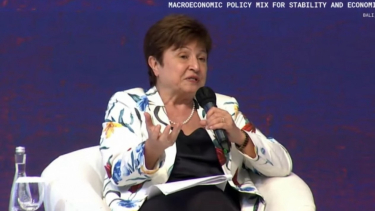
The geopolitical maneuvers in the Middle East are occurring against a backdrop of shifting global economic forecasts. Interestingly, the International Monetary Fund (IMF) recently adjusted its growth projections for the Russian Federation, a development that complicates the global diplomatic puzzle. Despite ongoing international tensions, the IMF raised Russia’s growth outlook, citing the resilience of commodity prices—particularly oil and gas—as a primary driver.
The rise in commodity prices is directly linked to the instability in the Middle East. As the U.S. maintains its blockade and regional tensions remain high, the global supply of oil remains constrained, keeping prices elevated. This has inadvertently benefited other major energy exporters like Russia. For the Trump administration, the challenge lies in balancing the "Maximum Pressure" campaign against Iran with the need to stabilize global energy markets to prevent a domestic and international economic downturn.
Diplomatic Reactions and Strategic Analysis
While the White House remains confident in its narrative, international observers and diplomatic experts are analyzing the potential long-term consequences of this U.S.-China alignment. If China indeed halts arms sales to Iran, it would represent a significant isolation of the Islamic Republic, leaving it with few major global allies beyond perhaps Moscow.
Political analysts suggest that China’s cooperation may come at a price. In exchange for abandoning Tehran and supporting the reopening of the Strait of Hormuz, Beijing likely expects concessions from Washington regarding trade tariffs, technology transfers, or the U.S. military posture in the Indo-Pacific region.
"This is classic Trumpian diplomacy—transactional, personality-driven, and focused on immediate, high-impact results," says Marcus Thorne, a senior fellow at the Center for Global Strategic Studies. "By bringing China into the fold on the Iran issue, Trump is effectively attempting to dismantle the ‘Axis of Resistance’ from the outside in. However, the question remains whether this is a permanent strategic shift by China or a temporary tactical move to avoid a direct confrontation with the U.S. Navy in the Gulf."
Conclusion: The Road to Beijing
As the world looks toward the May 14-15 summit in Beijing, the stakes could not be higher. The permanent reopening of the Strait of Hormuz would provide a much-needed reprieve for global shipping and energy markets, which have been on edge since the blockade began. However, the enforcement of such an agreement will require unprecedented coordination between the U.S. and Chinese navies, two forces that are more often viewed as rivals than partners.
For President Trump, the upcoming visit to China represents an opportunity to solidify what he views as his greatest diplomatic achievement to date. For President Xi Jinping, the meeting offers a chance to secure China’s energy future and position Beijing as a "responsible stakeholder" in global security matters, even if it means distancing the country from a long-term ally in Tehran.
As of Wednesday evening, Tehran has not officially responded to the claims of a U.S.-China deal. However, the silence from the Iranian Foreign Ministry suggests a government grappling with a rapidly changing and increasingly hostile international environment. With the Strait of Hormuz at the center of the world’s attention, the coming weeks will determine whether the "warm hug" in Beijing leads to a lasting peace or merely a brief pause in a deepening global conflict.