The political landscape was rocked this week by an unprecedented public spat between United States President Donald Trump and Pope Leo XIV, escalating over three tumultuous days on social media and triggering concerns about diplomatic relations between Washington and the Vatican. The controversy, unfolding largely on Trump’s Truth Social platform, saw the former president launch a series of scathing criticisms against the Pontiff, accusing him of weakness on critical global issues and aligning with political adversaries.
A Brewing Diplomatic Storm: Initial Tensions Emerge
The seeds of this high-profile disagreement were sown earlier in the week when reports surfaced of a diplomatic confrontation involving the Vatican’s highest-ranking diplomat. Cardinal Christophe Pierre, the Apostolic Nuncio to the United States, reportedly faced a stern rebuke from Pentagon officials regarding comments made by Pope Leo XIV. These papal statements were perceived by elements within the U.S. government as direct criticisms of the Trump administration’s policies, particularly in the realm of foreign affairs and military strategy.
While the Vatican confirmed that Cardinal Pierre had indeed met with Eldridge Colby, the U.S. Under Secretary of Defense for Policy, they quickly moved to downplay the significance of the encounter. A statement from the Holy See insisted that the meeting was "part of the routine mission of the Papal Representative and provided an opportunity to exchange views on matters of mutual benefit," seeking to frame it as a standard diplomatic engagement rather than a confrontation.
Despite these assurances, the narrative of a burgeoning U.S.-Vatican rift began to solidify, fueled by anonymous leaks and media speculation. The situation gained further traction with a report from Mirror on Wednesday, April 15, 2026, which underscored the growing perception of discord between the two influential entities. This backdrop set the stage for Pope Leo XIV’s subsequent public remarks, which would ignite the full fury of President Trump.
Pope Leo XIV’s Call for Peace: A Catalyst for Controversy
On Saturday evening, Pope Leo XIV delivered a powerful message during the Vatican’s vespers service, addressing the ongoing "Iran War" – a term used broadly to describe a hypothetical conflict or escalating tensions involving Iran that has drawn global attention. His comments were a direct and unequivocal condemnation of militarism and the pursuit of power, echoing traditional papal calls for peace and diplomacy.
"The Iran War has been fueled by a delusion of omnipotence that surrounds humanity, becoming increasingly unpredictable and aggressive," the Pontiff declared, his words resonating across the globe. He issued a fervent plea to world leaders, urging them to step back from the brink of further conflict: "To them we cry out: stop! It is time for peace! Sit at the table of dialogue and mediation – not at the table where rearmament is planned and deadly actions are decided."
The Pope did not shy away from critiquing the underlying motivations for conflict, stating, "Enough of self-worship and money! Enough of the ostentation of power! Enough of war! True strength is shown in serving life." These statements, delivered with moral authority, were widely interpreted as a rebuke to any nation or leader prioritizing military might and unilateral action over peaceful resolution, inadvertently placing them in direct opposition to President Trump’s known foreign policy doctrines.
The Axelrod Meeting: A Political Spark
The tension escalated further with subsequent reports that Pope Leo XIV had arranged a meeting with David Axelrod, a prominent political strategist known for his instrumental role in the Obama administration. For President Trump, who frequently frames his political opponents as "losers" and "radicals," the perceived association of the Pontiff with a key figure from a rival administration appeared to be the final straw. This meeting, whether symbolic or substantive, seemed to confirm Trump’s suspicions of the Pope’s political leanings and ignited his direct public counterattack.
Trump’s Truth Social Onslaught: "Weak on Crime and Foreign Policy"
On Sunday evening, President Trump unleashed a lengthy and vitriolic tirade against Pope Leo XIV on his Truth Social platform. In a series of posts, he accused the Pontiff of being "weak on crime and foreign policy," laying bare his frustrations with the Vatican leader’s stance on various issues.
Trump’s initial salvo focused on what he perceived as the Pope’s hypocrisy regarding "fear." "He talks about the ‘fear’ felt towards the Trump Administration, but fails to mention the FEAR that the Catholic Church and all other Christian Organizations experienced during COVID when they arrested priests, pastors, and everyone else for holding church services, even when outdoors and keeping ten, even twenty feet apart," Trump wrote, attempting to reframe the narrative around religious freedom during the pandemic and casting himself as a protector of faith. This statement, while lacking specific evidence of widespread arrests of clergy in the US for outdoor services, resonated with a segment of his base who felt religious institutions were unfairly targeted during lockdowns.
The former president then ventured into unprecedented territory by expressing a preference for a fictional relative of the Pope. "I much prefer Pope Leo’s brother, Louis Prevost, a staunch MAGA (Make America Great Again) supporter from Florida," Trump declared, adding, "He understands, and Leo does not!" This bizarre intervention into papal succession, even if fictional, underscored Trump’s willingness to challenge established norms and inject partisan politics into religious affairs.
Trump continued his assault by directly criticizing the Pope’s views on international relations. "I don’t want a Pope who thinks it’s okay for Iran to have Nuclear Weapons. I don’t want a Pope who thinks it’s terrible that America attacked Venezuela, a country that sends enormous amounts of drugs into the United States and, even worse, emptied their prisons, including murderers, drug dealers, and criminals, into our country," he asserted. These comments directly contradicted the Vatican’s long-standing advocacy for nuclear non-proliferation and diplomatic solutions over military intervention, and implicitly endorsed a more aggressive U.S. foreign policy stance.
He further lambasted Pope Leo for daring to criticize an American President for "doing exactly what got him elected." Trump then pivoted to self-praise, citing his "landslide victory," "setting the lowest crime rates in history," and "creating the greatest stock market in history" – claims that are often disputed or require significant context. He suggested that the Pontiff should be "grateful" for his election, implying a direct correlation between his own political ascendancy and the Pope’s position, a highly unusual and presumptuous claim regarding the Holy See.
The President’s diatribe concluded with a reiteration of his disapproval: "Pope Leo’s ‘weak on crime and weak on nuclear weapons’ stance does not sit well with me. Nor does the fact that he met with Obama sympathizers like David Axelrod, a left-wing LOSER, who was one of the people who wanted churchgoers and clergy arrested. Leo needs to fix his behavior as Pope, use common sense, stop pandering to the radical left, and focus on being a great Pope, not a politician. It is severely hurting him and, more importantly, hurting the Catholic Church!" This aggressive ultimatum reflected Trump’s characteristic blend of personal attack and political demand, directly challenging the Pope’s spiritual authority with a partisan lens.
The AI Image Controversy: A Visual Provocation
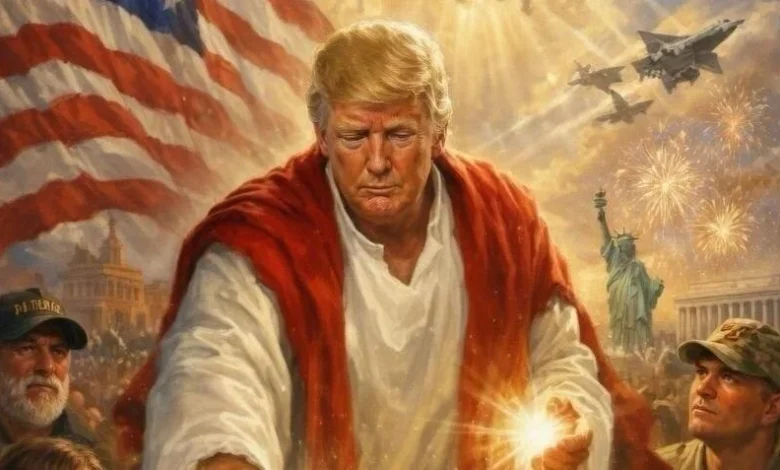
Adding another layer of controversy to the unfolding drama, President Trump subsequently posted an AI-generated image on Truth Social. The image depicted him in a Christ-like pose, radiating divine light from his hands as he appeared to "heal" a sick man in a bed, while a demonic figure lurked ominously in the background. The visual, quickly dubbed "Trump as Jesus" by observers, sparked immediate outrage and widespread condemnation, with many decrying it as blasphemous and sacrilegious.
Facing intense backlash, Trump swiftly deleted the controversial post. When questioned by reporters about the image, he offered a seemingly evasive explanation, stating, "That image was supposed to be me as a doctor making people better." His Vice President, JD Vance, attempted to frame the incident as a misunderstanding of humor. "Of course, he deleted it because he realized many people didn’t understand his humor," Vance explained, though the seriousness of the imagery left many unconvinced. The episode highlighted the increasing use of AI in political messaging and the fine line between satire and offense, particularly when religious iconography is involved.
Pope Leo XIV’s Resolute Response: No Fear, No Politics
Amidst the swirling controversy, Pope Leo XIV maintained a posture of quiet defiance and unwavering commitment to his spiritual mandate. Speaking to journalists aboard the papal plane during a visit to Africa, the Pontiff directly addressed Trump’s attacks, refusing to be drawn into a political tit-for-tat.
"I am not a politician, and I do not wish to engage in a debate with him," Pope Leo stated firmly. He emphasized that his role transcends partisan politics. "I do not think the Gospel message should be misused as some people are doing. I continue to speak out strongly against war, striving to promote peace, dialogue, and multilateralism among nations to find solutions to problems."
The Pope reiterated the moral urgency of his message, particularly in light of global suffering. "Too many people are suffering right now, too many innocent lives are being lost, and I believe someone must stand up and voice for something better," he asserted. He made it clear that his message was universal, not directed solely at one leader. "I say this to all world leaders, not just to him (Trump): let us end wars and promote peace and reconciliation."
Crucially, Pope Leo XIV directly addressed the implied threat from the Trump administration. "I am not afraid of the Trump administration or of speaking loudly about the Gospel message, which I believe is my duty here, the Church’s duty here," he declared, signaling his resolve to continue advocating for peace and justice without succumbing to political pressure. His remarks underscored the Vatican’s traditional independence from secular political powers and its commitment to its moral teachings.
Broader Implications and Analysis: A Clash of Ideologies and Authorities
The public confrontation between President Trump and Pope Leo XIV carries significant implications, reverberating across diplomatic, political, and religious spheres.
Diplomatic Strain: The direct, personalized attacks from a sitting or former U.S. President on a sitting Pontiff represent an extraordinary breach of diplomatic protocol. While the U.S. and the Holy See maintain full diplomatic relations, such public acrimony can strain channels of communication and cooperation on global issues where their interests might otherwise align, such as humanitarian aid, religious freedom, and conflict resolution. The Vatican, a sovereign state with immense moral authority, does not typically engage in direct public feuds with national leaders, preferring nuanced diplomacy. Trump’s approach forces a different kind of engagement, potentially alienating a key global actor.
Political Ramifications in the U.S.: For President Trump, these attacks could solidify support among his base who view international institutions and traditional authorities with skepticism, particularly if they are perceived as "globalist" or aligned with the "left." However, it risks alienating a significant segment of Catholic voters in the United States, a diverse demographic that has historically swung between political parties. While many Catholics support conservative social policies, direct attacks on the Pope could be seen as an affront to their faith, potentially impacting future election cycles. The episode also highlights Trump’s unique communication style, which prioritizes direct engagement and confrontation over traditional political decorum.
The Role of Social Media in International Relations: The entire episode underscores the transformative, and often disruptive, role of social media in modern international relations. President Trump’s use of Truth Social as a primary platform for attacking a world religious leader bypasses traditional diplomatic channels and media gatekeepers, allowing for immediate, unfiltered, and often inflammatory communication. This phenomenon creates new challenges for diplomacy, where nuanced statements are often misinterpreted or overshadowed by sensational headlines.
Clash of Secular and Religious Authority: At its core, this conflict represents a clash between secular political power and religious moral authority. Pope Leo XIV, like his predecessors, views his role as a shepherd guiding humanity towards peace and justice, drawing on millennia of Christian teaching. President Trump, on the other hand, operates from a highly nationalistic and politically transactional framework. Their differing worldviews make such confrontations almost inevitable when their paths intersect on global policy issues like war, migration, and human rights. The Pope’s assertion that he "is not afraid" underscores the Church’s long history of standing up to temporal powers.
The Future of US-Vatican Relations: The incident raises questions about the long-term trajectory of relations between the United States and the Holy See, particularly if President Trump were to return to office. While diplomatic ties are unlikely to be severed, the public animosity could lead to a more strained and less cooperative relationship. The Vatican’s continued advocacy for multilateralism, dialogue, and humanitarian concerns will likely persist, potentially creating ongoing points of friction with an administration focused on "America First" policies and unilateral action.
In conclusion, the three days of public dispute between President Donald Trump and Pope Leo XIV have not only created a diplomatic spectacle but have also laid bare profound ideological differences. It serves as a stark reminder of the complexities inherent in the intersection of global politics, religious authority, and the pervasive influence of social media in shaping international discourse. The repercussions of this unprecedented exchange are likely to be felt for some time, influencing public perception, diplomatic engagements, and the ongoing dialogue between faith and power on the world stage.