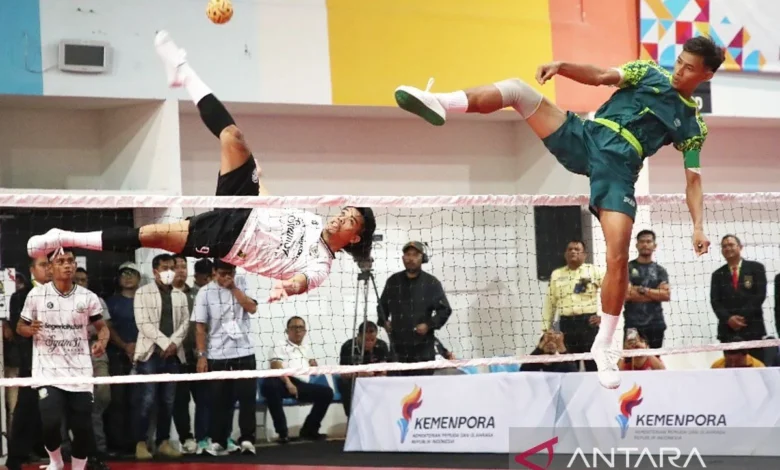
Jakarta (ANTARA) – Have you ever witnessed a sport that blends the agility of volleyball with the acrobatic kicks of football, yet is played without using hands? This captivating description perfectly encapsulates Sepak Takraw, a traditional Southeast Asian sport that continues to enthrall audiences and participants across numerous nations, including Indonesia, Thailand, Malaysia, and the Philippines. Its unique combination of aerial prowess and precise footwork has cemented its status as a regional sporting treasure, with its popularity growing both domestically and on the international stage.
The very name "Sepak Takraw" is a testament to its cross-cultural origins, derived from a fusion of two languages. The word "Sepak," originating from the Malay language, translates to "to kick," while "Takraw" is a Thai term referring to a "woven rattan ball." Thus, literally, Sepak Takraw signifies "kicking the rattan ball." The sport’s formal recognition and standardization were solidified following a match between Malaysia and Thailand in Kuala Lumpur in 1960.
Prior to its official naming, the sport was known by different appellations in various regions. In Malaysia, for instance, it was referred to as "Sepak Raga Jaring." The inclusion of the term "jaring" (net) is credited to Hamid Mydin, widely regarded as a foundational figure in the sport’s development. In Penang in 1945, Mydin added "jaring" to distinguish the game from the traditional "Sepak Raga," which was played without a net. This evolution highlights the sport’s gradual formalization and adaptation from its more rudimentary forms.
Often dubbed "Kick Volleyball," Sepak Takraw is a team sport typically played by two to four players per team on a court similar in size to a badminton court. It ingeniously merges elements of volleyball and footvolley, with a crucial restriction: players are only permitted to use specific body parts to strike the ball over the net. These include the feet, knees, shoulders, chest, and head, mirroring the hand-based play of volleyball but demanding an entirely different set of skills and coordination.
Internationally, the governance of Sepak Takraw falls under the purview of the International Sepaktakraw Federation (ISTAF), established in 1988. ISTAF plays a pivotal role in standardizing rules, organizing global competitions, and promoting the sport worldwide. The sport is known by a variety of local names across different countries, underscoring its deep-rooted presence in the region. These include Sepak Raga in Indonesia, Brunei, Malaysia, and Singapore; Sipa in the Philippines; Chinlone in Myanmar; and Takraw in Thailand, among others in various Asian nations. This linguistic diversity reflects the sport’s organic spread and integration into local cultures.
The Historical Tapestry of Sepak Takraw
The origins of Sepak Takraw are believed to trace back to Malaysia approximately 500 years ago, gaining significant popularity among royalty in the 15th century. This royal patronage likely contributed to its early spread and refinement. By the 16th century, the game had made its way to Indonesia, where it became known as Sepak Raga. Its popularity across Southeast Asia began to surge in the 1940s, a period marked by the formalization of its rules and the establishment of organized competitions.
The inaugural official competition for the sport took place in Penang in 1945, under the name "Sepak Raga Jaring." This event was a crucial step in moving the game from informal village play to a more structured competitive arena. The subsequent establishment of the Malaysian Sepak Raga Federation in Penang in 1960 further solidified its organizational framework. A significant milestone was its inclusion in the Southeast Asian Peninsular Games (SEAP Games) in 1965. It was during this pivotal event that the sport was officially christened "Sepak Takraw," a name that would come to represent its modern identity.
Beyond its Southeast Asian lineage, some historical accounts suggest that Sepak Takraw might have been introduced to the region by Chinese traders, sharing a common ancestry with football. This theory posits that the sport could have evolved from Cuju, an ancient Chinese ball game recognized by FIFA as one of the earliest forms of modern football. Cuju was historically practiced as a military exercise, where soldiers would kick a leather ball, aiming to keep it airborne for as long as possible. This ancestral connection, if accurate, would place Sepak Takraw within a much broader global history of ball games, highlighting its deep and varied roots.
Unraveling the Rules: The Mechanics of Sepak Takraw
Sepak Takraw is played on a court with dimensions similar to those used for badminton, measuring 13.4 meters by 6.1 meters. A net, 1.52 meters high at the center and 1.55 meters high at the posts, divides the court. Each team consists of three players: two "inside players" and one "back player," also known as the "Tekong."
The positioning of players is strategic. The Tekong is responsible for serving, initiating play from the back of the court. The two inside players, typically a "Feeder" and a "Killer," are positioned closer to the net and are responsible for setting up and executing offensive plays. The game is played in sets, with the first team to reach 21 points winning a set. A match is won by the first team to secure two sets.
The Flow of Play: A Dance of Feet and Flight
The game commences with a coin toss to determine which team serves first. The serving team’s Tekong initiates the rally by tossing the ball and kicking it over the net into the opponent’s court. The objective is for the receiving team to return the ball using only their feet, knees, chest, head, or shoulders, preventing it from hitting the ground on their side of the court and ultimately attempting to score by landing it within the opponent’s boundaries.
The dynamics of a Sepak Takraw match are a breathtaking display of athleticism. Players execute astonishing aerial maneuvers, including bicycle kicks, somersaults, and powerful spikes, all while maintaining control of the ball with their feet. The Feeder’s role is crucial in setting up the Killer for an explosive attack, often involving intricate passing sequences and deceptive movements. The Tekong, while primarily a server, also participates in defensive plays and can transition to an attacking role if the opportunity arises.
The scoring system is straightforward: a point is awarded each time the ball lands in the opponent’s court, goes out of bounds after being touched by the opposing team, or if a team commits a fault, such as touching the net with their body or hitting the ball with their hands. The intensity of each point is palpable, as teams strive for precision and power, often leading to rallies that showcase incredible skill and endurance.
International Recognition and Development
The International Sepaktakraw Federation (ISTAF) has been instrumental in elevating the sport’s global profile. ISTAF organizes major tournaments, including the Sepak Takraw World Cup, the ISTAF Super Series, and various continental championships. These events attract top talent from around the world, showcasing the sport’s athleticism and strategic depth to a wider audience.
The recent resolution of dualism in Indonesia’s Sepak Takraw leadership, as reported by ANTARA, is a positive development for the sport’s governance and future growth. The involvement of the Indonesian National Sports Committee (KONI) and the Indonesian Olympic Committee (KOI) in resolving these organizational issues signals a commitment to a unified and effective management structure. Such resolutions are vital for fostering national talent, improving training programs, and ensuring smooth participation in international competitions. The Ministry of Youth and Sports (Menpora) has often emphasized the need to resolve such dualisms in various sports, recognizing their detrimental impact on progress.
The sport’s continuous evolution and growing international presence are evident in its inclusion in major multi-sport events. Sepak Takraw is a regular fixture in the Asian Games, the Southeast Asian Games, and the World Games, further enhancing its visibility and appeal. As more athletes embrace the sport and training facilities improve, the level of competition is expected to rise, drawing even greater international attention.
The Broader Impact and Future Prospects
The enduring appeal of Sepak Takraw lies in its unique blend of physical demands and strategic play. It is a sport that requires exceptional agility, flexibility, coordination, and a keen understanding of physics. The visual spectacle of players defying gravity with their acrobatic maneuvers captivates audiences, making it a compelling spectator sport.
From a cultural perspective, Sepak Takraw is more than just a game; it is a reflection of Southeast Asian heritage and community spirit. Its traditional roots and widespread popularity across the region foster a sense of shared identity and pride. As the sport continues to gain international traction, it serves as a cultural ambassador, introducing the vibrant traditions of Southeast Asia to the global stage.
The future of Sepak Takraw appears bright. With robust international federations, increasing media coverage, and growing participation rates, the sport is poised for further expansion. The ongoing efforts to refine rules, enhance training methodologies, and promote grassroots development will undoubtedly contribute to its sustained growth. As the world increasingly seeks out sports that offer both exhilarating action and rich cultural narratives, Sepak Takraw stands out as a compelling and dynamic contender, ready to capture the attention of a global audience. The commitment shown by national sports bodies and international federations to nurture its development is a strong indicator of its potential to become a truly global phenomenon, transcending its regional origins to become a celebrated sport worldwide.