Five Palestinians Killed in Israeli Airstrike on Police Vehicle in Gaza City Despite Fragile Ceasefire Agreement

The fragile peace that has tenuously held the Gaza Strip together for several months was shattered on Tuesday, April 14, 2026, when an Israeli airstrike targeted a vehicle in the heart of Gaza City. The attack, which struck a clearly marked police vehicle, resulted in the deaths of four individuals, including a three-year-old toddler. This incident, followed shortly by a fatal shooting in the northern territory of Beit Lahia, brings the day’s death toll to five, marking one of the most significant escalations in violence since the ceasefire agreement was brokered on October 10 of the previous year. As both the Israeli Defense Forces (IDF) and Hamas officials exchange accusations of protocol violations, the international community watches with growing concern, fearing that the progress made toward regional stability may be unraveling.
Detailed Chronology of the April 14 Escalation
The events of Tuesday began in the early morning hours in the northern district of Beit Lahia. According to local sources and the Gaza Civil Defense, an individual was killed by small arms fire originating from Israeli positions along the border fence. The victim, whose identity has not yet been fully released pending notification of kin, was reportedly in an area that has seen frequent skirmishes between border patrols and local residents.
The situation escalated significantly later in the afternoon. At approximately 2:00 PM local time, an Israeli aircraft—identified by witnesses as either a drone or a fixed-wing fighter—dispatched a precision-guided munition toward a white vehicle patrolling a central thoroughfare in Gaza City. The vehicle belonged to the local police force, an entity that the Gaza Interior Ministry maintains is a civil service organization responsible for municipal order, but which Israel frequently links to the security apparatus of Hamas.
Mahmoud Bassal, a spokesperson for the Gaza Civil Defense, confirmed that the strike was instantaneous and devastating. "Four people were killed, including a child, and several others were injured in the attack that targeted a police vehicle," Bassal stated during a press briefing held shortly after the recovery operations began. The impact of the strike caused significant damage to nearby storefronts and sent shrapnel into a crowded pedestrian area, accounting for the additional injuries.
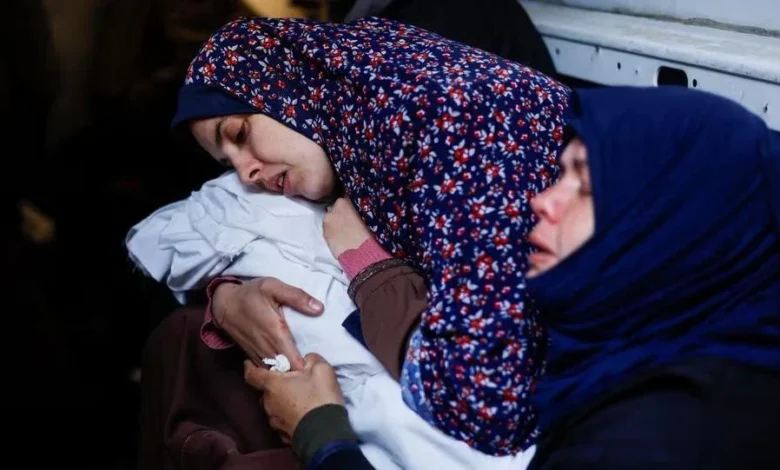
The most tragic casualty of the afternoon was identified as Yahya al-Mallahi, a three-year-old toddler who was reportedly in the vicinity of the vehicle when the missile struck. Medical officials at Al-Shifa Hospital, which remains the primary medical hub in Gaza City despite years of damage and reconstruction efforts, confirmed they received the bodies of the four victims. The sight of the child’s body being carried into the morgue sparked an immediate wave of grief and anger among the residents gathered at the facility.
The Fragility of the October 10 Ceasefire
To understand the gravity of Tuesday’s events, one must look at the context of the October 10 ceasefire. Signed following a period of intense hostilities, the agreement was intended to provide a long-term "period of calm" to allow for humanitarian aid delivery and the reconstruction of Gaza’s decimated infrastructure. Under the terms of the deal, both parties agreed to a cessation of proactive military operations, though "defensive actions" and "targeted responses to immediate threats" remained vaguely defined loopholes that both sides have utilized.
Since the ceasefire took effect, the region has existed in a state of "no war, no peace." While large-scale aerial campaigns had ceased, smaller incursions, sniper fire, and incendiary balloon launches have continued to plague the border regions. Independent monitors have recorded over 200 minor violations of the ceasefire by both parties over the last six months. However, the targeting of a police vehicle in a densely populated urban center represents a departure from the low-level friction that has characterized the truce.
The Israeli military, when contacted by international news agencies including AFP, stated that it was "investigating the details" of the Gaza City strike. Historically, the IDF has justified strikes on police vehicles by arguing that the Gaza police force is an integral part of Hamas’s military infrastructure, used for intelligence gathering and maintaining tactical control over the population. Conversely, Palestinian officials argue that the police are non-combatants under international law, tasked with civil duties such as traffic control and crime prevention.
Humanitarian and Social Impact
The death of Yahya al-Mallahi has once again highlighted the disproportionate impact of the conflict on Gaza’s youngest residents. According to data from various human rights organizations operating in the strip, children make up nearly 45% of the total population of Gaza, and they are frequently the unintended victims of "targeted" military operations.
The psychological toll on the population is equally profound. For many residents of Gaza City, the months following the October 10 ceasefire offered a rare glimpse of normalcy. Markets had begun to thrive again, and some reconstruction projects had moved past the debris-clearing phase. Tuesday’s strike serves as a stark reminder that the threat of sudden violence remains an everyday reality.
"We were beginning to think the worst was behind us," said an Al-Shifa hospital worker who requested anonymity. "But when you see a three-year-old on a stretcher, you realize that the ‘ceasefire’ is just a word used by politicians. For us, the war never truly ended."
Official Responses and Political Repercussions
The Gaza Interior Ministry issued a stern statement following the strike, condemning what it termed a "cowardly assassination" of civil servants. The ministry emphasized that the police vehicle was performing routine duties and that the attack constitutes a "clear and dangerous violation" of the standing ceasefire agreement. They called upon the international mediators—primarily Egypt and Qatar—to intervene and hold the Israeli government accountable.
In Israel, the political climate remains divided over the efficacy of the ceasefire. Hardline members of the governing coalition have frequently criticized the October 10 agreement, calling for more aggressive "proactive neutralization" of threats within Gaza. While the official military stance remains one of investigation, some political analysts suggest that the strike may have been a response to intelligence regarding a specific threat, or perhaps a signal of a shifting policy toward the enforcement of the truce.
The United Nations Office for the Coordination of Humanitarian Affairs (OCHA) expressed "deep concern" over the loss of civilian life. A spokesperson for the UN Secretary-General urged both sides to exercise "maximum restraint," warning that a return to full-scale hostilities would be catastrophic for the two million people living in the Gaza Strip, many of whom are still living in temporary shelters.
Analysis of Implications
The implications of the April 14 strike are manifold. First, it challenges the sustainability of the October 10 ceasefire. Ceasefires in the Israel-Palestine conflict are often built on a foundation of "quiet for quiet." When that quiet is broken by a high-profile strike in a city center, the domestic pressure on Hamas to retaliate becomes immense. If Hamas chooses to respond with rocket fire, it could trigger a "tit-for-tat" cycle that rapidly escalates into a multi-day conflict.
Second, the incident raises questions about the definition of "combatant" in the modern Gazan context. By targeting a police vehicle, Israel is asserting that the distinction between civil governance and military activity in Gaza is non-existent. This stance complicates future ceasefire negotiations, as it leaves civil servants in a state of constant vulnerability.
Third, the international reaction will be a litmus test for the current diplomatic landscape. If the mediators can successfully de-escalate the situation in the next 48 hours, it will prove that the October 10 framework has some degree of resilience. If not, it may signal that the region is entering another period of protracted instability.
Supporting Data and Regional Context
As of early 2026, Gaza’s economic and humanitarian indicators remain dire. Despite the ceasefire, unemployment remains above 40%, and access to clean water is a daily struggle for the majority of the population. The "reconstruction fund" established after the last major conflict has only seen about 30% of its promised capital delivered, largely due to the restrictive "dual-use" list that limits the import of construction materials like cement and steel.
The following data points provide a snapshot of the environment in which Tuesday’s violence occurred:
- Ceasefire Duration: 186 days (since Oct 10, 2025).
- Total Casualties during Ceasefire (estimated): 42 Palestinians, 3 Israelis (mostly in border skirmishes).
- Infrastructure Status: 60% of buildings damaged in previous conflicts remain unrepaired.
- Healthcare Capacity: Al-Shifa Hospital is currently operating at 120% capacity, even before the influx of victims from the latest strike.
Conclusion
The strike on April 14, 2026, serves as a grim milestone in the ongoing struggle between Israel and the factions within the Gaza Strip. The death of five people, including a three-year-old child, has reignited the flames of resentment and underscored the fragility of diplomatic solutions in the absence of a comprehensive political settlement. As the families of Yahya al-Mallahi and the other victims prepare for their funerals, the eyes of the world are once again fixed on the narrow coastal enclave, waiting to see if the coming days will bring a return to the negotiating table or a descent back into the darkness of war. The investigation promised by the Israeli military and the calls for justice from the Gaza Interior Ministry represent two diametrically opposed narratives of a conflict that continues to claim lives, regardless of the "ceasefire" labels applied by the outside world.