Socio Today
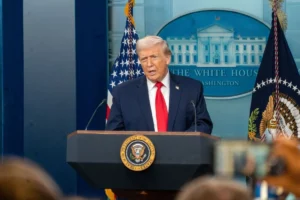
In a significant geopolitical and economic development, United States President Donald Trump announced on Thursday, September 10, 2026, that the United States has solidified its position as the world’s preeminent oil producer. Speaking before a capacity crowd at a rally in Dallas, Texas, the President highlighted that this status was achieved even before accounting for the vast oil reserves of Venezuela, which have now been integrated into the American strategic energy framework.
The announcement follows the finalization of a high-stakes energy agreement involving the North American Blue Energy Partners (NABEP) and the United States government. This deal centers on the exploitation of Venezuela’s proven oil reserves, estimated at approximately 65 billion barrels, and marks a pivotal shift in hemispheric energy policy. President Trump described the arrangement as potentially the most significant energy deal in the nation’s history, emphasizing that the inclusion of Venezuelan assets strengthens the U.S. energy dominance on a global scale.
The Anatomy of the NABEP Energy Agreement
The agreement between the United States and the energy consortium is complex, involving structural shifts in ownership and state-led oversight. According to documents released by the White House, the core of the arrangement involves NABEP transferring a 35 percent equity stake in its parent company directly to the Office of Strategic Capital, an entity operating under the U.S. Department of Defense (Pentagon).
The administration has underscored that this transfer is structured in a manner that places no additional fiscal burden on American taxpayers. Furthermore, the Department of State has secured a strategic procurement right, allowing the U.S. government to purchase up to 20 percent of the resulting oil production at cost. This provision is designed to provide the U.S. with a buffer against volatile global market fluctuations, ensuring a steady supply for domestic requirements.
The scope of the deal is extensive, with the White House confirming that NABEP has been granted a 100-year concession covering 17 distinct oil fields. This long-term horizon reflects the administration’s intention to stabilize the energy landscape in the region for the next century. However, there remains a discrepancy in the public narrative; Acting President of Venezuela, Delcy Rodriguez, previously characterized the agreement as having a 25-year duration, signaling potential friction or differing interpretations regarding the long-term operational timeline.

Economic Projections and Financial Allocations
The economic ramifications of the agreement are expected to be substantial. The White House projects that the partnership will generate roughly US$200 billion—or approximately Rp3,517 trillion—in combined royalties and tax revenue over the initial 25-year period.
These funds are officially earmarked for the reconstruction of Venezuela’s infrastructure and the revitalization of its social sectors. By tying energy production to development goals, the administration aims to stabilize the economic climate within Venezuela, which has faced years of internal instability and humanitarian challenges. The success of this financial pipeline, however, will largely depend on the sustained operational capacity of the 17 identified oil fields and the global price of crude oil, which has recently seen significant volatility.
Global Energy Context and Market Sensitivity
The timing of this announcement comes against the backdrop of heightened global energy anxiety. Recent reports indicate that international oil prices have consistently remained above the US$100 per barrel threshold. This surge is largely attributed to ongoing tensions and conflicts between the United States and Iran, which have disrupted supply chains and created a climate of uncertainty in the energy sector.
In Indonesia, policymakers have been monitoring these developments closely. Finance Minister Purbaya Yudhi Sadewa has publicly reassured the public that the national budget remains robust enough to withstand the shocks of high global oil prices. The Indonesian government’s ability to navigate these prices is a microcosm of the challenges faced by many nations that are net importers of energy, making the U.S.-Venezuela deal a matter of intense international scrutiny.
Chronology of Shifting U.S.-Venezuela Relations
The path to this agreement has been marked by decades of diplomatic friction. For years, the U.S. maintained a policy of strict sanctions and diplomatic isolation toward the Venezuelan leadership. The transition to this collaborative energy partnership represents a radical departure from the "maximum pressure" campaigns that characterized the early 2020s.
- Early 2020s: The United States imposed heavy sanctions on Venezuela’s state-owned oil company, PDVSA, effectively halting most foreign investment in the country’s energy sector.
- 2024-2025: A series of back-channel negotiations began as global energy demand spiked and the U.S. sought to diversify its supply away from traditional conflict-prone regions.
- August 2026: Preparatory talks for the NABEP concession were finalized, setting the stage for the official announcement in September.
- September 10, 2026: President Trump formally acknowledges the inclusion of Venezuelan reserves into the U.S. energy sphere during his Dallas rally.
Analysis: Strategic Implications for Global Power
The decision to integrate Venezuelan oil into the U.S. portfolio is a calculated strategic move. By controlling the production and distribution of a significant portion of the world’s largest oil reserves, the U.S. effectively curbs the influence of other major oil-producing nations that have historically leveraged energy as a tool of political coercion.

For the United States, the primary benefit is energy security. By securing 20 percent of production at cost, the U.S. creates an insurance policy against future supply disruptions. However, the move also places the U.S. in the position of being a primary guarantor of stability in Venezuela. If the project is to succeed, the U.S. must ensure that the internal political environment in Venezuela remains conducive to long-term industrial operations. This creates a complex paradox: while the U.S. seeks to reduce its reliance on foreign actors, it is now deeply entangled in the internal affairs of a nation it previously sought to isolate.
Challenges to Implementation
Despite the optimism expressed by the White House, several hurdles remain. The Venezuelan energy infrastructure has suffered from years of underinvestment and neglect. Bringing these 17 oil fields to full, efficient production will require significant capital expenditure, technical expertise, and time. Critics of the deal have pointed to the risk of "resource nationalism," where a future Venezuelan government might seek to renegotiate or cancel the concessions granted to NABEP, potentially leading to lengthy international arbitration.
Furthermore, the environmental implications of ramping up production in the region have yet to be fully addressed. With global pressure mounting to transition toward renewable energy, a 100-year commitment to fossil fuel extraction represents a doubling-down on carbon-intensive energy sources. While the administration frames this as a necessity for economic and national security, it stands in contrast to the global trend of energy transition policies.
Conclusion
The announcement by President Trump signifies a new era in American energy policy, one where domestic and international production assets are managed as a singular, unified strategic reserve. By securing a foothold in Venezuela, the U.S. has not only claimed the title of the world’s largest oil producer but has also taken a decisive step toward controlling the flow of global energy for the next century.
Whether the economic benefits will materialize as projected and whether the political stability required for such a project can be maintained remain to be seen. As the world watches the implementation of the NABEP agreement, the move serves as a stark reminder that in the realm of global geopolitics, energy remains the ultimate currency of power. The coming months will be critical in determining whether this gamble on Venezuelan reserves will stabilize global markets or introduce new layers of complexity to an already volatile international landscape.