Family Outcry Disrupts Constitutional Court Proceedings Amidst Tense Legislative Election Dispute Hearings

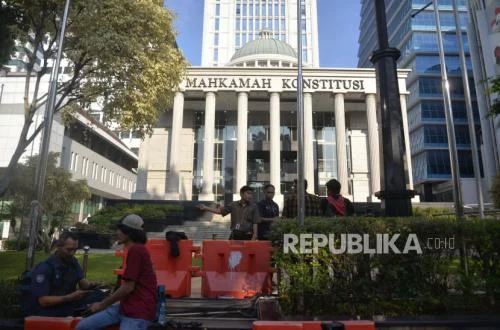
JAKARTA – A dramatic scene unfolded at the Constitutional Court (MK) building on Wednesday, May 29, 2024, when individuals claiming to be family members of a key witness for the Democratic Party, identified as Sulaiman, caused a commotion and demanded access to him during an ongoing legislative election dispute hearing. The incident injected an unexpected element of human drama into the already high-stakes legal proceedings, raising questions about witness welfare and the transparency of judicial processes. The family’s emotional outburst stemmed from allegations that Sulaiman had been taken from his home days earlier and had since been unreachable, leading them to suspect coercion.
The disturbance began as Sulaiman was being escorted into the Constitutional Court building, accompanied by one of the legal representatives for the Democratic Party. According to observations made at Gedung I of the Constitutional Court, Sulaiman was seen dressed entirely in black, with his face obscured by a mask. This attire and the manner of his entry immediately drew attention, only to be compounded by the sudden appearance of his distraught family.
The Witness and the Case
Sulaiman was scheduled to testify as a witness for the Democratic Party in the Election Dispute Case (PHPU Pileg) 2024, specifically case number 196-01-14-22/PHPU/DPR-DPRD-XXII/2024. This particular case involves a challenge to the legislative election results, with the General Election Commission (KPU) acting as the respondent and the National Mandate Party (PAN) as the related party. The presence of such a witness is crucial in PHPU cases, as their testimony often aims to provide direct evidence or insights into alleged irregularities, fraud, or procedural violations that could impact election outcomes. In the context of legislative disputes, witnesses might speak to vote tabulation errors, ballot stuffing, or other forms of electoral misconduct at the polling station or district level.
Family’s Desperate Plea and Allegations
The commotion escalated when a man and a woman, positioned outside the building, began shouting, desperately demanding to meet with Sulaiman. The woman, identified as Sulaiman’s sister and dressed in a yellow top with a black headscarf, cried out, "I am his sister! Do you know that? Everything is unfair! There is coercion!" Her attempts to force her way into the building were thwarted by security personnel, who maintained a firm but cautious perimeter.
Following the initial outburst, the sister, along with two other individuals, was questioned by a Constitutional Court official regarding their reasons for attempting to forcefully enter the premises. During this exchange, Sulaiman’s sister tearfully explained that her brother had been picked up from their home on Friday, May 24, 2024, and had subsequently become completely incommunicado. "There was no agreement. The plan was for (Sulaiman) to be taken out of the house, he said goodbye, and since then, there has been no news of him," she recounted, her voice laden with distress. This claim of an unscheduled departure and subsequent communication blackout fueled the family’s fears, leading them to believe that Sulaiman might be under duress or undue influence, compromising the integrity of his testimony.
Background of the 2024 General Elections and PHPU
The incident occurred against the backdrop of the highly contentious 2024 General Elections in Indonesia, which saw simultaneous presidential and legislative polls on February 14, 2024. The elections were marked by intense campaigning, robust public debate, and, inevitably, numerous allegations of irregularities and disputes.
The Constitutional Court (Mahkamah Konstitusi or MK) serves as the ultimate arbiter for election disputes in Indonesia. Its role is enshrined in the constitution, granting it the authority to review the results of both presidential (PHPU Pilpres) and legislative (PHPU Pileg) elections. The court’s decisions are final and binding, making its proceedings a critical component of upholding democratic integrity and public trust in the electoral system.
While the specific incident involving Sulaiman pertains to a legislative dispute, it is important to note the broader context of the MK’s workload following the 2024 elections. The court had previously concluded its hearings for the presidential election dispute, delivering its highly anticipated verdict on April 22, 2024. This earlier decision, which affirmed the victory of President-elect Prabowo Subianto and Vice President-elect Gibran Rakabuming Raka, was a monumental moment for the nation. However, the legislative election disputes, involving hundreds of petitions from various political parties and candidates challenging results across different electoral districts, represent an equally complex and extensive undertaking for the court. The sheer volume and intricate nature of these cases underscore the challenges in ensuring electoral fairness across the vast archipelago.
Constitutional Court Procedures and Witness Protection
The Constitutional Court adheres to strict procedures for handling election disputes, which include the presentation of evidence, expert testimonies, and witness statements. Witnesses are deemed critical as they provide firsthand accounts or direct knowledge pertinent to the alleged violations. The court is generally expected to ensure the safety and impartiality of all witnesses.
In Indonesia, the Witness and Victim Protection Agency (LPSK) exists to provide protection for witnesses and victims in various legal cases, including those of national importance. While not explicitly mentioned in the initial report whether Sulaiman was under LPSK protection, the family’s allegations highlight the critical need for robust mechanisms to safeguard witnesses from intimidation, coercion, or undue influence, especially in politically charged cases like election disputes. The integrity of a witness’s testimony is paramount to the fairness of the judicial process, and any perception of compromise can undermine public confidence in the court’s rulings.
The MK’s internal security protocols are designed to manage public access and maintain order during sensitive hearings. The quick response of security personnel in preventing the family from entering the building demonstrated the court’s commitment to maintaining decorum. However, the emotional nature of the family’s claims points to potential gaps or challenges in communication and welfare protocols concerning witnesses, particularly when they are separated from their families for extended periods.
Statements and Reactions from Related Parties (Inferred)
- Democratic Party: While no direct statement from the Democratic Party was provided in the initial report regarding the family’s allegations, it is plausible that the party would issue a statement emphasizing the importance of Sulaiman’s testimony to their case. They might either deny any coercion, stating that Sulaiman was a willing participant, or express concern over the family’s distress, promising to facilitate communication or address their concerns while upholding legal procedures. The party would likely stress that their objective is to ensure justice through legitimate legal channels.
- Constitutional Court Spokesperson: A spokesperson for the Constitutional Court would likely reiterate the court’s commitment to due process, transparency, and the safety of all parties involved, including witnesses. They might clarify the procedures for witness summoning and protection, assuring the public that any allegations of coercion would be taken seriously and investigated if evidence warrants. The court would likely emphasize its role as an impartial arbiter and its dedication to upholding the rule of law.
- Legal Experts and Observers: Legal commentators and electoral observers would likely voice concerns over the incident, highlighting the delicate balance between securing witness testimony and protecting their rights and welfare. They might call for greater transparency in witness handling protocols, potentially advocating for mandatory communication with families or greater involvement of independent third-party oversight, such as the LPSK, in high-profile cases. Such incidents, they might argue, could erode public trust if not handled with utmost care and transparency. The incident serves as a reminder of the human element in complex legal battles.
- KPU and PAN: As the respondent and related party, respectively, KPU and PAN would likely maintain a neutral stance regarding the witness’s family’s claims, emphasizing that the court’s proceedings should remain focused on the legal arguments and evidence presented. They would likely defer to the Constitutional Court’s authority in managing its hearings and ensuring the integrity of witness testimonies.
Implications and Broader Impact
The commotion at the Constitutional Court, while an isolated incident, carries significant implications. Firstly, it underscores the intense pressures surrounding electoral disputes in Indonesia. The stakes are incredibly high for political parties and candidates, leading to an environment where every piece of evidence and every witness testimony can be perceived as pivotal.
Secondly, the incident raises important questions about witness protection and welfare within the Indonesian legal system, particularly in politically charged cases. Ensuring that witnesses feel safe, are free from coercion, and maintain communication with their families is crucial for the credibility of their testimony and the integrity of the judicial process. Any perception that a witness might be testifying under duress could undermine the validity of their statements and, consequently, the court’s ability to render a fair and just decision.
Thirdly, the public nature of the family’s protest brings to light the human cost of these extensive legal battles. Beyond the political maneuvering and legal arguments, there are individuals and families whose lives are directly impacted. This public display of distress can affect public perception of the judicial process, highlighting the need for courts to not only be just but also to appear just and humane in their dealings.
Finally, the incident serves as a reminder of the challenges faced by the Constitutional Court in managing the vast number of PHPU cases. Balancing efficient judicial processes with thorough investigations and safeguarding the rights of all involved parties, including witnesses and their families, is a complex task. The resolution of these legislative disputes is critical for solidifying the legitimacy of the newly elected parliament and regional councils, thereby ensuring political stability and democratic continuity in Indonesia. The court’s ability to navigate such challenging situations transparently and fairly will be vital in maintaining public confidence in the rule of law.