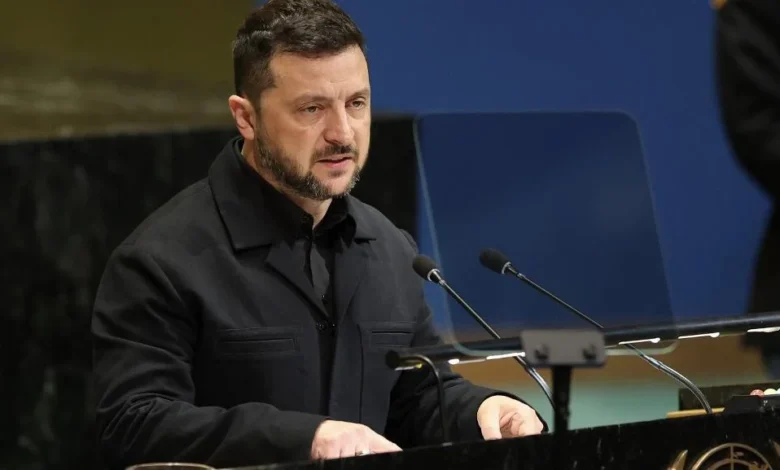
Ukrainian President Volodymyr Zelensky has expressed profound concern over the shifting focus of United States foreign policy, stating that American peace negotiators currently "have no time for Ukraine" due to the escalating conflict involving Iran. Speaking to the German public broadcaster ZDF, the Ukrainian leader lamented the distraction of key diplomatic figures and the subsequent disruption of vital military aid, which he warned could embolden Russian President Vladimir Putin and jeopardize Ukraine’s territorial integrity. Zelensky’s remarks highlight a growing anxiety in Kyiv that the geopolitical landscape is shifting, leaving Ukraine to contend with a stalled peace process and a critical shortage of advanced weaponry.
During his interview, Zelensky specifically named Steve Witkoff and Jared Kushner as the primary US figures who had previously been instrumental in mediating talks with Moscow to end the protracted war. According to Zelensky, these negotiators are now "constantly in talks with Iran," effectively sidelining the Ukrainian-Russian conflict. While describing both Witkoff and Kushner as "pragmatists" who are attempting to leverage Russian influence to de-escalate Middle Eastern tensions, Zelensky cautioned that this shift in attention comes at a high cost for Eastern Europe. He emphasized that if the United States fails to maintain consistent pressure on the Kremlin, preferring instead a "soft dialogue," the Russian leadership will lose its fear of international repercussions, leading to further aggression.
The Stagnation of the Geneva Peace Process
The diplomatic vacuum created by the focus on Iran has had a tangible impact on the formal peace process. Negotiations aimed at ending the conflict between Russia and Ukraine have been effectively frozen since the outbreak of hostilities in Iran on February 28, 2026. The last time Russian and Ukrainian negotiators met was in Geneva, Switzerland, in February, just before the regional instability in the Middle East reached a breaking point. Since then, the momentum for a negotiated settlement has dissipated, replaced by a diplomatic stalemate that Zelensky attributes directly to the redirection of American strategic resources.
The President’s critique suggests a rift in the perceived priorities of the current US administration’s diplomatic corps. By focusing on Iran, Washington appears to be attempting to prevent a broader regional conflagration in the Middle East, potentially seeking Russia’s assistance as a mediator or a stabilizing force in that theater. However, from Kyiv’s perspective, this approach risks validating Putin’s "might makes right" philosophy. Zelensky argued that any perceived weakness or lack of focus from Washington provides Moscow with the breathing room it needs to reconstitute its forces and dig in for a longer, more attritional conflict.
Critical Shortages in Air Defense Systems
Beyond the diplomatic stagnation, the most immediate threat to Ukraine remains the slowdown in military hardware deliveries. Zelensky identified the supply of US-made weaponry as a "major problem" that has worsened since the end of February. He warned that a prolonged war in the Middle East would inevitably lead to a reduction in the volume of arms available for Ukraine, particularly in the realm of sophisticated air defense systems.
"If the war continues, there will be fewer weapons for Ukraine," Zelensky told ZDF. "This is very important, especially in terms of material for air defense." He later clarified during a press conference in Norway that the shortage is most acute for PAC-3 (Patriot Advanced Capability-3) interceptor missiles, as well as the older PAC-2 variants. These systems are the cornerstone of Ukraine’s defense against Russian ballistic and cruise missile strikes. The PAC-3, in particular, is highly sought after for its "hit-to-kill" technology, which is essential for neutralizing advanced Russian missiles like the Iskander and Kinzhal.
The procurement of these systems has become increasingly complex. Zelensky noted that much of this equipment is currently being sourced through the PURL (Procurement for Ukraine Resource Leverage) program. Launched last year, the PURL initiative was designed to allow Ukraine to receive American-made military hardware that is financed by European nations. While the program was intended to create a sustainable pipeline for defense materials, the administrative and logistical focus required to maintain it has reportedly waned as Washington pivots toward the Iranian crisis.
Strategic Shift: The Norway-Ukraine Defense Partnership
In response to the slowing pace of American support, Zelensky has sought to bolster ties with European partners to ensure a steady supply of defense technology. During a recent visit to Oslo, Zelensky and Norwegian Prime Minister Jonas Gahr Støre signed a landmark "joint declaration on increased defense and security cooperation." This agreement represents a strategic pivot for Kyiv, aiming to reduce its total reliance on US-led supply chains by fostering local and regional production capabilities.
A key component of this new partnership is the announcement that Ukrainian-designed drones will now be produced on Norwegian soil. Prime Minister Støre stated that the Norwegian government intends to "facilitate closer cooperation between the defense industries of Norway and Ukraine." This move is seen as a way to circumvent the logistical bottlenecks currently plaguing US shipments and to tap into Norway’s advanced manufacturing and technological sectors. For Ukraine, moving production to a NATO member state like Norway provides a layer of security for its industrial base, which remains under constant threat from Russian long-range strikes.
Zelensky acknowledged that while these European partnerships are vital, they cannot immediately fill the void left by a distracted United States. He described the current delivery of weapons as coming "slowly," characterizing the situation on the front lines as "very difficult." The delay in interceptor missiles, in particular, leaves Ukrainian cities and critical infrastructure vulnerable during a period when Russia has shown no signs of de-escalating its aerial campaign.
Timeline of Geopolitical De-escalation and Re-escalation
To understand the gravity of Zelensky’s current position, one must look at the chronology of the past several months. In early 2026, there was a cautious optimism that the Geneva talks might produce a framework for a permanent ceasefire. Both sides had made incremental concessions, and the presence of high-level US negotiators like Witkoff and Kushner signaled that Washington was committed to a resolution.
- February 2026: Negotiators meet in Geneva. Progress is reported on humanitarian corridors and prisoner exchanges.
- February 28, 2026: A major conflict erupts in Iran, involving regional powers and drawing immediate US diplomatic and military attention.
- March 2026: US diplomatic resources are diverted to Tehran and neighboring capitals. The Geneva talks are indefinitely postponed.
- March-April 2026: Reports emerge of "slow-walking" in the delivery of PAC-3 missiles to Ukraine. The PURL program experiences bureaucratic delays.
- April 15, 2026: President Zelensky goes public with his frustrations, highlighting the "pragmatism" of US negotiators as a threat to Ukrainian security.
This timeline illustrates a rapid shift in global priorities. For Ukraine, the outbreak of the "Iran War" was a worst-case scenario, splitting the attention of its most powerful ally at a time when the Russian military was beginning to show signs of exhaustion.
Analysis of Implications: A Two-Front Diplomatic Challenge
The current situation presents a multifaceted challenge for the international community. From a US perspective, the necessity of preventing a nuclear-armed Iran or a total collapse of Middle Eastern stability is a paramount national security interest. However, the "zero-sum" nature of diplomatic attention means that every hour spent on Iran is an hour taken away from the Ukraine-Russia conflict.
Military analysts suggest that the shortage of PAC-3 and PAC-2 missiles is not merely a logistical issue but a production one. The US defense industrial base is currently under strain to supply multiple theaters. If Washington is prioritizing the deployment of Patriot batteries to the Middle East to protect its assets and allies from Iranian proxies, Ukraine’s quota naturally suffers. Zelensky’s public "complaint" is likely a calculated move to pressure the US Congress and the administration to increase production capacity or to find alternative ways to prioritize Ukrainian defense.
Furthermore, Zelensky’s warning about "soft dialogue" with Putin touches on a long-standing fear in Eastern Europe: that the West might trade Ukrainian interests for Russian cooperation elsewhere. If the US seeks Russia’s help in restraining Iran, there is a risk that Moscow will demand a "free hand" in Ukraine as its price. By labeling Witkoff and Kushner’s approach as overly pragmatist, Zelensky is signaling to the global community that Ukraine will not accept a "grand bargain" that compromises its sovereignty.
The Path Forward: Diversification and Self-Reliance
As the conflict in Iran continues to dominate the headlines in Washington, Ukraine is increasingly looking toward a "Europeanized" defense strategy. The deal with Norway is likely the first of several bilateral agreements intended to create a decentralized network of arms production. By moving drone production to Norway and seeking similar arrangements with other European nations, Kyiv is attempting to insulate itself from the volatility of US domestic politics and shifting foreign policy focuses.
However, the reality remains that for high-end capabilities—specifically advanced missile defense and satellite intelligence—the United States remains indispensable. Zelensky’s remarks serve as a stark reminder that the "America First" or "Pragmatist" approach to foreign policy can have unintended consequences for global stability. Without a renewed commitment from the US to balance its interests in both the Middle East and Eastern Europe, the hard-won gains of the Ukrainian military over the past years could be at risk.
The "very difficult situation" described by Zelensky and Prime Minister Støre is a call to action for the NATO alliance. As 2026 progresses, the ability of the West to manage two simultaneous major geopolitical crises will be the ultimate test of its leadership and industrial resilience. For now, Ukraine remains in a state of precarious waiting, hoping that the "pragmatists" in Washington can find the time to ensure that the defense of democracy in Europe does not become a casualty of conflict elsewhere.