Thousands of Bats Infest Vacant Home in Tasikmalaya Prompting Emergency Response from Fire Department

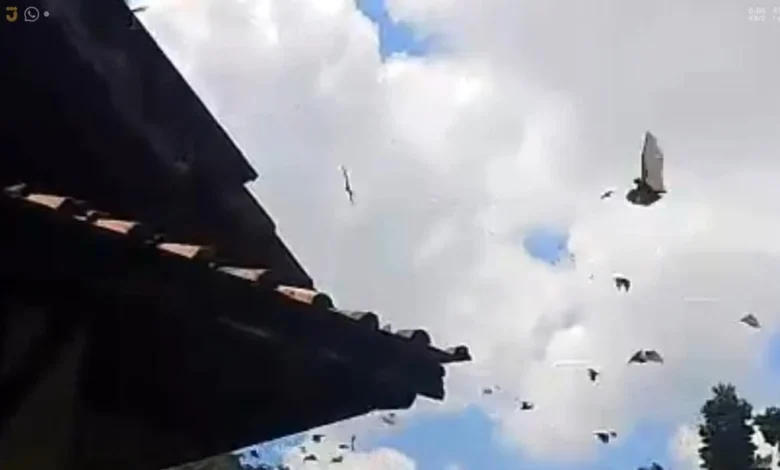
A massive colony of bats numbering in the thousands has been discovered occupying the attic of a residential property in Tasikmalaya, West Java, triggering an intensive four-hour evacuation operation by local emergency services. The incident occurred at a house owned by a resident identified as Enung, located in Kampung Gentong, Buniasih Village, within the Kadipaten District of Tasikmalaya Regency. The discovery has raised significant concerns regarding public health and property maintenance, as the sheer volume of the infestation—estimated to exceed 15,000 individual bats—transformed a quiet neighborhood into the site of a complex wildlife management crisis.
The infestation was brought to light on Tuesday, April 14, 2026, when the homeowner, who had left the property vacant for a significant period, returned to find the structure "taken over" by the winged mammals. Upon witnessing the scale of the colony, which had completely saturated the roof structure and ceiling areas, Enung immediately contacted the Tasikmalaya Regency Fire and Rescue Department (UPTD Damkar). The homeowner expressed overwhelming shock at the sight, noting that the sheer density of the animals made it impossible for her to address the situation without professional intervention.
Emergency Mobilization and Tactical Challenges
Upon receiving the report, the UPTD Damkar of Tasikmalaya Regency dispatched a specialized rescue squad to the Kadipaten District. The response team faced logistical hurdles from the outset, including a transit time of over two hours due to the remote location of the village and the geographical terrain of the regency. When the team, led by Squad Commander Aam, arrived at the scene, they found that the initial report had significantly underestimated the magnitude of the problem.
Commander Aam noted that while the department is frequently called for animal rescues—ranging from snake removals to wasp nest destructions—the scale of this bat colony was unprecedented for a single residential dwelling. The team had initially arrived equipped with standard wildlife nets, a tool typically sufficient for smaller groups of animals. However, the reality of the situation required a swift change in strategy. The bats were found clinging to every available surface of the wooden roof supports and the underside of the tiles, creating a living carpet of fur and wings that spanned the entirety of the attic space.
"We received the report and moved quickly to the location, bringing our netting equipment," Aam stated during the operation. "However, the owner did not specify the exact volume. Based on our assessment, there were likely over 15,000 bats. It was an immense colony."
Chronology of the Four-Hour Evacuation
The evacuation process began in the early afternoon and proved to be a grueling task for the rescue personnel. The initial attempt to use nets was quickly abandoned as it became clear that catching thousands of bats individually was not only inefficient but also posed a risk of injury to the animals and potential exposure to the officers. The sheer density of the colony meant that for every bat caught, hundreds more remained agitated within the confined space.
Recognizing the futility of manual capture, the Damkar team transitioned to a more sophisticated dispersal technique: controlled smoking or fumigation. This method is designed to create an environment that is uncomfortable for the bats, encouraging them to leave the structure voluntarily without causing them permanent harm.
Before initiating the smoking process, the team had to prepare the house to ensure the bats had a clear exit path. This involved several tactical steps:
- Structural Modification: Officers carefully removed sections of the ceiling (eternit) and several roof tiles to create large apertures.
- Strategic Smoke Placement: A controlled smoke source was introduced into the lower levels of the house, allowing the smoke to rise naturally into the attic.
- External Monitoring: Personnel were stationed outside to monitor the exit points and ensure the bats were dispersing away from neighboring houses.
As the smoke permeated the attic, the colony began to scatter. Witnesses described a dramatic scene as thousands of bats poured out of the roof openings, momentarily darkening the sky over Kampung Gentong. The process was slow and required patience to ensure that the majority of the colony had vacated the premises. By late afternoon, after nearly four hours of continuous effort, the bulk of the infestation had been cleared.
Environmental and Structural Factors
The UPTD Damkar analysis suggests that the infestation was the result of a "perfect storm" of environmental conditions. The house had remained unoccupied for a long duration, providing the bats with a sanctuary free from human disturbance. Furthermore, the lack of maintenance allowed small entry points—holes in the eaves and gaps in the roof tiles—to develop, which the bats exploited to gain access to the attic.
"The condition of the house was damp and dark, which is the ideal habitat for these creatures," Aam explained. "Because it was empty for a long time, the bats were able to establish a massive colony undisturbed. Once a few bats find a suitable location, they release pheromones that attract others, leading to this kind of exponential growth in the population."
The presence of such a large colony has also taken a toll on the structural integrity of the home. Bat guano (droppings) is highly acidic and, when accumulated in large quantities, can cause wood rot and damage to ceiling materials. The weight of 15,000 bats, combined with years of accumulated waste, poses a significant risk of ceiling collapse, a factor that the Damkar team had to navigate carefully during the evacuation.
Official Response and Public Health Warning
Engking, the Head of the Administrative Sub-Division at the Tasikmalaya Regency UPTD Damkar, confirmed the success of the mission, emphasizing that the department’s goal was to assist the resident while maintaining a balance with local wildlife. "Alhamdulillah, we were able to help the resident and complete the task successfully without causing unnecessary damage to the property," Engking said.
However, the incident has prompted a broader warning from the authorities regarding the health risks associated with bats in residential areas. While bats play a crucial role in the ecosystem—primarily through insect control and pollination—their proximity to human living quarters is a matter of medical concern.
Health experts point out that bat guano can harbor Histoplasma capsulatum, a fungus that causes histoplasmosis, a respiratory infection that can be severe if the spores are inhaled. Additionally, bats are known reservoirs for various zoonotic diseases. The Tasikmalaya Regency government has urged citizens to be vigilant about the state of vacant properties in their neighborhoods.
"We urge residents to report immediately if they find wild animals nesting in large numbers within residential areas," Engking added. "Beyond the physical disturbance, the accumulation of waste from these animals carries a significant potential for disease transmission."
Broader Implications and Analysis
The incident in Kadipaten highlights a growing challenge in West Java: the intersection of urban sprawl and wildlife habitats. As human settlements expand and more properties are left vacant due to urbanization or economic shifts, the likelihood of "synanthropic" behavior—wildlife adapting to human-made structures—increases.
In Indonesia, the Fire and Rescue Department (Damkar) has evolved significantly from its traditional role of firefighting. It now serves as the primary agency for "Rescue 113" operations, which include animal control, flood rescue, and hazardous material handling. This event underscores the need for these departments to be better equipped with specialized wildlife handling gear and biological safety training.
From an ecological perspective, the displacement of 15,000 bats raises questions about where the colony will relocate. Local environmentalists suggest that the lack of natural cave habitats or large old-growth trees in the vicinity often forces these colonies into human structures. This event may serve as a catalyst for local authorities to consider the preservation of natural habitats to prevent future "horror" scenarios in residential zones.
As of Tuesday evening, the Damkar team remained on-site to conduct a final sweep of the property, ensuring that no stragglers remained trapped behind walls or under flooring. The homeowner, Enung, has been advised to conduct thorough repairs to seal all potential entry points and to hire professional cleaning services to decontaminate the attic space.
The case of the "Bat House" in Tasikmalaya serves as a stark reminder to property owners of the importance of regular maintenance and the speed with which nature can reclaim neglected human spaces. It also stands as a testament to the diverse and often unpredictable challenges faced by emergency responders in West Java.