Millions of years ago, the rugged landscape that defines the Gunungkidul karst hills in the Special Region of Yogyakarta, Indonesia, rested entirely beneath the ocean’s surface. Shaped by profound and protracted tectonic processes, this ancient seabed was eventually uplifted, leaving behind a sprawling topography of jagged limestone formations, intricate cave systems, and dramatic coastal cliffs that meet the formidable expanse of the Indian Ocean.
The historical significance of this landscape has long captured the attention of naturalists and explorers. In his seminal 1836 publication, Licht- und Schattenbilder aus dem Innern von Java, German-born naturalist and explorer Friedrich Franz Wilhelm Junghuhn meticulously documented the stark beauty of Gunungkidul’s rocky terrain and the traditional ways of life of the local Javanese population. Junghuhn was particularly fascinated by how indigenous communities adapted to the challenging karst topography, utilizing deep caves and steep cliffs to harvest swiftlets’ nests. During his extensive expeditions, he immortalized the region—historically known as Goenoeng Sewoe (Thousand Mountains)—in a painting titled Zuidkunst Beoosten Rankop, capturing the panoramic views of the open ocean from the sharp limestone precipices near Ngungap Beach in the Rongkop district.
Modern exploration of the region reveals that this unique geological signature extends far beyond historical accounts. Contemporary travelers navigating the southern coastlines of Gunungkidul—including Kesirat, Watunene, Siung, Pengilon, and the secluded cove of Wohkudu—encounter identical geological formations. Sharp coral rocks fringe the shoreline, dominating both the tidal zones and the interior transit routes, serving as a physical testament to the region’s marine origins and offering invaluable insights into geomorphological evolution.

Embarking on an Unplanned Nocturnal Journey
Seeking refuge from the relentless pace of urban life and the pressures of daily routines, a group of travelers recently undertook a rigorous expedition to the isolated shores of Wohkudu Beach. Distinguished by its lack of cellular connectivity and the complete absence of modern infrastructure, Wohkudu offers a rare sanctuary defined solely by acoustic isolation and the raw power of crashing ocean waves.
The journey commenced late in the evening, diverging from the congested traffic arteries of Yogyakarta’s urban center toward the quieter southern districts. Transitioning past the Imogiri-Siluk corridor, the paved highway transformed into a narrow, winding rural route flanked by dense darkness. As the motorbikes ascended the winding elevation separating Bantul and Gunungkidul, the illuminated skyline of the city gradually faded behind a canopy of monoculture vegetation, predominantly consisting of teak forests and local agricultural crops.
Unlike many remote coastal destinations in Gunungkidul notorious for impassable infrastructure, the initial phase of the route benefited from stable asphalt roads. However, upon reaching a remote outpost marked by a solitary roadside stall, vehicular access abruptly terminated. Guided only by the ambient glow of the stall’s light and the intermittent illumination of a crescent moon piercing through heavy cloud cover, the expedition entered its most challenging phase.
Traversing the Karst Terrain Under the Cover of Darkness
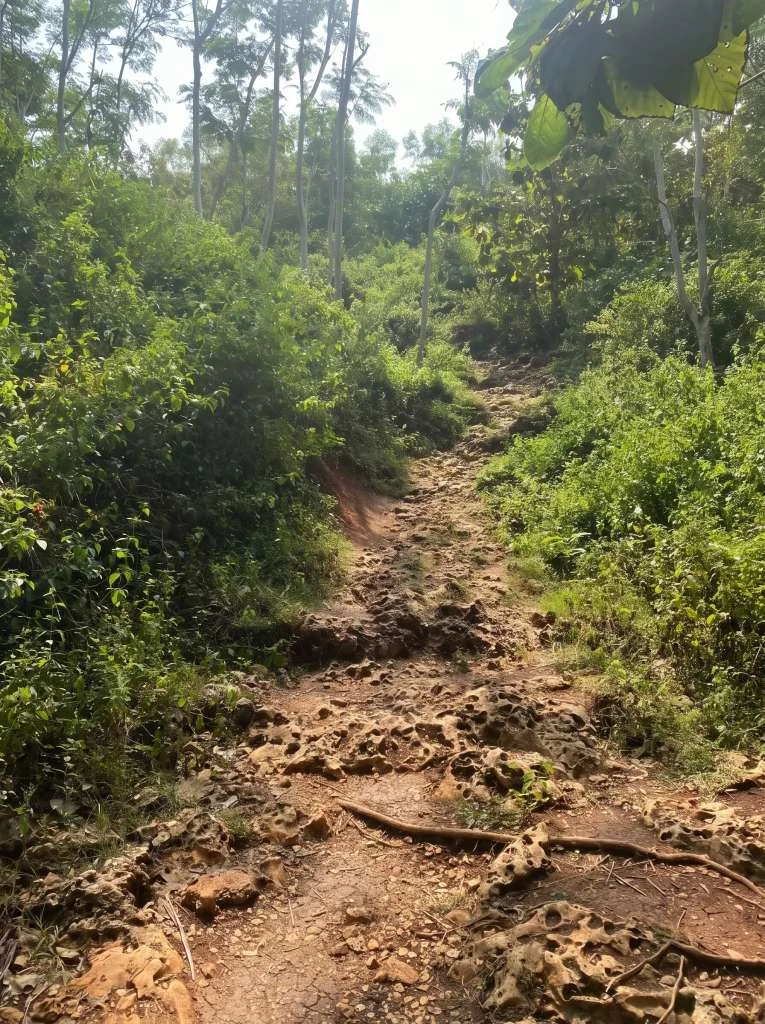
The final approach to Wohkudu Beach required navigating a steep, unpaved footpath heavily compromised by heavy rainfall earlier that afternoon. Armed with flashlights, the travelers contended with slippery mud and razor-sharp limestone projections that lined the descent through the karst hills.

The physical toll of the trek was compounded by sensory deprivation; surrounded by dense foliage and absolute darkness, the auditory cues of the ocean remained faint for much of the descent. It was only after an extended march down the sloping terrain that the deep, resonant roar of the waves broke the nocturnal silence, signaling the proximity of the coast. Upon arrival at the shoreline, the soft luminescence of campers’ tents confirmed the presence of fellow travelers inhabiting the remote cove.
Confronting Coastal Extremes: A Midnight Storm
With the hour approaching midnight, the expedition members swiftly erected their tents directly upon the white sand shoreline, positioned to face the open ocean and the barrier of coastal rock formations. Initial serenity was short-lived, as escalating offshore winds and violent wave action rapidly transformed the coastal environment.
As the night progressed, meteorological conditions deteriorated sharply. High-velocity winds and intense rainfall battered the encampment, producing wave impacts against the coral barriers that generated severe acoustic pressure. The severity of the storm ultimately compromised the structural integrity of the campsite; one of the tents succumbed to the lateral wind forces, its anchors failing to secure themselves adequately in the loose coastal sand.
Operating under severe constraints amid driving rain and gale-force winds, the travelers were forced to relocate and re-pitch their shelter mid-storm. While the incident presented immediate physical risks, it provided a rare, firsthand encounter with the unmitigated meteorological forces that continuously shape the southern coast of Java.

Dawn and Geological Reflections
By early morning, the storm front dissipated, replaced by golden sunlight breaking through from behind the eastern limestone hills. The resulting play of light cast contrasting hues across the twin karst promontories that flank Wohkudu Beach, natural bulwarks that protect the compact shoreline from the unyielding swells of the southern sea.
While Wohkudu lacks the expansive linear geography of neighboring Gunungkidul beaches, its confined architecture underscores a distinct micro-ecosystem forged by millennia of wave erosion and tectonic uplift. As daytime temperatures rose, visitors utilized the calm morning hours to explore the tidal margins before initiating the arduous ascent back through the limestone hills.
Reflecting on the expedition, the journey to Wohkudu Beach serves as a comprehensive study of endurance and natural history. By bridging the historical observations of 19th-century naturalists like Franz Junghuhn with contemporary adventure tourism, the experience highlights the complex interplay between human exploration, infrastructural isolation, and the dynamic geological forces continuously sculpting the southern perimeter of Java.