The global popularity of South Korea as a primary tourist destination has witnessed an unprecedented surge over the past decade, a phenomenon largely attributed to the "Hallyu" or the Korean Wave. This cultural export—encompassing globally acclaimed television dramas, K-pop music, and cinema—has successfully transformed the country’s image from a localized East Asian industrial hub into a premier travel destination. For international travelers, particularly from Southeast Asia, these filming locations serve as physical manifestations of the narratives they consume on-screen. Beyond the visual appeal, the South Korean tourism sector has strategically leveraged this interest, integrating cinematic landmarks into the national infrastructure to boost economic growth through hospitality and retail.
The Macroeconomic Impact of Hallyu Tourism
According to data from the Korea Tourism Organization (KTO), the country saw a record-breaking influx of tourists prior to the global health crisis, with a significant percentage of visitors citing popular culture as their primary motivator for travel. The economic implications are profound; tourism-related expenditure contributes billions of dollars annually to the South Korean GDP. By meticulously preserving or thematically enhancing sites featured in major productions, the government has created a sustainable "tourism-culture" feedback loop. This strategy not only sustains the popularity of specific districts but also drives traffic to secondary and tertiary regions, spreading the economic benefits beyond the Seoul metropolitan area.
Geonbae and the Evolution of Urban Nightlife
While the name "Geonbae"—the Korean equivalent of "cheers"—is often associated with the social act of drinking, specific districts characterized by this spirit have become focal points for nightlife tourism. In neighborhoods like Hongdae or parts of Itaewon, the landscape is defined by a dense concentration of bars, pubs, and eateries that mirror the vibrant social scenes depicted in popular romantic dramas.
From an urban planning perspective, these areas are vital for the night-time economy. The concentration of nightlife venues allows for high-density pedestrian traffic, which in turn supports a massive service industry workforce. Observations from local chambers of commerce indicate that these districts are not merely tourist traps; they are essential hubs for cross-cultural exchange. For the average visitor, walking through these streets provides a sensory experience that aligns with the "metropolitan chic" aesthetic often portrayed in media, offering a tangible connection to the high-energy lifestyle seen in productions like "Itaewon Class."

Daehakro: The Cultural Heart of Seoul
For those seeking a more sophisticated immersion, the Daehakro district stands as a testament to South Korea’s commitment to the performing arts. Stretching over 1.6 kilometers, this area is frequently compared to New York City’s Broadway or London’s West End. Historically, the area earned its name ("University Street") due to its proximity to Seoul National University’s former campus. Since the university relocated in the 1970s, the district has reinvented itself as a theater district, housing dozens of small to medium-sized performance venues.
Data suggests that Daehakro hosts hundreds of plays and musicals annually, ranging from experimental fringe theater to large-scale commercial productions. This density of artistic output creates a unique ecosystem where actors, playwrights, and theater-goers converge. For tourists, Daehakro offers a glimpse into the authentic creative pulse of South Korea, away from the more commercialized shopping districts. The impact of this area is significant, as it preserves a traditional intellectual and artistic culture that contrasts with the fast-paced nature of modern corporate Korea.
Starfield Library: Architecture as a Destination
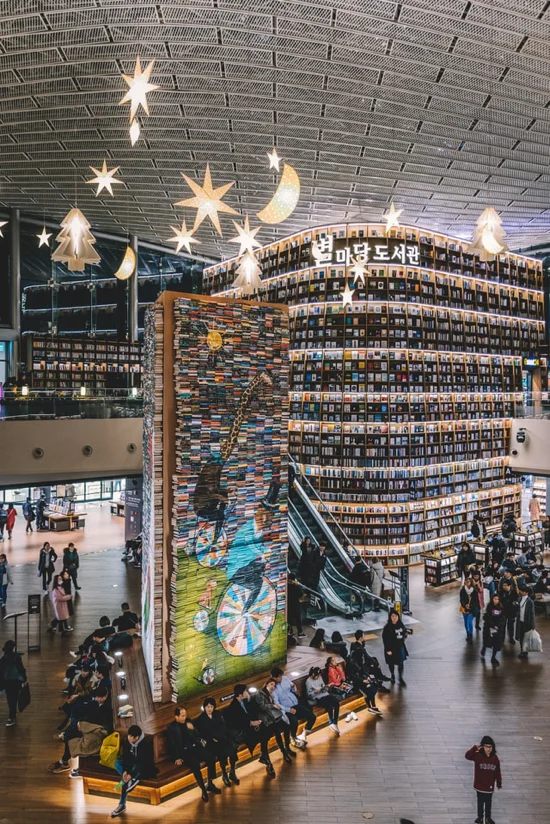
The Starfield Library, located in the heart of the COEX Mall in Gangnam, serves as a prime example of modern urban architectural design serving a dual purpose as both a functional public space and a tourist landmark. Opened in 2017, the library features a massive, open-concept design with bookshelves reaching 13 meters in height.
The library houses over 50,000 titles and provides an expansive space for reading, meeting, and quiet contemplation. Its inclusion in various television series has elevated it to an iconic status, drawing thousands of daily visitors who seek the perfect aesthetic photograph. However, beyond the visual appeal, the Starfield Library represents a broader trend in South Korean urban development: the creation of "third spaces." These are environments that are neither home nor work, designed to foster community engagement and intellectual accessibility. By integrating such a vast repository of knowledge into a commercial shopping complex, the city of Seoul has successfully bridged the gap between consumerism and culture.
Strategic Implications and Future Outlook
The success of these locations highlights a strategic shift in how South Korea markets itself. Rather than relying solely on historical sites such as Gyeongbokgung Palace, the nation has successfully promoted its contemporary lifestyle. Government officials and tourism boards have recognized that modern, "Instagrammable" locations are just as critical to the country’s tourism strategy as ancient history.

However, this rapid growth brings challenges. Over-tourism in popular neighborhoods has led to concerns regarding the quality of life for local residents. In response, municipal governments in Seoul have begun implementing regulations to balance the influx of tourists with the needs of the local community. These include noise ordinances in nightlife districts and the promotion of "off-the-beaten-path" destinations to distribute tourist foot traffic more evenly.
Conclusion: A Synthesis of Reality and Fiction
The intersection of travel and media has fundamentally altered the tourism landscape in South Korea. Locations like Geonbae, Daehakro, and the Starfield Library are more than just geographical points on a map; they are cultural touchstones that allow visitors to step into the narratives they admire. As the global interest in Korean culture continues to expand, these sites will likely undergo further development to maintain their relevance.
For the international traveler, the lesson is clear: Korea offers a multifaceted experience that caters to both the seeker of high-energy nightlife and the patron of the arts and literature. By maintaining a balance between preserving these cultural sites and modernizing their accessibility, South Korea ensures that it will remain at the top of the global tourism hierarchy for years to come. Whether one is looking for the quintessential urban experience or a quiet afternoon surrounded by books, the diverse landscape of South Korea continues to evolve, proving that its true allure lies in its ability to adapt and present its best self to the world.