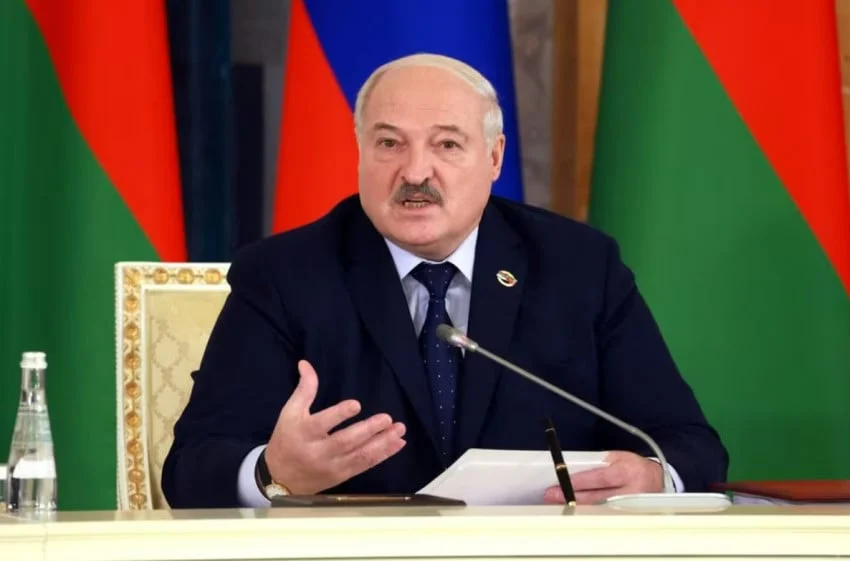
MOSCOW — In a striking development that has reverberated across diplomatic corridors in Eastern Europe, Belarusian President Alexander Lukashenko has openly questioned the historical logic utilized by Russian President Vladimir Putin to justify the ongoing military invasion of Ukraine. Lukashenko, traditionally recognized as Moscow’s most steadfast and crucial political ally, drew a provocative historical parallel during a recent interview, suggesting that if ancient territorial claims are applied to modern geopolitics, the Russian Federation could logically find itself obligated to cede vast swaths of its own sovereign territory to Mongolia.
The commentary, delivered during an extensive interview with the French publication Le Point, represents a rare instance of public skepticism from Minsk regarding the foundational ideological narratives emanating from the Kremlin. While Lukashenko has remained a primary enabler of Russia’s military campaigns—having permitted Belarusian territory to serve as a staging ground for the initial full-scale invasion of Ukraine in February 2022—his latest remarks expose underlying ideological friction within the Union State alliance.
Deconstructing the Kremlin’s Historical Revisionism
At the heart of the ideological justification presented by President Vladimir Putin for the military campaign in Ukraine is the concept of historical irredentism. Putin has repeatedly argued that Russians and Ukrainians constitute a single people, historically and spiritually intertwined through the legacy of Kievan Rus, a medieval East Slavic state that emerged in the late 9th century. According to the Kremlin’s narrative, because Kyiv served as the historic political and cultural epicenter of Rus, the modern Ukrainian state lacks a legitimate basis for independent sovereignty and rightfully belongs within the Russian geopolitical sphere.
Historians, political scientists, and international legal experts have extensively scrutinized these arguments, characterizing them as a form of historical revisionism designed to manufacture a casus belli for imperial expansion. The Kremlin’s official rhetoric has consistently downplayed the distinct linguistic, cultural, and political evolution of Ukraine over the centuries, framing the nation’s existence outside the Russian sphere as an artificial historical anomaly.
However, the intervention by President Lukashenko introduces an unexpected layer of internal critique. By reducing the Kremlin’s expansive historical logic to an absurdity, the Belarusian leader inadvertently highlighted the precarious nature of utilizing medieval history to redraw 21st-century borders.
The Mongolian Parallel and the Logic of Retrospective Sovereignty
During his discussion with Le Point, Lukashenko articulated a counter-argument rooted in the complex and often violent tapestry of Eurasian history. Addressing the notion that modern borders should reflect ancient realms, Lukashenko posed a rhetorical question that immediately caught the attention of international observers.
"If it is said that the territory of Ukraine is Russian land since ancient times," Lukashenko stated, "well, if you dig deeper, the territory of Russia once belonged to the Mongol-Tatar Empire. Remember? So, according to that logic, to whom should the entirety of Russia be handed over—to Mongolia?"
This reference targets the era of the Mongol yoke, during which the fragmented principalities of Kievan Rus were subjugated by the Mongol Empire in the 13th century. For more than two centuries, the Golden Horde exercised suzerainty over Russian lands, exacting tribute and fundamentally shaping the administrative, military, and political evolution of the nascent Russian state. By invoking this historical epoch, Lukashenko exposed the inherent vulnerability of geopolitical arguments that cherry-pick specific centuries to legitimize contemporary territorial conquests while ignoring subsequent centuries of divergent historical development.
Despite offering this biting critique, Lukashenko’s interview remained complex and internally contradictory. Observers noted that the Belarusian leader tempered his remarks by praising Putin as a shrewd and calculating politician, maintaining his overall rhetorical alignment with Moscow even as he dismantled the intellectual framework of the invasion’s justification.
Background and Context of the Russia-Belarus Alliance
To fully understand the significance of Lukashenko’s remarks, one must examine the multifaceted relationship between Moscow and Minsk, particularly in the wake of the 2020 Belarusian presidential election. Following widespread protests that erupted across Belarus—which Western governments and domestic opposition groups claimed were heavily rigged to secure Lukashenko’s sixth term—the incumbent leader found himself politically isolated from Western capitals.
Facing severe economic sanctions and domestic unrest, Lukashenko turned decisively toward the Kremlin for survival. In exchange for financial bailouts, intelligence sharing, and robust political backing, Lukashenko deepened the integration of Belarus into the Union State framework. By early 2022, this alliance manifested logistically when tens of thousands of Russian troops utilized Belarusian soil to launch the ill-fated lightning offensive toward the Ukrainian capital of Kyiv.
Throughout the nearly three years of grueling warfare that have followed, Belarus has served as a vital logistical hub, repair station, and launching pad for Russian air and missile strikes against Ukrainian infrastructure. Consequently, any public divergence from Moscow’s official messaging—however veiled or mixed with praise—carries substantial weight within international geopolitical analysis.
Chronology of Ideological Justifications and Military Escalation
The ideological groundwork for the invasion of Ukraine was laid years before the tanks crossed the border, evolving through distinct phases:
- July 2021: President Vladimir Putin publishes a lengthy, formal essay titled On the Historical Unity of Russians and Ukrainians, outlining the argument that modern Ukraine occupies historically Russian lands and that its sovereignty is fundamentally artificial.
- February 2022: Russia launches a full-scale invasion of Ukraine, utilizing Belarusian territory as a primary axis of advance. The Kremlin formally cites the need to "demilitarize" and "denazify" Ukraine, while implicitly referencing historical imperatives.
- September 2022: Moscow annexes four Ukrainian regions—Donetsk, Luhansk, Kherson, and Zaporizhzhia—following hastily organized "referendums" widely condemned by the United Nations General Assembly as illegal and illegitimate under international law.
- Throughout 2023–2024: As the conflict settles into a protracted war of attrition, Russian state media and official rhetoric increasingly emphasize civilizational warfare against the West, framing Ukraine merely as a proxy for NATO expansion rather than a sovereign nation with agency.
- Late 2024 / Early 2025: Incidental fractures in narrative synchronization emerge, highlighted by Lukashenko’s public critique of historical irredentism in his interview with Western media.
Broader Implications and International Reactions
While Western diplomats and analysts have largely dismissed the Kremlin’s historical arguments as baseless pretexts for imperial aggression, Lukashenko’s intervention provides fresh analytical material regarding the internal dynamics of the Russo-Belarusian partnership.
Diplomatic analysts suggest that Lukashenko frequently engages in a delicate balancing act. On one hand, he relies entirely on Russian military and economic patronage to maintain his authoritarian grip on power. On the other hand, he consistently seeks to preserve a degree of sovereign maneuvering room, wishing to avoid complete absorption into the Russian Federation and striving to keep Belarus from being dragged directly into the ground combat phase of the war.
By introducing the historical precedent of the Mongol Empire, Lukashenko may be attempting to signal to both domestic and international audiences that the boundaries of political compliance have practical limits. Furthermore, such rhetorical flourishes allow Minsk to occasionally project an image of independent foreign policy thinking, which could prove useful should future diplomatic negotiations to resolve the conflict eventually materialize.
Economic and Strategic Vulnerabilities of Minsk
Beyond the realm of historical debate, the structural dependence of Belarus on Moscow remains absolute. The Belarusian economy relies heavily on discounted Russian energy imports, subsidized loans, and access to the vast Russian consumer market for its industrial and agricultural exports.
Military integration between the two nations has likewise reached unprecedented heights. The deployment of Russian tactical nuclear weapons to Belarusian territory in 2023 cemented Minsk’s role as a frontline state in the ongoing standoff between Moscow and the NATO alliance. This deep security entanglement ensures that, despite occasional verbal deviations from the Kremlin script, operational control over strategic military assets within Belarus remains firmly in Russian hands.
Conclusion
Alexander Lukashenko’s comparison of Russian historical claims on Ukraine to a hypothetical Mongolian claim over modern Russia serves as an ironic reminder of the perils inherent in utilizing ancient history to justify modern warfare. While the remark was embedded within an interview that ultimately reaffirmed his loyalty to the Kremlin, it exposed the logical fragility of the ideological foundation underpinning the invasion.
As the conflict in Ukraine continues to exact a devastating human, economic, and geopolitical toll, statements of this nature underscore the complex, transactional, and occasionally contradictory nature of the alliance between Moscow and Minsk. Whether this rhetorical slip will have any tangible impact on the trajectory of the war remains highly doubtful, but it permanently documents the internal contradictions voiced even by Vladimir Putin’s closest international partner.