Nestled in a modest alleyway off Jalan Jaksa Agung Suprapto, the quiet hum of activity in Malang begins to peak just as the evening chill settles over the city. Long before urban revitalization projects reshaped East Java’s second-largest city, the flickering lights of a small street-side cart have drawn crowds evening after evening. This is the home of Puthu Lanang, a culinary institution that has operated continuously since 1935. In an era defined by rapid culinary commercialization, fast-casual chains, and constant menu reinvention, this legacy stall stands as a testament to the enduring appeal of heritage street food, maintaining its original recipes, operational scale, and unwavering commitment to quality across nearly nine decades.
A Chronological Evolution: From Itinerant Cart to Culinary Landmark
The history of Puthu Lanang is deeply intertwined with the social and economic fabric of Malang. The enterprise was established in 1935 by the late Supiah and her husband, Abdul Jalal. During the Dutch colonial period and the subsequent turbulent years of the Indonesian national revolution, the couple operated without a fixed location, traversing the neighborhoods of Malang using traditional wooden shoulder poles (pikulan) to hawk their freshly steamed rice cakes.
As the city expanded post-independence, Supiah and Abdul Jalal eventually settled their operations in the Celaket district. Locals quickly dubbed the delicacy "Puthu Celaket," a moniker that gained such widespread recognition that competing vendors throughout the region adopted similar names to capitalize on its burgeoning reputation.
The turning point in the business’s structural continuity occurred in 1985. Siswoyo, the son of Supiah, formally assumed management responsibilities. Having assisted his mother since childhood—balancing his formal education with daily labor at the stall—Siswoyo made the conscious decision to preserve the family trade upon completing his higher education. Recognizing the changing economic landscape, he introduced institutional diversification, expanding operations to handle catering requests for hotels, corporate gatherings, and traditional market snack towers (tumpeng jajanan pasar).
The official rebranding to "Puthu Lanang" occurred in the early 2000s. Derived from a casual family discussion regarding the absence of male grandchildren in the lineage at the time, Siswoyo proposed the name lanang—which translates to "male" in the Javanese language—to serve as a masculine counterpart to the more common moniker puthu ayu. In 2003, with the pro bono assistance of a regular patron who worked as a notary, the trademark was officially registered and legally protected, cementing its identity away from the generic regional titles of the past.

The Gastronomic Mechanics of Traditional Puthu
The enduring appeal of Puthu Lanang transcends mere nostalgia; it is anchored in the precision of its culinary methodology and the sensory experience of its production. Unlike modern mass-produced snacks, the manufacturing process is transparently executed before the waiting clientele.
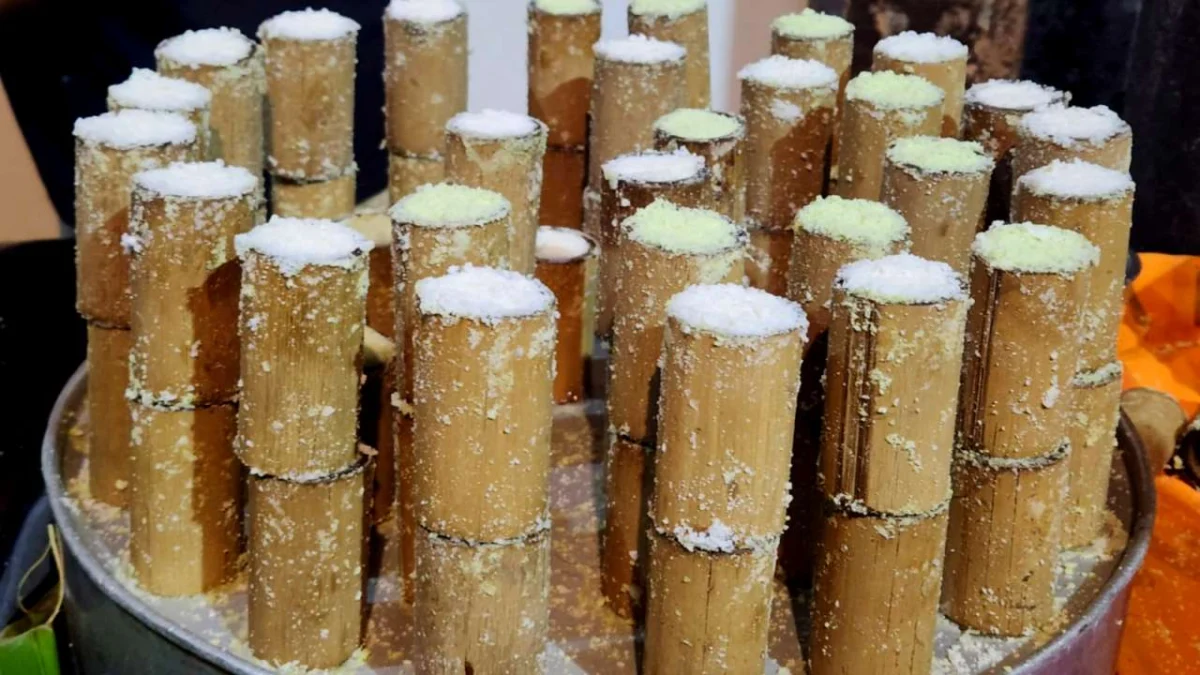
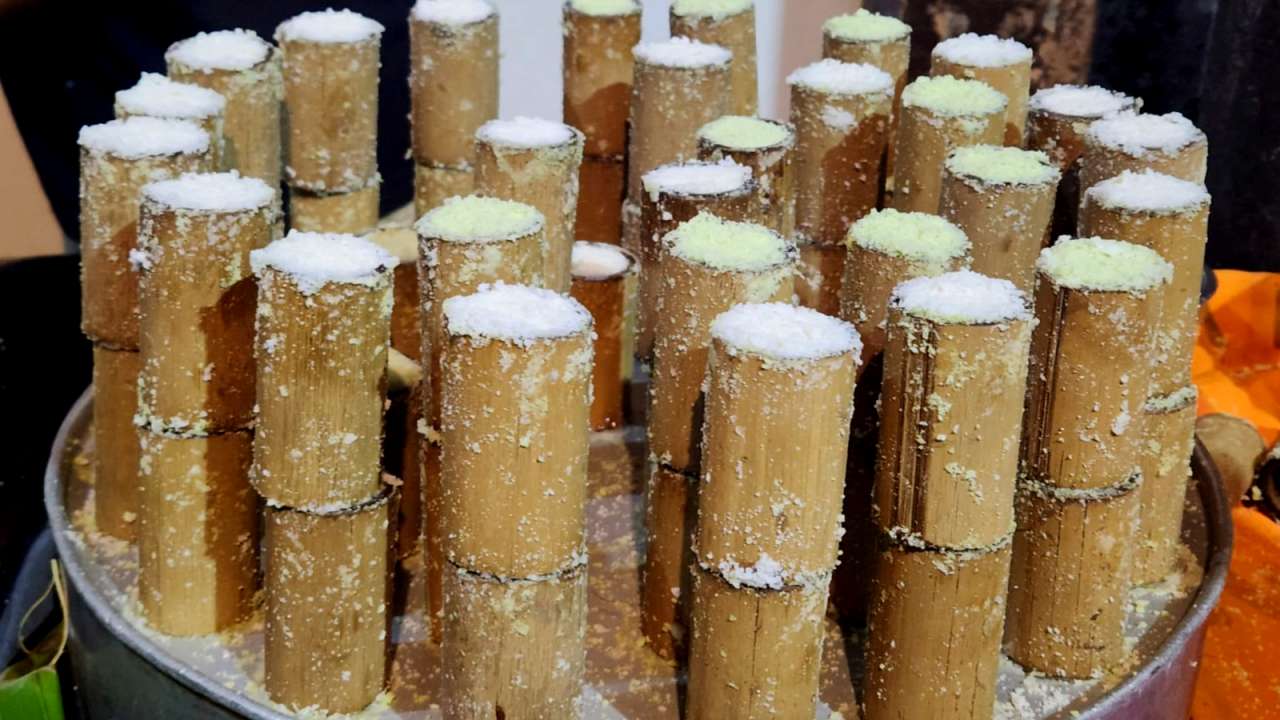
The primary ingredient, coarse-ground rice flour, is lightly packed into specialized cylindrical bamboo tubes. Layers of dark palm sugar (gula jawa) are interspersed within the flour before the apparatus is placed over a specialized steaming vessel utilizing pressurized steam. Within minutes, the heat forces moisture through the grain, rendering the flour soft and cohesive while melting the interior sugar into a viscous core.
Upon extraction, the cylindrical cakes are coated generously in freshly grated coconut. Puthu Lanang maintains two primary variants: the classic white rice formulation and a vibrant green iteration infused with natural pandan leaf extract. The resulting textural profile relies on the juxtaposition of the pliable, neutral-flavored rice cake against the molten, caramel sweetness of the palm sugar and the savory crunch of the coconut.

Beyond its signature dish, the stall offers a curated selection of classical Javanese pastries (jajanan pasar), including lupis (glutinous rice wrapped in banana leaves), cenil (chewy tapioca starch confections), and klepon (sweet rice flour balls bursting with liquid palm sugar). These items are frequently sold as a consolidated mixed portion priced at approximately IDR 18,000, providing an accessible cross-section of traditional East Javanese confectionary arts.
Operational Philosophy: The Principle of "Jual Mau, Beli Mau"
At the core of Puthu Lanang’s longevity is a strict operational philosophy summarized by the family adage, “jual mau, beli mau”—loosely translated as "what is offered for sale must be worthy of being bought and consumed by one’s own family." This ethos dictates every phase of the supply chain and food preparation cycle.
According to management, cost-cutting measures are strictly prohibited. Fresh coconut is procured daily to prevent rancidity, and artificial preservatives, synthetic sweeteners, or chemical food colorings are intentionally excluded from the production line. When national macroeconomic pressures cause spikes in the prices of foundational commodities such as rice flour, palm sugar, or coconut, the enterprise absorbs the fiscal margin rather than compromising on ingredient grade or portion size.

This uncompromising stance on quality control has cultivated profound customer loyalty, fostering multi-generational patronage. It is common for elderly residents of Malang who frequented the cart in their youth to introduce their grandchildren to the establishment, establishing a generational rite of passage. Furthermore, the brand’s reputation has attracted high-profile figures. Historical records and family anecdotes indicate that the stall has catered to prominent political figures across Indonesian history, including former President Suharto—who reportedly summoned the vendors to the Cendana presidential residence in Jakarta during the 1980s—as well as former President Megawati Soekarnoputri and current political leaders.
Economic and Cultural Implications: The Choice Not to Scale
In contemporary business analysis, heritage food brands of this magnitude are frequently pressured to pursue aggressive franchise models, centralize production, or migrate to metropolitan hubs such as Jakarta to maximize profitability. Puthu Lanang has repeatedly resisted such overtures.
Siswoyo and his management team have turned down multiple partnership offers and expansion proposals, citing the perishable nature of the product. Traditional puthu experiences rapid quality degradation post-steaming; refrigeration alters its texture, and reheating compromises its aromatic integrity. By deliberately restricting operations to a single location at Gang Buntu, Jalan Jaksa Agung Suprapto, the enterprise prioritizes quality assurance and brand integrity over exponential financial growth.

This conservative economic model carries significant implications for urban cultural preservation. As Malang transitions into a modern educational and tourist hub characterized by commercial cafes and contemporary dining concepts, pockets of tangible cultural heritage like Puthu Lanang provide urban anchors. They contribute to the local tourism economy not through infrastructural scale, but through experiential authenticity, attracting domestic and international travelers seeking genuine historical engagement.
Conclusion
As evening operations wind down in the narrow alleyway of Jalan Jaksa Agung Suprapto, the queue of patrons waiting patiently for a paper-wrapped portion of steaming green and white cakes illustrates a broader socio-cultural truth. Puthu Lanang has endured for nearly a century not because it successfully anticipated every shift in the modern economic landscape, but precisely because it refused to compromise its foundational principles.
In an era defined by transience and speed, the steady hiss of steam escaping from bamboo cylinders remains a powerful auditory and olfactory marker of continuity—a living archive of Malang’s culinary heritage preserved one portion at a time.