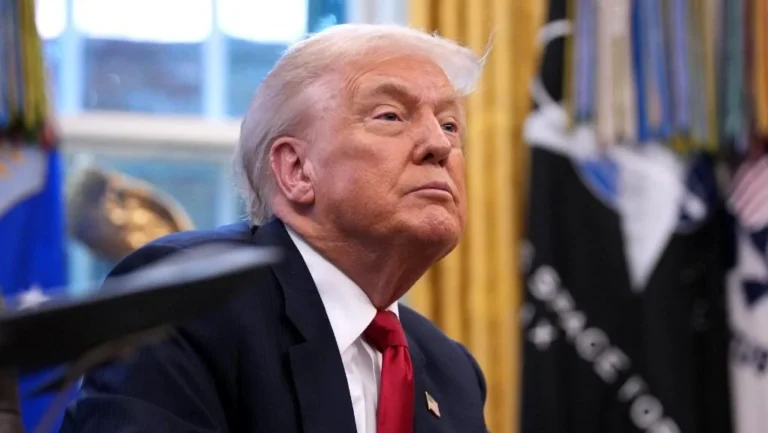
Former United States President Donald Trump has publicly claimed that his political endorsement single-handedly rescued Israeli Prime Minister Benjamin Netanyahu from a definitive defeat in the country’s high-stakes general election. Making his assertions through his proprietary social media platform, Truth Social, Trump argued that his vocal backing fundamentally shifted voter sentiment in Israel, transforming what pre-election pollsters projected as a crushing political wipeout into a competitive race characterized by a narrow lead for Netanyahu and his ruling Likud party against their primary opposition, the centrist National Unity alliance led by former military chief Gadi Eisenkot.
According to Trump, his strategic intervention successfully reversed a severe deficit in public opinion polls, altering the trajectory of the election toward either a potential political deadlock or an outright victory for the veteran Israeli leader. Writing on the platform, Trump emphasized the purported weight of his influence, stating that the dramatic shift occurred exclusively after his endorsement was publicly delivered, framing his actions as motivated by a desire to secure stability and favorable outcomes for the Middle East, Israel, and the United States alike.
The developments underscore the enduring and complex interplay between American domestic politics and Israeli electoral outcomes, a dynamic that has repeatedly surfaced during successive political cycles in both nations. As election officials continued the arduous task of processing millions of ballots across the country, international observers monitored the situation closely, analyzing how the preliminary results could redefine regional diplomacy, security policies, and the ongoing geopolitical landscape of the Middle East.
Chronology of the Electoral Showdown
The road to the latest Israeli legislative election was paved with unprecedented domestic turmoil, protracted regional conflicts, and deep societal polarization. Over the preceding months, Prime Minister Netanyahu’s political standing had faced severe erosion, driven by mounting public scrutiny over security failures, domestic policy reforms, and the complex management of multiple military fronts. Initial polling data compiled by leading Israeli news agencies and independent research institutes consistently depicted a bleak outlook for the incumbent administration, predicting that Netanyahu’s right-wing coalition would fall drastically short of the 61-seat threshold required to form a stable majority in the 120-seat Knesset.
As the campaign entered its final weeks, the opposition bloc—strengthened by the inclusion of former military chief Gadi Eisenkot and prominent figures from the centrist and center-right spectrum—gained significant momentum. Pundits and political analysts increasingly pointed toward a historic realignment in Israeli politics, forecasting that Netanyahu’s lengthy tenure as prime minister was drawing to an unceremonious close.
It was against this backdrop of projected defeat that Donald Trump issued his prominent endorsement. Following the public display of support, internal polling trends within Israel began to register subtle shifts. Campaign strategists noted a consolidation of the conservative base, which had previously shown signs of fragmentation and voter apathy. By the time polling stations closed and the initial exit polls were broadcast on television networks, the narrative of an inevitable landslide opposition victory had dissolved into a neck-and-neck statistical contest, setting the stage for a tense multi-day vote-counting process.
Current Electoral Data and Vote Tallies
As the official count progressed through Wednesday afternoon, data released by election authorities and aggregated by outlets such as The Times of Israel revealed a fiercely contested political environment. With more than 2.1 million ballots processed—representing over one-third of the total electorate—provisional results indicated a starkly different outcome from the early pre-election predictions.
The preliminary figures placed Benjamin Netanyahu’s Likud party and its aligned right-wing and religious coalition partners with a cumulative 57 seats in the Knesset. Conversely, the competing reform and opposition bloc spearheaded by Gadi Eisenkot trailed closely behind, securing 47 projected seats. Meanwhile, a collection of predominantly Arab-Israeli and Palestinian-minority parties emerged as a crucial wildcard in the legislative arithmetic, collectively tracking toward an estimated 16 seats.
These numbers represent a significant improvement over the initial exit poll projections released immediately after voting concluded, which had estimated Netanyahu’s coalition capturing merely 51 to 52 seats while placing Eisenkot’s alliance within a competitive 49 to 51 seat range. Despite the upward trajectory of the prime minister’s tally, the arithmetic reveals a persistent vulnerability. With 57 seats secured in the preliminary count, Netanyahu remains four seats shy of the magical 61-seat majority required to independently establish a functioning government, pointing toward arduous coalition negotiations ahead.
Official Reactions and Declarations of Victory
In the wake of the evolving data, Prime Minister Netanyahu wasted little time in claiming a political mandate. Addressing a gathering of enthusiastic supporters and party loyalists, the incumbent leader declared unequivocal confidence in the trajectory of the election, asserting that the preliminary results reflected a definitive democratic endorsement of his leadership and the broader nationalist agenda.
Netanyahu emphasized that the Likud party had successfully defended its position as the largest single faction in the legislature, arguing that no opposing political entity possessed the structural backing to challenge its dominance. "What we see is that the Likud party is the largest party. No one can rival us," Netanyahu declared to the cheering crowd. He further reinforced his claim by highlighting the collective strength of the right-wing bloc, asserting that the majority of the Israeli electorate had spoken in favor of conservative governance and that this prevailing majority would ultimately dictate the formation of the next administration.
Conversely, leaders of the opposition bloc adopted a more cautious tone, emphasizing that the race remained mathematically fluid until every legal ballot was accounted for. Representatives from Gadi Eisenkot’s alliance pointed out that the failure of either major bloc to secure a decisive 61-seat majority leaves the door open for protracted negotiations, potential floor-crossings, and the possibility of forming unity governments or triggering subsequent electoral cycles. The Arab-Israeli political parties also signaled their intention to leverage their projected 16 seats strategically, maintaining that their constituencies would demand substantial policy concessions before extending support to any prospective governing coalition.
Broader Implications for Domestic Governance and Regional Diplomacy
The inconclusive nature of the current vote count carries profound implications for the domestic stability and international standing of Israel. A protracted period of political paralysis could severely complicate governance at a time when the nation faces critical economic pressures, complex social debates, and heightened regional security challenges. The necessity of assembling a coalition comprising multiple distinct ideological factions historically grants smaller extremist or single-issue parties outsized leverage, often resulting in policy compromises that can strain international alliances.
From a foreign policy perspective, the potential return of a Netanyahu-led right-wing government—bolstered by the rhetorical backing of high-profile international figures like Donald Trump—signals continuity in Israel’s diplomatic posture regarding key regional adversaries and defense strategies. However, it may also exacerbate existing diplomatic frictions with Western allies who advocate for alternative approaches to the Israeli-Palestinian conflict and regional integration.
As election officials continue the meticulous verification and counting of the remaining ballots, international diplomats, financial markets, and domestic citizens alike remain fixed on Jerusalem. The ultimate resolution of this electoral deadlock will not only determine the immediate political fate of Benjamin Netanyahu but will also chart the course of Israeli statecraft and societal direction for the foreseeable future.