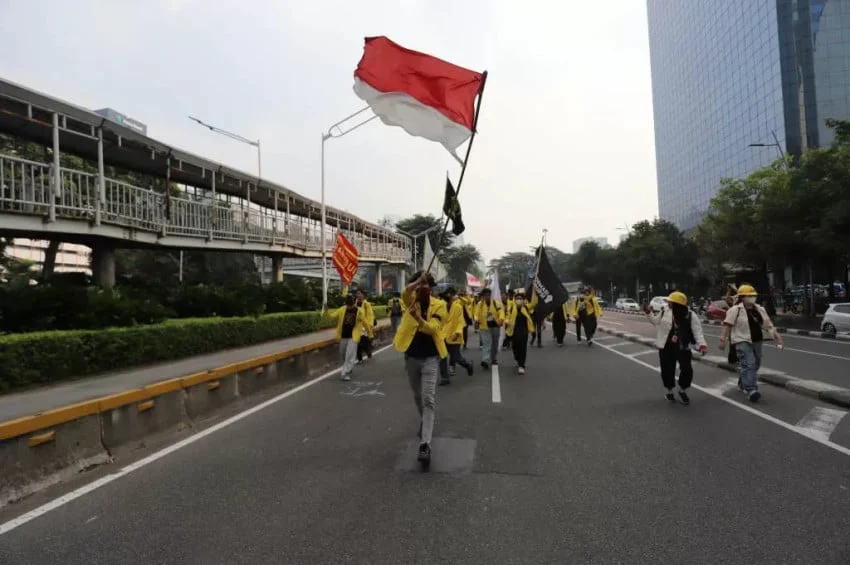
Jakarta is bracing for a series of widespread demonstrations on Wednesday, October 28, 2026, as various student bodies, prominent among them the Student Executive Board of the University of Indonesia (BEM UI), alongside broader civil society coalitions, converge on the capital to voice critical public demands. In anticipation of the mass mobilization, the Jakarta Metropolitan Police (Polda Metro Jaya) has announced comprehensive, situational traffic management plans across four critical strategic hubs in Central Jakarta.
The demonstrations are slated to begin at 10:00 AM Western Indonesian Time (WIB) and will persist until the conclusions of the respective rallies. Authorities have identified four primary zones expected to experience severe vehicular congestion: the legislative complex surrounding the People’s Consultative Assembly and the House of Representatives (DPR/MPR RI) in Senayan, the iconic Hotel Indonesia (HI) Roundabout, the National Monument (Monas) area, and the Tugu Tani historic intersection.
Commuters, public transport operators, and daily motorists traveling through Central Jakarta have been strongly advised by law enforcement to proactively seek alternative routes, adjust their travel schedules, or bypass these arterial zones entirely. Meanwhile, the orchestration of the security apparatus has drawn sharp scrutiny from human rights watchdogs, with the National Commission on Human Rights (Komnas HAM) issuing explicit reminders to security forces to prioritize a rights-based approach while managing the crowds.
Traffic Management and Operational Adjustments
According to official advisories disseminated via the Traffic Management Center (TMC) of Polda Metro Jaya through its official communication channels, including the Instagram handle @tmcpoldametro, deployment plans are fully operationalized to balance public security with the fundamental right of assembly. The police have emphasized that road closures and traffic diversions will be implemented dynamically, responding in real-time to the density and movement of the marching protesters.
The four designated zones—DPR/MPR RI complex, Bundaran HI, Monas, and Tugu Tani—represent traditional focal points for sociopolitical expressions in the capital. The DPR/MPR complex serves as the legislative heart where student leaders typically deliver direct petitions to lawmakers. Meanwhile, Bundaran HI and Monas offer expansive public plazas capable of accommodating thousands of demonstrators engaged in speeches, theatrical performances, and collective deliberations. Tugu Tani, situated near several government ministries and historical academic institutions, often acts as a critical transit node for converging student contingents.
Traffic officers from the Jakarta Traffic Directorate (Ditlantas Polda Metro Jaya) will be stationed at strategic intersections to guide motorists through alternative corridors. For instance, traffic heading toward the Gatot Subroto corridor near the legislative complex may be diverted onto parallel side streets or arterial pathways bypassing Senayan. Similarly, vehicles navigating the Sudirman-Thamrin axis near Bundaran HI will be rerouted through eastern or western flanks to minimize paralysis in the central business district.
Background Context and Catalyst for the Mobilization
The October 28 mobilization does not occur in a vacuum; it represents the culmination of mounting socio-economic and political anxieties that have simmered among Indonesian youth and civil society organizations throughout the latter half of 2026. October holds significant historical resonance in Indonesia as the commemoration month of the 1928 Youth Pledge (Sumpah Pemuda), historically serving as a rallying cry for student movements demanding institutional accountability, anti-corruption reforms, and the protection of democratic liberties.
In recent weeks, student syndicates, spearheaded by BEM UI alongside coalitions from other major campuses such as Gadjah Mada University (UGM), Institut Teknologi Bandung (ITB), and Airlangga University (Unair), have organized localized discussions addressing legislative transparency, environmental sustainability, economic pressures, and civil liberties. The convergence of these issues has translated into coordinated national action plans, with Jakarta serving as the primary epicenter.
Civil society organizations, including labor unions, environmental watchdogs, and legal aid institutes, have aligned with the student front. This inter-generational coalition argues that recent policy trajectories require robust public pushback. By selecting multiple symbolic locations across Central Jakarta, the organizers aim to decentralize their message, ensuring that both the legislative branch and the executive administration bear witness to the scale of public discontent.
Komnas HAM Issues Direct Guidance on Security Protocols
Given the historical sensitivities surrounding crowd control operations in Indonesia, the National Commission on Human Rights (Komnas HAM) has proactively intervened to establish clear operational boundaries for law enforcement personnel. On Monday, October 26, 2026, Komnas HAM Chairperson Anis Hidayah issued a formal public statement urging security forces to strictly adhere to international and domestic human rights standards during the handling of the demonstrations.
Anis underscored that the freedom of expression and the right to assemble in public spaces are constitutionally guaranteed under the 1945 Constitution of the Republic of Indonesia (UUD 1945) as well as national human rights legislation. Consequently, she asserted that these fundamental rights must be protected, facilitated, and enabled rather than suppressed.
"The duty of the apparatus is certainly to ensure the conduciveness of the implementation of this right, ensuring it is carried out peacefully, without using excessive force, and without resorting to violence," Anis stated during a press briefing in Jakarta.
Komnas HAM’s intervention reflects ongoing institutional efforts to prevent the escalation of friction between security personnel and demonstrators. Previous major protest cycles in Indonesia have occasionally been marred by instances of friction, property damage, and allegations of disproportionate use of force by security elements. By issuing a preemptive reminder, Komnas HAM seeks to institutionalize de-escalation tactics, open communication channels between field commanders and student marshals, and guarantee medical access for any participants in need.
Polda Metro Jaya Responses and Proactive Measures
In response to Komnas HAM’s advisories and operational imperatives, the leadership of Polda Metro Jaya has reiterated its commitment to humane, professional, and persuasive security management. Senior police officials have maintained that personnel deployed to the field will not be equipped with live ammunition, aligning with standard operating procedures for civil unrest and public assembly management.
Instead, crowd control units (Samapta and Brimob elements) will rely on standard non-lethal deterrents—such as water cannons and tear gas—strictly as a measure of last resort, should public order completely disintegrate or violent elements infiltrate the peaceful assemblies. Field commanders have been instructed to maintain open dialogues with student coordinators, facilitating designated pathways for long-marches and ensuring that logistics, sanitation, and medical tents can operate without obstruction.
Furthermore, intelligence units have been deployed to monitor potential agitators or third-party provocateurs who might attempt to hijack the legitimate grievances of the student movement to instigate civil unrest or vandalism. Both student marshals and police liaisons have established internal communication protocols to quickly isolate disruptive actors and preserve the peaceful character of the demonstrations.
Socio-Economic and Political Implications
The mass demonstrations scheduled for October 28, 2026, carry profound implications for the political landscape of Indonesia. As the government navigates complex fiscal reforms, infrastructural transitions, and evolving diplomatic commitments, the resurgence of an assertive student movement signals that civil oversight remains vigilant.
Economically, localized traffic paralyzation in Central Jakarta inevitably introduces operational friction for businesses operating within the capital’s commercial core. Financial institutions, retail centers, and corporate offices along the Sudirman-Thamrin corridor have instituted flexible work-from-home (WFH) policies for their employees to mitigate the risks associated with transit disruptions. However, economic analysts note that the short-term disruption is a minor trade-off for the long-term preservation of a vibrant, participatory democracy where civic feedback channels remain open.
Politically, the handling of the October 28 protests will serve as an essential litmus test for the administration’s commitment to democratic tolerance and human rights protection. A successful, peaceful mobilization managed with restraint by security forces will reinforce Indonesia’s standing as a stable democracy that respects civil liberties. Conversely, any mishandling risks reigniting polarized public debates regarding state authority and freedom of expression.
As Wednesday morning approaches, all eyes remain fixed on Central Jakarta. The interplay between thousands of idealistic students, watchful civil society groups, pragmatic traffic planners, and human rights monitors will determine the narrative of a day dedicated historically to national unity and youth empowerment. Public authorities continue to urge calm, cooperation, and adherence to established traffic directives as the capital prepares for a significant chapter in its contemporary socio-political discourse.