Standing quietly amidst the bustling thoroughfare of Jalan Kramat Raya No. 106 in Central Jakarta, the Museum Sumpah Pemuda remains one of the most sacred physical repositories of the Indonesian national independence movement. Far more than just a collection of aging artifacts and preserved architecture, this historical landmark serves as the physical cradle of modern Indonesian nationalism. It was within these very walls that the foundational identity of a unified nation was formally articulated, bridging diverse ethnic, linguistic, and regional factions into a singular collective consciousness. Today, the museum stands as a solemn reminder of the sacrifices, intellect, and profound unity of the early twentieth-century youth leaders who dared to envision an independent Indonesia long before it became a political reality.
The architectural lineage of the building itself traces back to the early 1900s, long before it gained monumental status in the annals of Indonesian history. Originally constructed as a residential dwelling owned by Sie Kong Lian, a prominent ethnic Chinese entrepreneur, the property occupied a strategic location in Batavia. As the twentieth century progressed, the socio-political landscape of the Dutch East Indies began to shift dramatically with the advent of the Ethical Policy, which inadvertently fostered a nascent class of native intellectuals. Recognizing the potential of the property, students attending the School tot Opleiding van Inlandsche Artsen (STOVIA), the premier training institution for native physicians, and the Rechtsschool, a law school for native civil servants, began renting the building around 1908.
What started primarily as a boarding house and a quiet sanctuary for academic pursuits gradually transformed into an intellectual incubator. By 1927, the building had evolved into a bustling hub for various indigenous youth organizations, earning the moniker Indonesische Clubgebouw (The Indonesian Clubhouse). It became the epicenter of nationalist discourse, where bright young minds gathered to debate anti-colonial strategies, cultural preservation, and the socio-economic upliftment of the native population. The convergence of these brilliant minds within the Kramat Raya residence set the stage for one of the most pivotal events in the archipelago’s journey toward self-determination.
Chronology of the Second Youth Congress and the Birth of a Nation
The historical trajectory leading up to October 28, 1928, was marked by meticulous planning, ideological negotiations, and an urgent desire to transcend regional divisions. The journey toward the Second Youth Congress officially commenced on August 15, 1928, when key representatives from various student and youth factions—most notably the Perhimpunan Pelajar-Pelajar Indonesia (PPPI)—assembled at the Kramat Raya building. During this preparatory meeting, delegates deliberated on the necessity of consolidating the fragmented youth movements into a unified front against colonial rule. They formally decided to organize the Second Youth Congress, building upon the foundations laid by the First Youth Congress of 1926, which had yielded promising yet localized discussions regarding unity.
The Second Youth Congress officially convened over a historic two-day period, spanning October 27 and 28, 1928, across several strategic locations in Batavia, with the final and most crucial session taking place at the Indonesische Clubgebouw on Jalan Kramat Raya. The congress brought together a diverse cross-section of youth organizations from across the archipelago, including Jong Java, Jong Sumatranen Bond, Jong Bataksbond, Pemoeda Indonesia, Jong Islamieten Bond, Jong Celebes, and Sekar Roekoen, alongside representatives of the ethnic Chinese community.
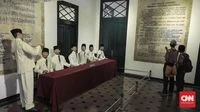
It was during the climactic final session on October 28 that the drafting committee, spearheaded by figures such as Mohammad Yamin, formulated the historic pledge. The resulting resolution, read aloud and subsequently commemorated as the Sumpah Pemuda (Youth Pledge), famously established three fundamental pillars for the nascent nation: one motherland (tanah air yang satu, tanah Indonesia), one nation (bangsa yang satu, bangsa Indonesia), and one language of unity (bahasa persatuan, bahasa Indonesia). This declaration effectively dismantled tribal and regional chauvinism, forging a collective national identity that transcended the Dutch divide-and-rule strategy.
Preservation Efforts and the Evolution into a National Museum
Following the triumphant conclusion of the 1928 congress, the building on Jalan Kramat Raya underwent numerous spatial and functional transformations as the colonial era gave way to the turbulent years of the National Revolution and the subsequent independence era. Over the decades, the historic structure served varying commercial and residential purposes, operating at different times as a private residence, a floral shop, a hotel, and a commercial office space. With each transition, the physical integrity of the historical site faced the looming threat of modern urban development and neglect.
Recognizing the irreplaceable cultural and historical value of the structure, the Jakarta Provincial Government initiated comprehensive restoration efforts in 1973 under the visionary leadership of Governor Ali Sadikin. The restoration aimed to meticulously revert the building to its 1928 architectural state, preserving the spatial layout that bore witness to the birth of the youth pledge. On May 20, 1973—deliberately chosen to coincide with National Awakening Day (Hari Kebangkitan Nasional)—the building was officially inaugurated as a museum. A decade later, on February 7, 1983, the institution was formally designated as the Museum Sumpah Pemuda, cementing its status as a protected national heritage site managed under the auspices of the Ministry of Education, Culture, Research, and Technology.
Curatorial Offerings and Priceless Historical Artifacts
Today, the Museum Sumpah Pemuda houses an extensive and carefully curated collection of artifacts, photographs, documents, and dioramas that chronicle the arduous evolution of the Indonesian nationalist movement. Among its most treasured possessions is the original violin belonging to Wage Rudolf Supratman, the brilliant composer and journalist who famously first performed the national anthem, "Indonesia Raya," on that historic October afternoon in 1928. The violin stands not merely as a musical instrument, but as a symbolic instrument of cultural resistance that helped harmonize the spirit of freedom among the delegates.
Visitors to the museum are also greeted by a faithful replica of the original Sumpah Pemuda manuscript, inscribed in the Van Ophuijsen orthography (the old spelling system of the colonial period). The faded yet powerful words on display encapsulate the ideological core of the independence struggle, reminding contemporary generations of the linguistic and cultural compromises required to build a unified state out of thousands of distinct islands and ethnic groups.
Furthermore, the museum features comprehensive photographic documentation and personal memorabilia belonging to pivotal architects of the youth movement, including prominent national figures such as Mohammad Yamin and Professor Mr. Soenario. Exhibits also highlight the contributions of various indigenous scouting organizations, such as the Indonesische Nationale Padvinderij (INPO), which played a crucial role in instilling discipline, camaraderie, and nationalist values among the youth. The inclusion of the Youth Unity Monument (Monumen Persatuan Pemuda) on the premises further enhances the educational landscape of the museum, providing a focal point for reflection and historical study.
Visitor Information, Operational Hours, and Economic Accessibility
In its ongoing commitment to public education and historical preservation, the management of the Museum Sumpah Pemuda maintains a structured and accessible visitation schedule designed to accommodate students, researchers, domestic tourists, and international visitors alike. The museum opens its doors from Tuesday through Thursday, as well as on Saturdays and Sundays, operating between 08.00 and 16.00 Western Indonesian Time (WIB). On Fridays, operating hours are slightly extended to close at 16.30 WIB to accommodate religious schedules. To facilitate maintenance, curatorial inventory, and staff rest, the facility remains closed to the public every Monday and on official national public holidays.
To ensure that historical education remains financially accessible to all segments of society, the admission fee structure is kept remarkably modest. Domestic visitors aged twelve and above are charged a nominal entry fee of Rp5,000, while children aged three to twelve enjoy a subsidized rate of Rp3,000. Meanwhile, foreign tourists seeking to explore the origins of Indonesian nationalism are charged an entry fee of Rp25,000. These modest revenues contribute directly to the upkeep, conservation, and educational programming of the museum, ensuring that future generations can continue to engage directly with the physical roots of the republic.
Broader Impact and Implications for Modern National Identity
The enduring relevance of the Museum Sumpah Pemuda extends far beyond its physical boundaries or its role as a repository for historical relics. In an era marked by rapid globalization, digital fragmentation, and occasional resurgences of regionalism or sectarian tensions, the museum functions as an ideological anchor for the Indonesian republic. It serves as a physical manifestation of the foundational social contract that binds the world’s largest archipelago together: the conscious choice of unity over division.
Historians, sociologists, and political analysts frequently point to the events of October 1928 as a masterclass in coalition-building and diplomatic foresight among marginalized populations. By choosing a single unifying language—Bahasa Indonesia—over the dominant vernaculars of larger ethnic groups like Javanese or Sundanese, the youth leaders demonstrated a pragmatic egalitarianism that prevented linguistic hegemony and laid the groundwork for a truly inclusive democratic state. Consequently, visits to the Museum Sumpah Pemuda are frequently integrated into civic education curricula, serving as a mandatory pilgrimage for students seeking to understand the immense cost and careful deliberation involved in constructing the Indonesian nation-state.
As contemporary Indonesia navigates the complexities of the twenty-first century, the legacy preserved within the walls of the Kramat Raya building remains profoundly vital. It challenges citizens to reflect upon the responsibilities of citizenship, the power of dialogue in resolving complex pluralistic challenges, and the continuous labor required to maintain national cohesion. Through its meticulous preservation of the past, the Museum Sumpah Pemuda continues to illuminate the path forward, ensuring that the foundational oath of 1928 echoes not only in history books, but in the living conscience of every Indonesian.