
The modern technology landscape has long been defined by walled gardens, where consumers find themselves tethered to specific ecosystems due to the friction involved in moving data between competing platforms. For years, transferring a simple photograph or a high-resolution video from an Android smartphone to an Apple iPhone required third-party messaging apps, cloud storage workarounds, or cumbersome wired connections. However, the paradigm of cross-platform connectivity is undergoing a seismic shift. Xiaomi is stepping up to dismantle these traditional barriers with the introduction of its latest flagship device, the Xiaomi 17T Pro. Powered by the advanced Xiaomi HyperOS, the smartphone brings robust, native cross-ecosystem file sharing capabilities to users, bridging the historically rigid divide between Android and iOS.
At the core of this cross-platform functionality is the integration of Quick Share and Xiaomi HyperConnect. These features are designed to address a very common modern consumer dilemma: the growing number of individuals who mix and match their hardware, utilizing an Android smartphone alongside an Apple iPad, MacBook, or iPhone. By enabling direct, wireless data transfers without the need for external intermediaries, Xiaomi is redefining what users can expect from mobile device interoperability. This strategic push toward ecosystem openness not only enhances day-to-day convenience but also signals a broader industry movement toward user-centric connectivity.
The Evolution of Cross-Platform Interoperability and Industry Chronology
To understand the significance of the Xiaomi 17T Pro’s cross-ecosystem capabilities, one must look at the broader timeline of mobile technology integration. For over a decade, proprietary protocols like Apple’s AirDrop set the gold standard for frictionless file sharing, but their utility was strictly confined to devices bearing the Apple logo. Android users, meanwhile, relied on a fragmented assortment of third-party applications, web-based transfer tools, or Bluetooth protocols that often suffered from slow transfer speeds and connection instability.
The turning point for Android-to-iOS interoperability began to take shape in late 2025. In November of that year, Google initiated a major breakthrough by rolling out initial cross-platform sharing support between Android devices and iPhones, debuting the functionality within its Google Pixel 10 hardware family. This development laid the groundwork for a broader industry standard. Building upon this foundation, Google announced plans in May 2026 to expand the availability of these interoperability features to its key hardware partners, granting third-party manufacturers the ability to integrate similar cross-platform sharing protocols into their custom user interfaces.

Xiaomi has rapidly capitalized on this open framework, embedding the functionality directly into the architecture of Xiaomi HyperOS. Through the implementation of Quick Share protocols that communicate seamlessly with Apple’s device discovery mechanisms, the Xiaomi 17T Pro allows users to effortlessly bypass historical platform restrictions. Furthermore, Xiaomi’s proprietary HyperConnect technology extends this connectivity even further, utilizing the Xiaomi Interconnectivity application to link the smartphone with a wider array of Apple hardware, including iPads and Mac computers, via local Wi-Fi and Bluetooth networks.
Official Perspectives on User-Centric Design and Content Creation
The push toward cross-ecosystem integration is not merely a technical achievement; it is a direct response to consumer behavior and the evolving demands of mobile content creators. As smartphone cameras achieve professional-grade quality, the volume and size of media files generated by everyday users have skyrocketed. Consequently, the journey of a piece of content—from the moment it is captured to the moment it is edited, shared, and published—has become a multi-step workflow that often spans multiple devices and platforms.
Weighing in on this consumer-centric philosophy, Andi Renreng, Marketing Director of Xiaomi Indonesia, emphasized that the modern smartphone experience extends far beyond the physical act of pressing a shutter button. According to Renreng, the true value of a mobile device lies in the entire lifecycle of content creation, which includes processing, enjoying, and distributing captured memories with absolute ease.
"We understand that the experience of using a smartphone today does not stop when a user successfully takes a photo or records a video," Renreng stated. "There is a continuous need to process, enjoy, and share every single one of those moments effortlessly."
He further elaborated that the development of the Xiaomi 17T Pro and the underlying Xiaomi HyperOS was guided by the vision of providing a holistic experience. This approach ensures that users are empowered from the initial capture phase all the way through to cross-ecosystem distribution, removing artificial bottlenecks that hinder productivity and creative expression.

Step-by-Step Implementation: How to Transfer Files from Xiaomi 17T Pro to iPhone
For users looking to take advantage of these new connectivity features, Xiaomi has streamlined the transfer process while maintaining stringent security and system compatibility requirements. Utilizing Quick Share to send files from the Xiaomi 17T Pro to a compatible iPhone relies on matching wireless protocols, effectively bridging Android’s sharing architecture with AirDrop-compatible discovery.
Before initiating a transfer, users must ensure that their devices meet specific software and configuration prerequisites. According to official Xiaomi documentation, the Xiaomi 17T Pro must be properly signed into a Google account, and the system must be updated to the latest Google Play System version that incorporates Apple device sharing support. Additionally, users need to verify that the "Share with Apple Devices" option is enabled within their system settings.
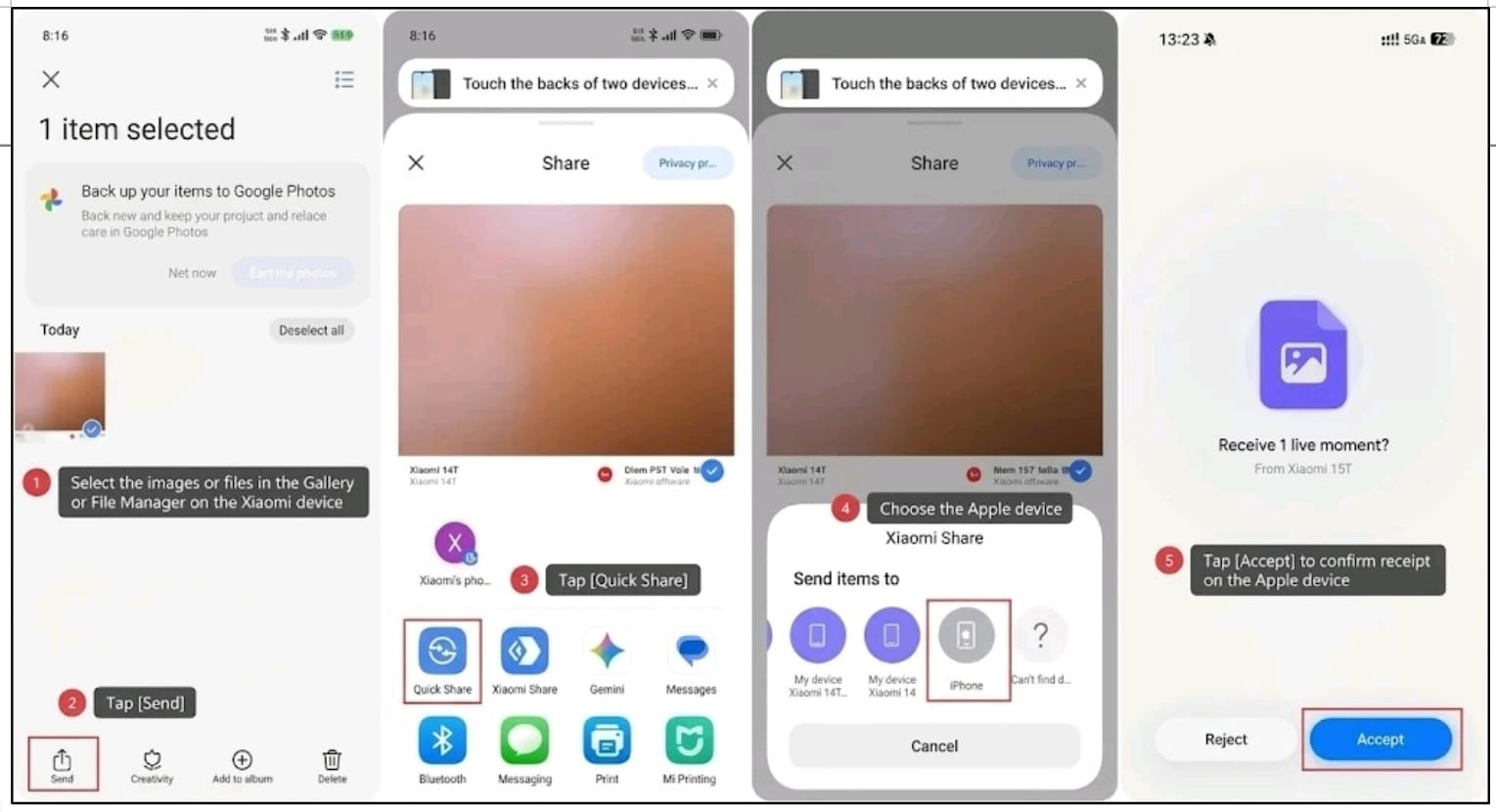
When executing a transfer via Quick Share, the process follows a straightforward workflow:
- Open the Gallery or File Manager application on the Xiaomi 17T Pro.
- Select the specific photo, video, or document intended for transfer.
- Tap the Share icon and select the Quick Share option.
- Ensure that the target iPhone is within range, has its discovery settings active, and appears on the device radar.
- Accept the incoming transfer prompt on the iPhone to complete the file migration.
For scenarios utilizing Xiaomi HyperConnect, the mechanism differs slightly. Because HyperConnect operates via the Xiaomi Interconnectivity ecosystem, Apple users must first download and install the official Xiaomi Interconnectivity application from the Apple App Store. Once installed, users open the Xiaomi Gallery, select the desired media, tap the Send button, and choose the detected Apple device. The file is then received seamlessly through the companion app on the iOS device, provided both gadgets share the same local network environment and have Bluetooth enabled.
Engineering Excellence: The Leica-Powered Camera System
The need for advanced cross-platform file sharing is underscored by the formidable imaging capabilities built into the Xiaomi 17T Pro. Designed to serve as a powerhouse for mobile photography and videography, the smartphone features an advanced triple-camera system developed in strategic collaboration with legendary optics brand Leica, utilizing high-performance Leica Summilux optical lenses.
At the heart of the imaging array is a 50-megapixel primary sensor—the Light Fusion 950—measuring a substantial 1/1.31 inches. This large sensor is complemented by Optical Image Stabilization (OIS), which effectively dampens hand tremors and physical movement to deliver sharp stills and steady footage even in challenging lighting conditions. To complement the primary shooter, Xiaomi has integrated a 50-megapixel periscope telephoto lens offering 5x optical zoom, enabling users to capture distant subjects with remarkable clarity. Rounding out the hardware is a 12-megapixel ultra-wide-angle camera with a expansive 120-field of view, ideal for sweeping landscapes and group portraits.
Videographers are similarly well-catered for, as the Xiaomi 17T Pro supports cinematic recording resolutions of up to 8K at 30 frames per second and 4K at an ultra-smooth 120 frames per second. Innovative software additions, such as Leica Live Moment, allow creators to capture dynamic moving sequences alongside rich contextual data. Once captured, users can immediately utilize the device’s comprehensive on-board editing suite to crop, color-grade, apply bespoke Leica filters, or assemble collages before dispatching the files to other devices via Quick Share or HyperConnect.
Robust Performance, Display Brilliance, and All-Day Battery Architecture
Processing high-resolution video streams, managing complex computational photography algorithms, and handling cross-ecosystem data transmissions require immense hardware horsepower. To meet these demands, the Xiaomi 17T Pro is driven by the cutting-edge MediaTek Dimensity 9500 chipset, built upon an advanced 3-nanometer fabrication process. Utilizing an All-Big-Core architecture, the processor is engineered to effortlessly conquer intensive multitasking and high-load workloads while maintaining exceptional energy efficiency.
To sustain peak performance during extended gaming sessions or prolonged 4K video rendering, Xiaomi has incorporated an advanced 3D IceLoop cooling system, which rapidly dissipates thermal buildup. Visuals are brought to life on a sprawling 6.83-inch AMOLED display boasting a 1.5K resolution, a fluid 144Hz refresh rate, 12-bit color depth, and comprehensive Dolby Vision certification. For outdoor legibility, the panel is capable of achieving a peak brightness of up to 3,500 nits under testing conditions.

Powering this comprehensive feature set is a high-density 7,000 mAh silicon-carbon battery designed to easily weather heavy daily usage. When it is time to recharge, the device supports ultra-fast 100W HyperCharge via a physical cable, alongside 50W wireless HyperCharge capabilities, ensuring minimal downtime for creators on the move.
Implications and Future Outlook of Cross-Ecosystem Integration
The introduction of native cross-platform file sharing on devices like the Xiaomi 17T Pro represents a notable milestone in consumer electronics. By breaking down the barriers that have historically separated Android and iOS ecosystems, manufacturers are responding to consumer demand for greater flexibility and reduced hardware lock-in.
For the average consumer, the implications are profound. The ability to instantly transfer media from a high-performance Android camera phone to an Apple laptop or tablet without relying on third-party cloud uploads streamlines workflows and preserves file integrity. While cross-device compatibility remains subject to software updates, hardware specifications, and regional firmware rollouts, the trajectory is clear. As platforms become increasingly interoperable, the consumer experience will no longer be defined by the brand logo on the back of a device, but rather by the seamlessness with which technology integrates into daily life.