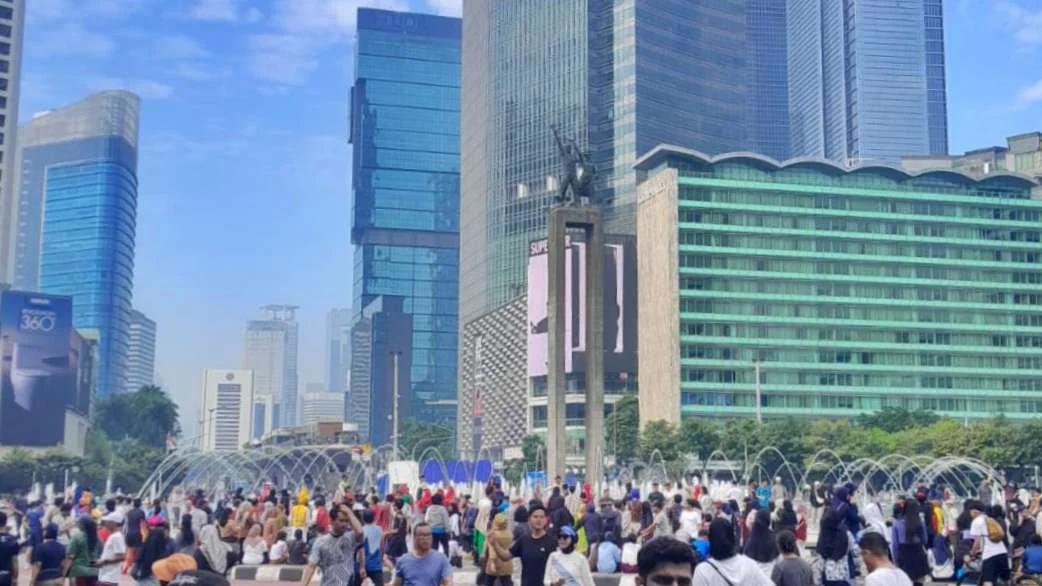
The iconic Welcome Monument, locally known as Patung Selamat Datang, has once again captured the public spotlight following a series of high-profile demonstrations and civic activities in the heart of Jakarta. Standing tall at the bustling Hotel Indonesia (HI) roundabout, the historical landmark recently bore witness to a daring environmental protest by Greenpeace Indonesia activists, turning public attention back to the architectural marvel that has defined the capital’s skyline for over six decades.
The early morning hours of October 20, 2026, marked a dramatic scene at the landmark when six Greenpeace activists scaled the peak of the Welcome Monument. Suspended from the towering structure, they unfurled giant yellow banners bearing the messages: "Handle the Climate Crisis, Lower the Cost of Living" and "Protecting the Environment = Protecting Quality of Life." The coordinated action by four men and two women quickly circulated across digital media platforms, generating widespread public discourse before on-site security personnel intervened and safely concluded the protest.
This demonstration catalyzed a sequence of mass gatherings at the Bundaran HI area. Just days later, on October 28, 2026, the location served as a primary assembly point for a large civilian protest. This was followed closely on October 29 by a chaotic Youth Pledge (Sumpah Pemuda) declaration event organized by university student groups, which later drew controversy due to the involvement of fraudulent representatives. These consecutive events thrust the historical monument back into the immediate line of sight for millions of commuters, residents, and observers, reminding the city of its enduring symbolic significance.
A Historical Gateway: Architectural Vision of the 1960s
Nestled among towering modern skyscrapers such as the Grand Indonesia shopping complex, Wisma Nusantara, and the historic Hotel Indonesia, the Welcome Monument occupies the intersection of Jalan Jenderal Sudirman and Jalan MH Thamrin. Despite being surrounded by contemporary commercial dominance, the bronze figures continue to project their historic greeting outward toward what was once the primary arrival corridor from Kemayoran Airport.
The inception of the monument is deeply rooted in the ambitious urban planning era of Indonesia’s first president, Sukarno. In preparation for the 1962 Asian Games IV, Sukarno initiated a series of grand infrastructure projects—often termed "lighthouse projects"—designed to project the dignity and modernity of the young republic to the international community. According to historical analyses, including insights from Farabi Fakih in Membayangkan Ibu Kota Jakarta di Bawah Soekarno, the Hotel Indonesia roundabout was conceptualized as the new gateway to Jakarta, shifting the focal point from the colonial-era Weltevreden district to the newly developing Thamrin corridor.
Hotel Indonesia itself holds the distinction of being the country’s first skyscraper, designed by American architect Abel Sorensen, while Wisma Nusantara emerged as the nation’s first modern high-rise office building. Before the monument itself was erected, the roundabout featured Indonesia’s first circular fountain, financed by Bank Negara Indonesia. Henk Ngantung, an artist who later served as the Governor of Jakarta from 1964 to 1965, metaphorically described the fountain as the "saucer on Thamrin Street"—a pioneering public installation that nurtured the capital’s early appreciation for urban aesthetics and public art.
The Artistic Process and Construction Chronology
The creation of the Welcome Monument began with a late-1959 summons at the Merdeka Palace, where Sukarno gathered prominent artists and officials, including Yogyakarta-based sculptor Edhi Sunarso, painter and future vice-governor Henk Ngantung, and sculptor Trubus Soedarsono. According to Edhi Sunarso’s autobiography, Meniti Jalan Pembebasan, Sukarno envisioned a nine-meter-tall statue to welcome international athletes and foreign dignitaries. Demonstrating the poses himself while still in his pajamas, Sukarno instructed the artists to draft individual sketches based on his vision.
Ultimately, the sketch submitted by Henk Ngantung was selected. It depicted a young man and woman smiling and waving, with the female figure holding a bouquet of flowers. The construction phase commenced in 1961 under the administration of Jakarta Governor Soemarno Sosroatmodjo, though Henk Ngantung played a prominent supervisory role.
As detailed in research by Grace Samboh and Ratna Mufida in Edhi Sunarso: Penggubah Monumen Bangsa, the creative process began with a 90-centimeter miniature model. Upon receiving presidential approval, the full-scale monument was meticulously crafted in sections in Kaliurang, Yogyakarta, due to its massive proportions, before being transported to Jakarta for final assembly.

Archival records from the September 5, 1961, edition of Berita Indonesia outline the physical specifications of the project: the structure reaches a total height of 20 meters, anchored by bronze human figures standing 6 meters tall and weighing approximately 5 tons. The statues overlook a circular pool measuring 78 meters in diameter. Henk Ngantung noted that the pool required specialized foundational pillars due to the marshy, waste-filled soil conditions of the area. Encircling the pool is a nine-meter-wide pedestrian promenade paved with high-grade tiles, cementing the location as both a visual landmark and a public urban space.
Sociological Implications and Modern Urban Identity
Officially completed in 1962, the Welcome Monument has endured as an impassive witness to the rapid socio-economic transformation of Jakarta. Sociologist Hikmat Budiman, in his work Sudah Senja di Jakarta: Ideologi, Kebijakan Publik, Politik, dan Ruang Ibu Kota, highlights a crucial characteristic of Sukarno’s monumental architecture: the intentional absence of dominant ethnic motifs. By steering clear of regional tribal symbols, Sukarno sought to articulate a unified national identity that transcended Indonesia’s diverse ethnic subdivisions.
Decades later, the space surrounding the monument continues to evolve. On typical Sunday mornings, the pedestrianized area transforms into a vibrant community hub, thronged by fitness enthusiasts and weekend crowds, functioning much like an urban town square amidst the concrete jungle.
However, the recent resurgence of high-profile events—ranging from international climate protests by Greenpeace to local political demonstrations—demonstrates that the Bundaran HI roundabout is far more than a relic of 1960s nation-building. It remains the preeminent civic stage of Indonesia, where contemporary citizens exercise their democratic rights beneath the watchful gaze of bronze figures designed more than sixty years ago to welcome a changing world.