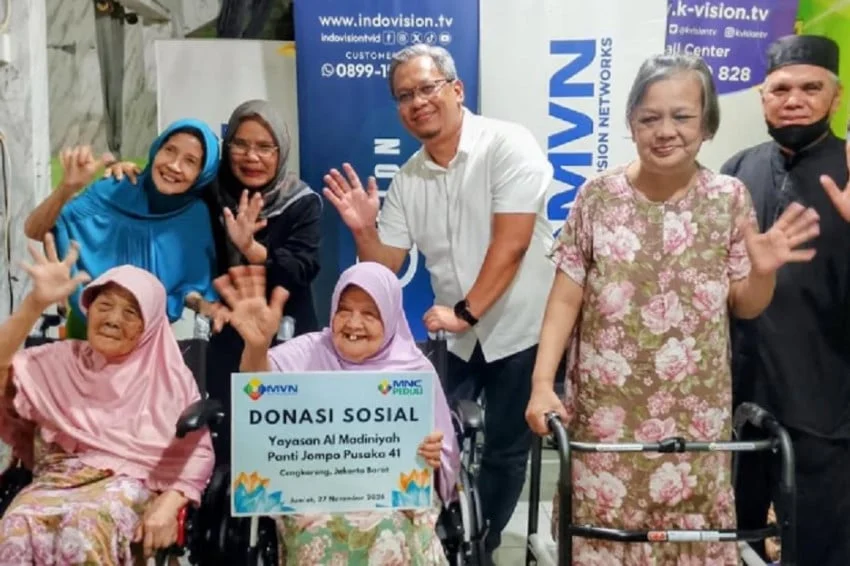
The commitment to corporate social responsibility and eldercare received a significant boost in West Jakarta as PT MNC Vision Networks Tbk, operating under the umbrella of MNC Peduli, delivered essential mobility equipment to the elderly residents of Panti Jompo Pusaka 41, housed within the Al-Madiniyah Foundation. The handover ceremony, marked by gratitude and relief from the facility’s administration, highlights an ongoing effort by major corporate entities to address the critical needs of vulnerable populations in urban centers. As demographic shifts place increasing pressure on eldercare facilities across Indonesia, targeted donations of medical and mobility aids serve as a vital lifeline for institutions operating with limited resources.
The official handover took place on Friday, November 27, 2026, at the Panti Jompo Pusaka 41 facility located in the Cengkareng sub-district of West Jakarta. Ferry Aryanto, serving in his capacity as Director of PT MNC Vision Networks Tbk, personally attended the event to deliver the assistance. The corporate delegation was received by Iis Ismawati, the head and owner of the nursing home, alongside staff members and several elderly residents. The package included six standard wheelchairs and six walking aids, items that administrators noted were urgently required to maintain the daily operational standards of the foundation.
Chronology and Background of the Initiative
The initiative was conceptualized months prior as part of MNC Peduli’s regular philanthropic calendar, which seeks to identify grassroots facilities experiencing acute shortages of basic operational tools. Panti Jompo Pusaka 41, which operates under the auspices of the Al-Madiniyah Foundation, provides shelter, care, and rehabilitation support for marginalized elderly individuals who lack family support systems or financial means to secure private care.
In the weeks leading up to the November 27 event, representatives from MNC Peduli conducted an assessment to determine the most pressing needs of the foundation. Facility administrators highlighted that while nutritional and medical needs were managed through various donor networks, structural mobility support remained severely deficient. Many of the existing wheelchairs and walkers within the facility had deteriorated due to constant use, leaving several residents confined to their beds or restricted in their ability to navigate communal areas.
Upon identifying this shortfall, PT MNC Vision Networks Tbk coordinated the acquisition of high-durability mobility aids designed to withstand rigorous daily use in a communal institutional environment. The selection of six wheelchairs and six walkers was calibrated to match the immediate occupancy metrics of the panti, ensuring an optimal distribution ratio for residents requiring physical assistance.
Official Reactions and Statements from Facility Leadership
The significance of the donation was underscored during the handover ceremony, where Iis Ismawati expressed profound appreciation on behalf of the foundation and its residents. Addressing the corporate delegation and local attendees, she emphasized the long-term utility of the provided equipment.
"Thank you very much, this is extraordinary because this assistance has a very long-term value," Iis stated during an interview at the location. "So it can be used rotationally. When one of our grandmothers passes away, it can be passed on and used by someone else. It is very extraordinary, exactly matching the needs of our facility."
Iis further elaborated on the daily operational challenges faced by the staff at Panti Jompo Pusaka 41. Maintaining the mobility of elderly residents is crucial not only for their physical health—preventing complications such as pressure sores and muscle atrophy—but also for their mental well-being and psychological resilience.
"This is extraordinary because we were facing a severe shortage of wheelchairs and walkers here," she continued. "This greatly supports our grandmothers to have a stronger will to live a long life."
The psychological impact of restored mobility cannot be overstated in geriatric care. Isolation and immobility are primary contributors to cognitive decline and depression among institutionalized seniors. By providing the means to move independently from dormitories to dining and recreational halls, the donation directly contributes to an improved quality of life for the residents.
Broader Context of Corporate Social Responsibility in Eldercare
The collaboration between PT MNC Vision Networks Tbk and Panti Jompo Pusaka 41 reflects a broader trend of corporate entities integrating social impact initiatives into their operational frameworks. In Indonesia, the intersection of rapid urbanization and changing family structures has placed unprecedented strain on traditional care models. Historically, multi-generational households assumed the responsibility of eldercare. However, economic pressures, smaller living spaces in metropolitan areas like Jakarta, and migration patterns have led to an increase in the number of seniors residing in charitable nursing homes.
Facilities like the Al-Madiniyah Foundation often rely entirely on philanthropic contributions, public donations, and the dedication of private individuals to sustain their operations. Government subsidies, while helpful, rarely cover the full spectrum of specialized medical equipment, nutritional needs, and facility maintenance required to support an aging population. Consequently, corporate social responsibility (CSR) programs initiated by major conglomerates play a pivotal role in filling these systemic gaps.
MNC Peduli, the philanthropic arm of MNC Group, has historically engaged in diverse social endeavors ranging from disaster relief and health education to environmental conservation and infrastructural support for marginalized communities. By channeling resources through specialized business units such as PT MNC Vision Networks Tbk, the organization ensures targeted interventions that address specific community vulnerabilities.
Implications for Geriatric Infrastructure in West Jakarta
The provision of mobility aids to Cengkareng’s Panti Jompo Pusaka 41 draws attention to the wider condition of geriatric infrastructure in West Jakarta and the surrounding metropolitan area. As the proportion of elderly citizens within Indonesia’s demographic profile increases—projected by national statistical agencies to reach significant milestones over the coming decades—the demand for specialized eldercare infrastructure is set to escalate sharply.
Analysts note that sustainable eldercare requires a multi-pronged approach involving public sector policy development, increased budgetary allocations for healthcare infrastructure, and robust private sector partnerships. Donations of wheelchairs and walkers, while addressing an immediate micro-level deficiency, also serve to raise public awareness regarding the challenges faced by charitable institutions.
Furthermore, the longevity and durability of the equipment donated by MNC Vision Networks Tbk are designed to maximize asset utilization. In a resource-constrained environment, the ability to reallocate durable medical equipment upon a resident’s passing ensures that the utility of the corporate contribution extends across multiple generations of residents, as noted by the facility’s administration.
Conclusion and Future Outlook
The successful execution of the handover event on November 27, 2026, marks another milestone in the ongoing philanthropic engagements led by MNC Peduli and its subsidiaries. By directly addressing the mobility needs of Panti Jompo Pusaka 41, PT MNC Vision Networks Tbk has provided both a practical tool for daily living and a psychological boost to the elderly residents of the Al-Madiniyah Foundation.
As Indonesia continues to navigate the social implications of an aging population, the collaboration between private corporations and community-based welfare institutions remains a crucial mechanism for ensuring that marginalized seniors receive the dignity, care, and support they require. Facility administrators hope that such initiatives will inspire continued engagement from the broader business community, fostering a culture of shared responsibility for the welfare of the nation’s elderly citizens.