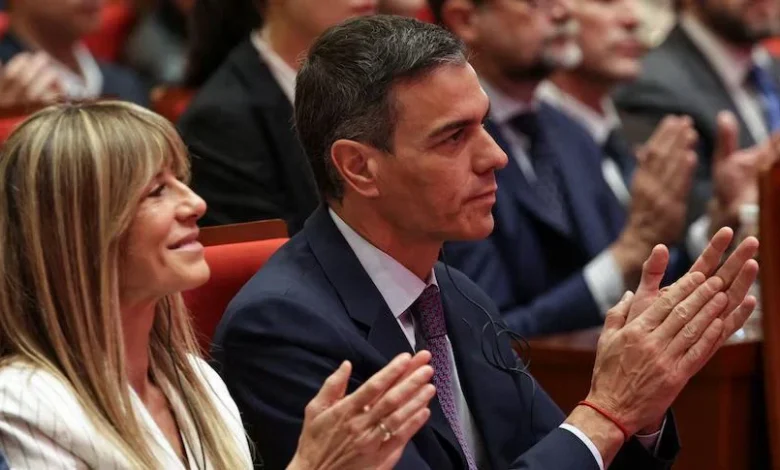
The Spanish judiciary has taken a significant and potentially destabilizing step against the administration of Prime Minister Pedro Sánchez following the formal indictment of his wife, Begoña Gómez, on multiple counts of corruption. According to court documents released in Madrid on Monday, April 13, 2026, the long-running criminal investigation into Gómez’s professional activities has yielded sufficient evidence to move forward with formal charges. The decision, handed down by Investigative Judge Juan Carlos Peinado, marks a watershed moment in Spanish politics, placing the Prime Minister’s inner circle under unprecedented legal scrutiny and threatening the stability of his minority coalition government.
The indictment of Begoña Gómez follows a two-year investigation that began in April 2024. The court’s ruling, dated April 11, 2026, outlines a series of allegations that suggest Gómez leveraged her status as the spouse of the head of government to secure professional advantages and manage public resources for private gain. Specifically, the 55-year-old has been charged with embezzlement, influence peddling, corruption in business dealings, and the misappropriation of public funds. The development has sent shockwaves through the Moncloa Palace, as Sánchez continues to maintain that the charges are part of a politically motivated smear campaign orchestrated by right-wing elements within the judiciary and the media.
The Core of the Allegations: The Complutense University Connection
At the heart of the judicial investigation is Gómez’s role at the Complutense University of Madrid (UCM), one of Spain’s most prestigious academic institutions. The inquiry focused on the creation and management of an "extraordinary chair" or master’s program focused on Competitive Social Transformation, which Gómez co-directed. Judge Peinado’s ruling suggests that the position served as a "vehicle for personal professional development" that may not have been accessible to Gómez had she not been the wife of the Prime Minister.
Prosecutors and the investigative judge have scrutinized the university’s decision to appoint Gómez to a leadership role despite her not holding a traditional doctoral degree, which is typically a prerequisite for such academic positions in Spain. Furthermore, the investigation explored whether Gómez used government-linked connections to secure sponsorships and funding for the university program from private companies that were simultaneously bidding for or receiving substantial public contracts from the Sánchez administration.
The judge’s findings indicate "sufficient indications of criminal conduct," particularly regarding the alleged use of public resources and institutional prestige to advance private interests. This aspect of the case—the intersection of academic appointments, private sector sponsorship, and government influence—forms the backbone of the influence peddling charge.
A Chronology of the Judicial Escalation
The legal troubles for Begoña Gómez did not emerge in a vacuum but are the result of a methodical escalation by the Spanish judiciary. The timeline of the case reflects a period of intense legal and political friction in Spain:
- April 2024: Judge Juan Carlos Peinado officially opens a preliminary investigation into Begoña Gómez following a complaint filed by "Manos Limpias" (Clean Hands), a self-described anti-corruption group with reported ties to far-right movements. The initial complaint focused on Gómez’s alleged letters of recommendation for business associates seeking government tenders.
- Summer 2024: The investigation expands as the court requests documents from the Complutense University and various government ministries. During this period, Prime Minister Sánchez took the unprecedented step of pausing his public duties for five days to reflect on his future, eventually deciding to remain in office despite what he called "harassment" of his family.
- 2025: Throughout the year, the investigation deepened, incorporating testimony from university officials and business executives. New allegations regarding the misappropriation of software developed for the university for Gómez’s personal business ventures were added to the probe.
- April 11, 2026: Judge Peinado signs the order to formally indict Gómez, citing the discovery of "sufficient evidence" of criminal activity across four distinct categories of financial and administrative crimes.
- April 13, 2026: The ruling is made public, coinciding with a high-profile state visit by Prime Minister Sánchez and Gómez to China.
Political Reactions and the "Lawfare" Debate
The formal indictment has triggered a firestorm in the Spanish Parliament (Cortes Generales). The conservative People’s Party (PP), led by Alberto Núñez Feijóo, and the far-right Vox party have renewed their calls for Pedro Sánchez’s immediate resignation. Opposition leaders argue that the indictment makes Sánchez’s position untenable, suggesting that a leader whose household is under criminal indictment for corruption cannot effectively govern or represent the nation’s interests.
"Spain cannot afford a Prime Minister who is more focused on his legal defense and that of his family than on the needs of the citizens," a spokesperson for the People’s Party stated following the news. The opposition has signaled its intent to launch a parliamentary commission of inquiry to further investigate the links between the Moncloa Palace and the private companies involved in the Gómez case.
In response, Pedro Sánchez has remained defiant. From Beijing, where he is conducting official diplomatic meetings, the Prime Minister reiterated his belief that the case is a manifestation of "lawfare"—the use of legal systems to delegitimize or damage political opponents. Sánchez has characterized the investigation as a "baseless attack" fueled by "ultra-right" organizations intended to topple a progressive government that they could not defeat at the ballot box.
Gómez herself has consistently denied any wrongdoing, with her legal team arguing that her professional activities were entirely transparent and that the charges represent a "distortion of administrative processes" into criminal allegations.
The Broader Context of Corruption Allegations
The indictment of Begoña Gómez is particularly damaging because it is not an isolated legal challenge facing the Sánchez administration. The Prime Minister is currently navigating a "perfect storm" of judicial probes involving his inner circle:
- The David Sánchez Investigation: The Prime Minister’s brother, David Sánchez, is currently under investigation in a separate case. He faces allegations of bribery, embezzlement, and influence peddling related to his employment by a provincial government in Extremadura. This investigation focuses on whether his hiring and subsequent salary were justified by actual work performed.
- The Koldo Case and José Luis Ábalos: Perhaps most damaging to the government’s reputation is the ongoing trial of José Luis Ábalos, the former Minister of Transport and once Sánchez’s right-hand man. Ábalos is accused of involvement in a bribery scheme related to the procurement of medical masks during the COVID-19 pandemic. The "Koldo Case," named after Ábalos’s former assistant Koldo García, has already led to several arrests and has cast a shadow over the government’s pandemic management.
The convergence of these cases has allowed the opposition to paint a picture of systemic "familial and political corruption" within the Spanish Socialist Workers’ Party (PSOE).
Institutional and Economic Implications
The formal indictment of a Prime Minister’s spouse is a rare occurrence in Western democracies and carries significant implications for Spain’s institutional health. Legal analysts suggest that the next phase of the proceedings will involve a "trial of the evidence," where the court must decide if there is enough merit to proceed to a full public trial. If the case goes to trial, it would be the first time in modern Spanish history that the wife of a sitting Prime Minister faces a criminal jury.
The timing of the indictment is also sensitive for the Spanish economy. As the government seeks to secure the final tranches of European Union recovery funds, the perception of judicial instability and high-level corruption could impact investor confidence. While Spain’s GDP growth has remained resilient compared to some of its Eurozone neighbors, the political paralysis caused by these legal battles may hinder the passage of essential legislation, including the national budget.
Furthermore, the case tests the independence of the Spanish judiciary. The tension between the executive branch and certain sectors of the judiciary has reached a boiling point, with the government accusing judges of overstepping their bounds, while judicial associations maintain that they are simply upholding the rule of law without fear or favor.
Conclusion and Next Steps
As Begoña Gómez returns from China, she faces a grueling legal schedule that will likely dominate the Spanish news cycle for months to come. The indictment does not automatically mean a conviction, but it shifts the burden of the narrative. The court must now weigh the defense’s arguments against the "indications of criminality" cited by Judge Peinado.
For Pedro Sánchez, the path forward is fraught with difficulty. His minority government relies on the support of various regionalist and nationalist parties, some of whom may find it increasingly difficult to support an administration mired in such high-profile legal controversies. While Sánchez has proven to be a resilient political survivor in the past, the formal indictment of his wife represents perhaps the most personal and legally complex challenge of his decade-long career at the forefront of Spanish politics.
The eyes of the European Union and the international community remain fixed on Madrid as the legal proceedings unfold, waiting to see if the Spanish institutions can resolve this crisis through the standard judicial process or if the political pressure will eventually lead to an early end for the Sánchez government. For now, the "Gómez Case" has evolved from a series of whispers and preliminary inquiries into a formal legal battle that will define the legacy of the current Spanish administration.