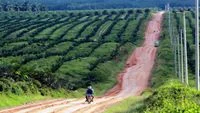
The Indonesian Palm Oil Farmers Association (APKASINDO) has issued a stern warning regarding the declining efficacy of the national Smallholder Palm Oil Replanting (Peremajaan Sawit Rakyat/PSR) program. During a recent seminar titled "Strengthening the National Palm Oil Campaign Narrative" held on Thursday, November 26, the association’s General Chairman, Gulat Manurung, highlighted a sharp contraction in annual replanting targets, which have plummeted from an initial 185,000 hectares to a mere 50,000 hectares for the current year. This downward trend, according to industry stakeholders, poses a significant threat to national crude palm oil (CPO) productivity, undermining the government’s ambitions to sustain both domestic food security and the expanding biodiesel mandate.
The Shrinking Ambition: A Chronology of PSR Targets
The PSR program was originally conceived as a strategic pillar to revitalize Indonesia’s aging palm oil plantations. Many smallholder plots, which make up a substantial portion of the nation’s total acreage, are currently dominated by trees past their prime productive age. Older palms often suffer from declining yields, making them economically inefficient and environmentally costly to maintain compared to newer, high-yield varieties.
However, the trajectory of the program has faced consistent headwinds. Data indicates that the annual replanting targets have seen a systematic reduction:
- Baseline/Initial Targets: 185,000 hectares.
- Mid-term Adjustments: 160,000 hectares, followed by a further reduction to 120,000 hectares.
- Current Status: The target has now been slashed to 50,000 hectares, a move that critics argue is fundamentally at odds with the national agenda of maximizing commodity output.
Gulat Manurung emphasized that the disparity between the government’s aspiration to lead the global CPO market and the bureaucratic reality on the ground is widening. He noted that the primary bottleneck is not a lack of farmer interest, but an insurmountable wall of administrative and legal requirements that disqualify vast swathes of smallholder land from eligibility.
The "Clean and Clear" Conundrum
At the heart of the crisis lies the "clean and clear" (C&C) status requirement. To participate in the PSR program, a farmer’s land must be free from any legal disputes, particularly regarding its classification in the national forest area inventory. Indonesia’s complex land-tenure history has left many smallholders working on plots that are now officially designated as state forest areas, even if they have been cultivated for generations.
The administrative burden of resolving these land-use conflicts is often beyond the financial and technical capacity of individual smallholder farmers. Gulat pointed out that even with the assistance of specialized teams—such as those within APKASINDO who have actively scouted for eligible land—finding plots that satisfy the rigid criteria has become nearly impossible. "We have exhausted every effort to identify land that meets the criteria, but the reality is that the pool of land labeled ‘clean and clear’ has effectively evaporated," he stated.
The irony, according to industry analysts, is that these are the very plantations that require replanting the most. By excluding them due to legacy land-use issues that the government has yet to resolve, the PSR program is essentially ignoring the segments of the industry that have the most room for yield improvement.
Productivity Gaps and the Economic Stakes
The economic stakes of the stagnation in the PSR program are high. A mature, well-maintained palm oil plantation can yield significant amounts of Fresh Fruit Bunches (FFB). APKASINDO’s internal data highlights a stark contrast in productivity between pre-replanting and post-replanting cycles:
- Pre-replanting: Yields are often as low as 500 kilograms per hectare.
- Post-replanting: With superior planting materials and better management, yields can surge to between 2.9 and 3.4 tons per hectare.
This represents a potential 5.4-fold increase in productivity. Given that the domestic demand for CPO is rising—driven heavily by the government’s B35 and future B40/B50 biodiesel mandates—the failure to modernize smallholder farms creates a long-term supply deficit.
Gulat Manurung pushed back against the narrative that the biodiesel mandate acts as a burden on the industry. Instead, he argued that the high domestic demand for energy should be viewed as a massive opportunity for local farmers. "Biodiesel is not an obstacle; it is a market opportunity. We have buyers lining up, so why are we treating the industry as if it is under threat?" he questioned. The limiting factor is not market access, but the lack of supply-side growth resulting from the stalled replanting process.
The Case for a Strategic National Mandate
The call from APKASINDO is for the government to elevate the PSR program to the status of a "Strategic National Project" (Proyek Strategis Nasional/PSN). By doing so, the association argues that the government would have the legal framework necessary to bypass certain bureaucratic hurdles.
Gulat’s proposal is straightforward: simplify the administrative requirements for farmers whose livelihoods depend on these plantations. He argues that if the program were designated as a strategic mandate, the government could streamline the verification of land status, providing a "fast-track" mechanism to ensure that the replanting budget is actually utilized rather than remaining unspent due to red tape.
"Requirements should not be used as an instrument to inhibit progress," Gulat remarked. "If the program is categorized as a national strategic priority, then administrative obstacles should be secondary to the objective of national food and energy security."
Broader Implications and Future Outlook
The frustration voiced by APKASINDO reflects a broader tension in Indonesia’s palm oil sector: the struggle to balance formal legal compliance with the informal reality of millions of small-scale farmers.
If the current trend continues, experts predict that the national palm oil industry could face a stagnation period. While large-scale corporate plantations have the resources to manage legal compliance and replanting independently, the smallholder sector—which accounts for nearly 40% of Indonesia’s total palm oil production—risks falling further behind. A decline in smallholder productivity does not only hurt the farmers’ incomes but also limits the government’s ability to stabilize the prices of cooking oil and other derivative products, as the raw material supply remains constrained.
Furthermore, there is an international dimension to this issue. Global buyers and international regulatory bodies are increasingly demanding sustainable and traceable palm oil. The PSR program is a key vehicle for ensuring that smallholders adopt modern, sustainable farming practices. If the program remains stalled, it becomes harder for Indonesia to demonstrate that it is successfully transitioning toward a more sustainable and productive agricultural future.
As the government considers its policy trajectory for the coming year, the industry will be watching closely to see if there is any movement toward loosening the administrative constraints on the PSR. Without a significant shift in policy, the gap between the nation’s potential and its actualized output will only continue to widen, leaving both the farmers and the national economy to bear the cost of bureaucratic inertia. The call for the PSR to be treated as a matter of national strategic importance is a clear signal that, for the farmers, the time for incremental change has passed.