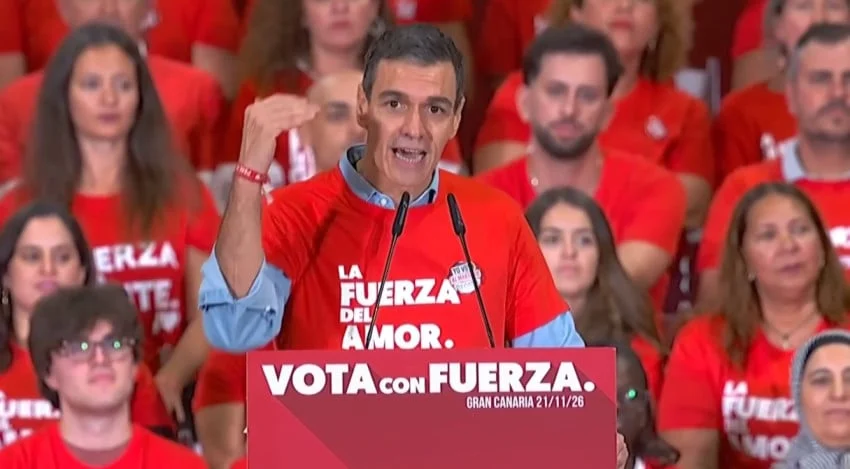
Spanish Prime Minister Pedro Sanchez has made a resolute commitment ahead of the country’s upcoming snap general election, promising to overhaul national defense legislation to permanently bar Madrid from participating in unauthorized or unlawful foreign military conflicts. Speaking before an enthusiastic crowd of supporters in the cultural and political hub of Barcelona, the leader of the Spanish Socialist Workers’ Party (PSOE) delivered a sharply critical assessment of current Middle Eastern conflicts, singling out Israeli Prime Minister Benjamin Netanyahu and condemning what he termed illegal military actions by the United States and Israel against Iran.
Sanchez’s remarks signal a decisive push to align Spain’s foreign policy firmly with the principles of international law and multilateral diplomacy. By drawing explicit historical parallels to the controversial 2003 United States-led invasion of Iraq—a war deeply unpopular among the Spanish public at the time—Sanchez aims to position his administration as an unwavering defender of global peace and a critic of military interventions that bypass United Nations mandates.
A Legislative Pledge for Peace
During his campaign rally in Barcelona, Sanchez outlined the core tenets of his government’s future foreign and defense agenda if re-elected. Central to this platform is a legislative amendment designed to tightly restrict the executive branch’s capacity to deploy Spanish armed forces or provide logistical support to foreign military campaigns that lack explicit authorization from the United Nations Security Council or broad international consensus.
“In the upcoming legislative term, we will revise the defense laws so that Spain will never, under any circumstances, be dragged into illegal wars—just as we experienced 20 years ago in Iraq, or as we are witnessing today in relation to Iran,” Sanchez declared to the applauding audience.
The prime minister emphasized that this potential legal reform represents a formal institutionalization of Spain’s anti-war sentiment. He reiterated that his administration views peace not merely as a passive preference, but as an active constitutional and moral obligation. “We are strengthening our foundational commitment to say ‘no to war’ and to rigorously uphold international law. Spain is, fundamentally and proudly, a nation of peace,” he added.
Geopolitical Context and Middle East Criticism
Sanchez’s fiery rhetoric in Barcelona did not occur in a vacuum. Over the past several years, Spain under his leadership has emerged as one of the most vocal critics within the European Union regarding Western and allied military strategies in the Middle East.
In his address, Sanchez directed pointed criticism at Israeli Prime Minister Benjamin Netanyahu, condemning the devastating military campaign in Gaza. Spain has consistently pushed for immediate humanitarian ceasefires, greater protection for civilians, and a sustainable two-state solution to the Israeli-Palestinian conflict. Furthermore, Madrid has taken tangible diplomatic steps that have periodically strained its bilateral ties with traditional allies, including formally recognizing the State of Palestine alongside several other European nations in mid-2024—a move that drew sharp diplomatic rebukes from the Israeli government.
Beyond the ongoing conflict in Gaza, Sanchez’s condemnation of potential military escalation involving Iran reflects deepening anxieties within Southern Europe regarding regional destabilization. The Spanish premier characterized recent escalations and offensive actions by the US and Israel against Iranian targets as breaches of international norms, warning that such maneuvers risk igniting a catastrophic wider conflict that could destabilize global energy markets, trigger massive refugee flows, and undermine European security.
Historical Echoes: The Ghost of the 2003 Iraq War
To fully understand the resonance of Sanchez’s promise, one must examine the profound psychological and political impact of the 2003 Iraq War on modern Spanish society.
Two decades ago, then-Prime Minister Jose Maria Aznar of the conservative People’s Party (PP) committed Spain to supporting the US-led coalition that invaded Iraq, famously posing alongside US President George W. Bush and UK Prime Minister Tony Blair at the Azores Summit. This decision was made despite overwhelming public opposition; polls at the time indicated that over 90 percent of the Spanish population opposed the war. Massive, historic protests flooded the streets of Madrid, Barcelona, and other major cities.

The political fallout for Aznar’s administration was immense. Critics argued that the intervention bypassed international law and directly provoked terrorist retaliation, most notably the devastating March 11, 2004 Madrid train bombings, which killed 192 people just days before a general election. The ensuing electoral defeat of the conservative government profoundly shaped Spain’s modern political consciousness.
By explicitly invoking the legacy of the Iraq War, Sanchez is tapping into a deep-seated national consensus against foreign entanglement. For decades, the phrase “No a la guerra” (No to war) has remained a powerful cultural and political touchstone in Spain. By promising to codify this sentiment into statutory defense law, Sanchez is attempting to bind future governments to a strict pacifist framework, preventing any future prime minister from unilaterally entangling the nation in controversial foreign interventions.
Political Implications and Domestic Reactions
The timing of Sanchez’s announcement is strategically significant. Facing a fiercely contested snap general election, the Socialist leader is seeking to energize the progressive wing of his electoral base, which places a high premium on anti-militarism, human rights, and independent European foreign policy.
Domestic reaction to the speech has predictably fractured along partisan lines.
Supporters and left-wing coalition partners praised the initiative as a courageous defense of democratic accountability and international humanitarian law. Proponents argue that introducing stricter parliamentary oversight and legal safeguards for military deployment prevents executive overreach and ensures that Spanish blood and resources are never squandered on unlawful foreign adventures.
Conversely, opposition parties, led by the conservative People’s Party (PP) and right-wing Vox, sharply criticized Sanchez’s remarks. Critics accused the prime minister of engaging in populist posturing for electoral gain at the expense of traditional alliances. Conservative lawmakers argued that weakening executive flexibility in defense matters could undermine Spain’s credibility within the North Atlantic Treaty Organization (NATO) and diminish its standing among Western allies during a period of acute global instability, marked by the ongoing war in Ukraine and heightened tensions in the Indo-Pacific and Middle East.
Foreign policy analysts have also noted the potential friction such a law could cause within international alliances. While NATO members are bound by collective defense commitments under Article 5, participating in out-of-area operations or coalition strikes has historically remained a matter of national discretion. A domestic legal framework that strictly categorizes certain allied operations as "illegal" could theoretically create legal and diplomatic impasses for Madrid’s participation in future multinational coalitions, even those operating under broad Western consensus.
Broader Impact on European Foreign Policy
Sanchez’s proposed defense overhaul reflects a broader, evolving debate within the European Union regarding "strategic autonomy." As traditional transatlantic alignments face pressure and the global order transitions toward a more multipolar framework, several European leaders are increasingly vocal about the need to chart a distinct diplomatic course that prioritizes regional stability and strict adherence to international jurisprudence.
While major European powers like Germany and France navigate complex defense modernization programs and maintain robust military commitments to various international coalitions, Spain’s vocal pacifism places it in a unique vanguard. If Sanchez successfully translates this campaign promise into formal legislation, it could establish a fascinating constitutional precedent within Western liberal democracies—effectively attempting to legally preempt the kind of foreign policy missteps that characterized the post-Cold War interventionist era.
As the campaign trail heats up, the debate over defense reform, international law, and Spain’s place in the global security architecture will undoubtedly remain central to the national discourse. Whether Sanchez’s ambitious pledge materializes into binding statute will depend heavily on the outcome of the ballot box and the shifting parliamentary arithmetic of the Spanish Cortes Generales. For now, however, the message from Barcelona is unmistakable: Spain’s progressive leadership intends to anchor its future firmly on the side of international law, resolute in its historical aversion to foreign entanglements.