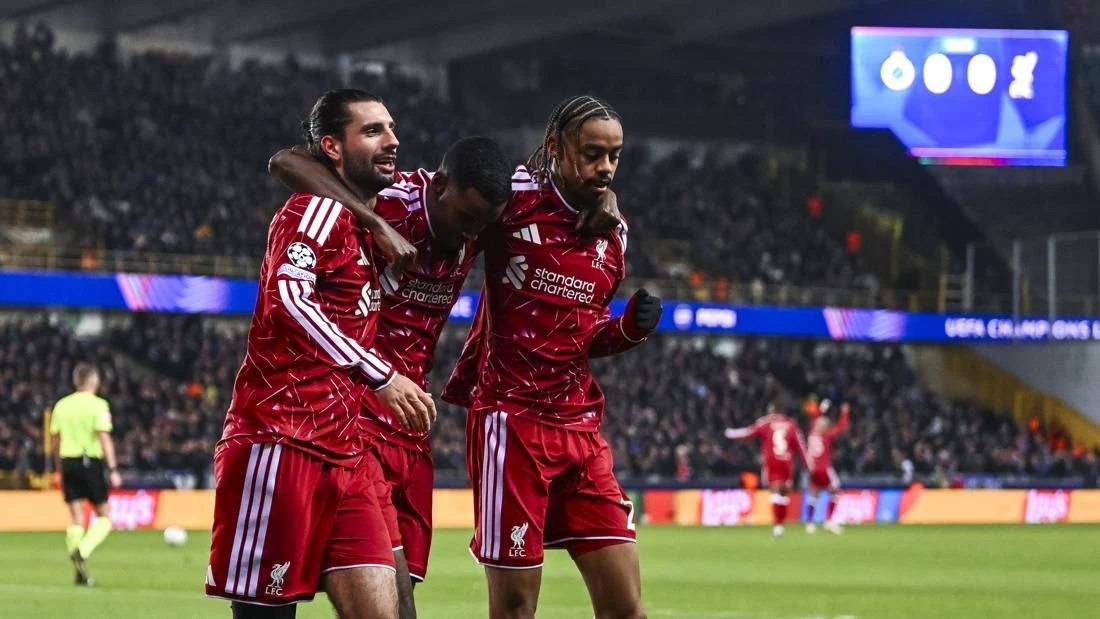
The UEFA Champions League group stage entered a critical phase on Thursday, November 26, 2026, as English powerhouse Liverpool traveled to Belgium to face Club Brugge at the historic Jan Breydel Stadium. Marking the fifth matchday of Europe’s premier club competition, the high-stakes fixture delivered an intense opening forty-five minutes of football. At the interval, it is the visiting Reds who hold the advantage, leading 1-0 courtesy of an early, well-crafted goal by Swedish striker Alexander Isak.
The match began under crisp autumnal conditions in Brugge, with both sides acutely aware of the implications that three points hold for their respective qualification campaigns. As the referee blew the whistle to commence proceedings, Liverpool immediately sought to establish dominance in possession, dictating the tempo of the game through quick ball circulation in the midfield. Their early initiative paid dividends in the thirteenth minute, stunning the passionate home crowd and putting the Premier League giants firmly in the driver’s seat.
Chronology of the First Half: Key Moments at Jan Breydel Stadium
The opening half of the encounter was characterized by tactical discipline from the visitors, punctuated by bursts of attacking brilliance and resilient defending under pressure from the hosts. The definitive breakthrough arrived when the match was barely a dozen minutes old. In the 13th minute, Liverpool orchestrated a swift and incisive attacking move down the flank. Playmaker Dominik Szoboszlai found space in the attacking third, driving towards the byline before cutting a precise, low pull-back into the penalty area. Alexander Isak met the delivery with pinpoint accuracy, steering his shot past the hapless Club Brugge defense and goalkeeper Yann Sommer to break the deadlock and make it 1-0 to Liverpool.
Stung by the early setback, Club Brugge refused to capitulate and immediately altered their tactical approach, injecting more urgency into their attacking phases. The Belgian side began to press higher up the pitch, looking to exploit any gaps left by Liverpool’s adventurous full-backs. Just four minutes after conceding, in the 17th minute, Brugge carved out their first clear-cut opportunity of the match. Felix Lemarechal rose above his marker inside the penalty box to meet a dangerous cross, directing a powerful header goalwards. However, Brazilian goalkeeper Alisson Becker demonstrated his world-class pedigree, reacting sharply to tip the effort over the crossbar and preserve Liverpool’s clean sheet.
As the half progressed past the half-hour mark, Club Brugge continued to probe for an equalizer. In the 30th minute, the persistent Lemarechal tried his luck from distance, unleashing a fierce strike from outside the penalty area that ultimately sailed just wide of the target, much to the relief of the traveling Liverpool supporters.
The physical nature of the European encounter took its toll shortly before the interval. In the 38th minute, young winger Victor Munoz embarked on a dazzling solo run, weaving his way through the Liverpool defense before attempting a close-range effort. The shot was bravely blocked by a recovering defender, but the resulting heavy collision left Munoz unable to continue. The injury forced a premature substitution for Liverpool, with manager Arne Slot introducing Rio Ngumoha from the bench to replace the stricken Spaniard.
Despite late pressure from the hosts, Liverpool’s backline held firm through the remainder of the first half. The referee’s whistle signaled the end of forty-five minutes, sending the teams into the dressing rooms with the scoreline reading Club Brugge 0, Liverpool 1.
Tactical Lineups and Strategic Setup
The tactical battle deployed by both managers was evident from the initial team sheets submitted prior kickoff. Club Brugge lined up in a disciplined formation under the guidance of their technical staff, featuring veteran goalkeeper Yann Sommer between the posts. The defensive block consisted of Kyrianni Sabbe, Jorne Spileers, Brandon Mechele, and Joaquin Seys. The midfield engine room was anchored by Hugi Vertlesen, Freddie Potts, and captain Hans Vanaken, tasked with neutralizing Liverpool’s creative threats while launching quick transitions. The attacking trident featured the pace and trickery of Carlos Forbs, Nicolo Tresoldi, and the industrious Felix Lemarechal.
Liverpool deployed a formidable starting eleven featuring Alisson Becker in goal. The defensive four comprised Milos Kerkez, Ronald Araujo, Jeremy Jacquet, and Jeremie Frimpong, balancing defensive solidity with overlapping width. In midfield, the creative burden fell upon the shoulders of Dominik Szoboszlai and Trey Nyoni, who controlled the central territories during the opening exchanges. The attacking department boasted immense dynamism, with Bradley Barcola, Florian Wirtz, Victor Munoz, and lone striker Alexander Isak leading the frontline, a combination that ultimately unlocked the Brugge defense in the opening stages.
Background Context and Group Stage Implications
Entering Matchday 5, the stakes in the UEFA Champions League group phase are exceptionally high. With the tournament utilizing the expanded league-phase format introduced in recent seasons, every single point carries immense weight in the race for automatic qualification to the Round of 16 or, at minimum, securing a spot in the knockout phase play-offs.
Liverpool’s campaign prior to this fixture had been marked by consistent performances, blending tactical maturity with clinical finishing. Securing an away victory in Belgium would significantly bolster their coefficient and virtually guarantee them a favorable position in the upper echelons of the league table heading into the final three fixtures of the opening phase. For Club Brugge, playing on home soil at the Jan Breydel Stadium represented a golden opportunity to upset the odds and rescue vital points to keep their European ambitions alive. Historically, Belgian clubs have proven formidable hosts in continental competitions, creating hostile environments that test the psychological resilience of visiting English sides.
Statistical Overview of the First Half
An analysis of the opening forty-five minutes reflects a closely contested affair, despite Liverpool holding the vital lead. While Liverpool dominated possession in the opening fifteen minutes—capitalizing on this period through Isak’s clinical finish—Club Brugge grew into the game significantly as the half progressed.
The home side managed to register multiple attempts on goal, testing Alisson Becker’s reflexes and forcing the Liverpool defense into making crucial clearances. Total shots favored the hosts during certain stretches of sustained pressure, though Liverpool’s defense, marshaled by Ronald Araujo and Jeremy Jacquet, successfully restricted clear-cut opportunities inside the 18-yard box. The physical intensity was underscored by the frequency of challenges in the midfield, culminating in Victor Munoz’s unfortunate injury late in the half, which forced tactical adjustments for the visitors.
Managerial Adjustments and Second-Half Outlook
As both squads retreated to their respective technical areas during the interval, tactical adjustments loomed large. For Club Brugge manager, the primary objective in the second half will be maintaining defensive discipline against Liverpool’s fluid front four while finding more clinical service for Nicolo Tresoldi and Carlos Forbs in the final third. The performance of Felix Lemarechal in the first half provided a blueprint for how Brugge can trouble Liverpool’s defense through late runs from midfield and aerial duels.
On the other side of the pitch, Liverpool’s technical staff faces the challenge of managing a delicate balance. Holding a narrow 1-0 lead away from home in Europe is historically perilous. While continuing to press for a second goal to kill off the contest is imperative, the Reds must also remain vigilant against Brugge’s counter-attacking speed, particularly following the enforced substitution of Victor Munoz for Rio Ngumoha. Preserving energy levels and exploiting spaces as the Belgian side inevitably pushes forward in search of an equalizer will dictate whether Liverpool can comfortably secure all three points.
Broader Impact on Domestic and European Campaigns
The outcome of this match carries repercussions that extend well beyond the immediate ninety minutes at the Jan Breydel Stadium. For Liverpool, a successful European campaign is a fundamental pillar of their seasonal ambitions, satisfying the expectations of supporters and club hierarchy alike. Managing squad depth during a congested winter fixture list—compounded by physical casualties like Munoz’s injury—will test the tactical acumen of Arne Slot and his coaching staff.
Conversely, Club Brugge’s performance in the first half demonstrates their capacity to compete at the highest level of European club football. Even if they fail to overturn the deficit in the second half, the competitive resilience displayed against one of England’s elite clubs serves as a testament to the growth and competitiveness of Belgian football on the continental stage. As the players step back onto the pitch for the second half, the footballing world watches closely to see whether Liverpool can consolidate their lead or if Club Brugge can engineer a memorable European comeback.