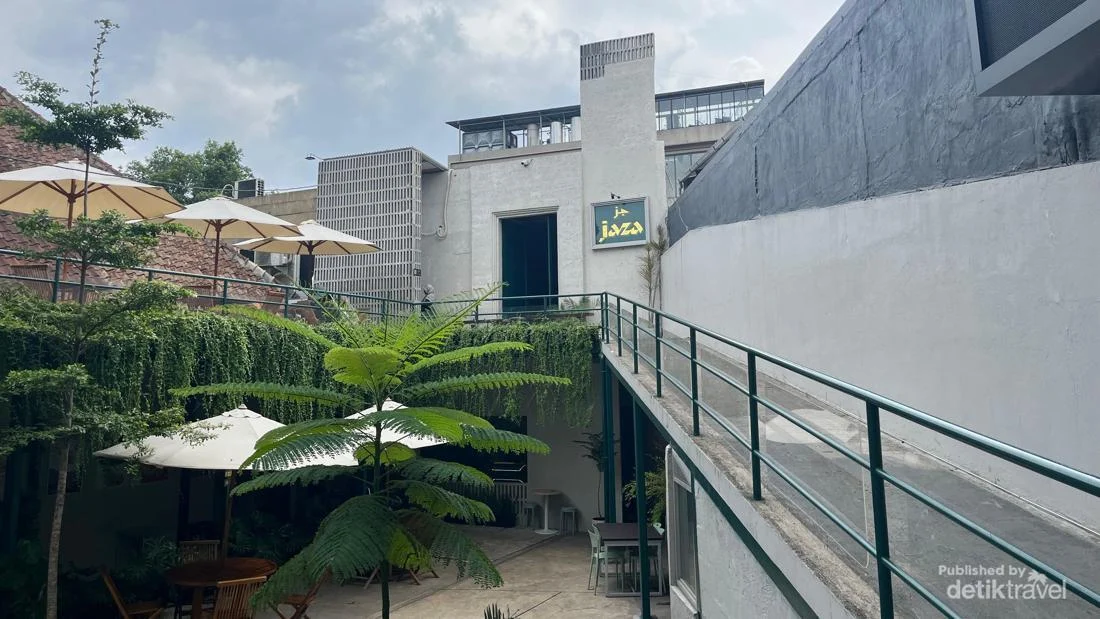
At 11:45 AM, the sun beats down with relentless intensity on the streets of Bandung, Indonesia. The city’s arterial roads are choked with the rhythmic pulse of mid-day traffic, a chaotic symphony of engines and impatient honks that defines the urban experience. Amidst this concrete labyrinth of commerce and noise, a sudden, melodic cadence cuts through the urban roar: the Adhan, the Islamic call to prayer. For those navigating the bustling Jalan Trunojoyo, the sound is familiar, yet the source is puzzling. There is no minaret reaching for the sky, no traditional dome casting a shadow, and no sprawling courtyard typical of Javanese mosques. Instead, the sound emanates from a structure that, to the uninitiated eye, appears to be a contemporary cafe. A discreet sign above the entrance reads: Masjid Jaza.
A Departure from Architectural Tradition
The physical layout of Masjid Jaza challenges the conventional blueprint of religious architecture in Indonesia. Upon entering, visitors are not immediately met with a prayer hall, but rather an environment that mirrors the vibrant energy of a modern culinary hub. The ground floor functions as a communal food court, featuring a curated selection of vendors serving local staples such as siomai, nasi Padang, and artisanal noodles. This design choice is intentional, bridging the gap between secular social activity and spiritual practice. The aesthetic leans heavily into minimalist industrialism, utilizing open spaces and warm lighting that cater to the lifestyle of Bandung’s youth, who are accustomed to "cafe-hopping" as a primary mode of social engagement.
To reach the sanctuary, one must ascend two levels, a vertical transition that serves as a metaphorical journey from the material world to the spiritual. The upper floor reveals a stark contrast to the lively atmosphere below. The prayer area is designed with a focus on serenity; it is compact yet efficiently organized, characterized by clean lines and modern furnishings. A thoughtful addition to this space is a self-service beverage station where visitors can prepare tea or coffee, fostering a sense of hospitality and communal warmth that is often missing from more rigid institutional spaces.
The Historical Metamorphosis: From Nightlife to Sanctuary
The most striking aspect of Masjid Jaza is not merely its aesthetic, but its history. Before its current iteration, the building served as a bar—a space traditionally associated with nightlife, loud music, and social indulgence. This radical shift in function represents a profound transformation in the urban landscape of Bandung. The transition from a venue of evening entertainment to a center for religious devotion serves as a poignant case study in adaptive reuse. It illustrates a trend where urban real estate is being reclaimed and repurposed to serve the evolving needs of an increasingly dense city, turning sites once reserved for nightlife into hubs of social and spiritual utility.
Addressing the Deficit of Urban Religious Infrastructure
The genesis of Masjid Jaza can be traced back to a growing concern among local residents and urban planners regarding the lack of accessible prayer facilities in the Trunojoyo corridor. As one of Bandung’s primary commercial districts, the area is saturated with high-end boutiques, restaurants, and office spaces, yet it remained a "desert" for public religious facilities.
Ari, a spokesperson for the management of Masjid Jaza, notes that the project was born out of necessity. "The motivation was purely a response to a void," Ari explained. "Trunojoyo is a prime commercial zone, but it was remarkably underserved in terms of accessible, comfortable, and inclusive spaces for prayer. We saw a need to integrate spiritual infrastructure into the existing commercial fabric of the city."
The project officially launched on April 10, 2026. Since its inception, the management has sought to move beyond the traditional role of a mosque, positioning it as a multi-functional community asset.
Chronology of Development and Strategic Planning
The development of Masjid Jaza followed a deliberate timeline, aimed at navigating both the physical constraints of the building and the sociological challenges of re-contextualizing a formerly "secular" space:
- Pre-2025: Identification of the Trunojoyo district as an area with high foot traffic but low religious facility accessibility.
- Early 2025: Acquisition of the former bar property, followed by a feasibility study on structural renovation.
- Late 2025: Construction phase, focusing on retrofitting the building to meet the acoustic and aesthetic requirements of a mosque while retaining its ground-floor commercial appeal.
- April 10, 2026: Official opening of Masjid Jaza to the public.
- Mid-2026 to Present: Implementation of community outreach programs, including collaborative events and social service initiatives.
Broader Implications: The Mosque as a Community Hub
The management of Masjid Jaza envisions a three-tiered approach to their mandate. First, the primary goal is to provide a comfortable, spiritually focused environment for the working population in the vicinity. Second, the mosque aims to serve as a collaborative space for community organizations. By offering a venue for workshops, seminars, and local meetings, the mosque actively encourages dialogue between different societal groups. Finally, the facility is designed to act as a social welfare center, providing aid and resources to the surrounding community.
This multifaceted approach aligns with modern sociological theories on "third spaces"—social environments separate from the two primary environments of home and the workplace. By integrating commercial elements (the food court) with religious and social functions, Masjid Jaza creates a hybrid environment that is both financially sustainable and socially relevant.
Analysis of Urban Impact
The case of Masjid Jaza offers valuable insights into urban development and the secular-religious divide in modern Indonesian cities. In rapidly densifying urban centers like Bandung, land availability for traditional large-scale religious architecture is increasingly scarce and prohibitively expensive. Masjid Jaza represents a pragmatic model of "micro-mosque" development that leverages existing building stock to meet public needs.
Furthermore, the social impact of this transformation is significant. By removing the stigma associated with the building’s former use as a bar and replacing it with a space of quietude and service, the developers have successfully reclaimed a segment of the city’s nightlife geography for the benefit of the general public. This model could serve as a template for other metropolitan areas in Southeast Asia facing similar pressures of urbanization and a lack of public facilities.
Challenges and Future Outlook
Despite its early success, Masjid Jaza faces the ongoing challenge of maintaining its dual identity. Balancing the bustle of a public food court with the sanctity required for prayer is a delicate operational task. Noise management, crowd control, and the maintenance of a respectful atmosphere are priorities for the management team.
Moreover, as the project matures, the focus will likely shift toward expanding its social programs. Ari emphasizes that the long-term goal is to make the facility a permanent fixture in the civic life of Bandung. "We want people to view this not just as a place to pray and leave, but as a place to contribute," Ari stated. "The collaboration between the community and the mosque is what will ultimately determine its success."
Conclusion: A New Paradigm for Religious Spaces
The emergence of Masjid Jaza is a testament to the fluidity of urban spaces. It reminds observers that the history of a building does not necessarily dictate its future utility. Through creative design, thoughtful planning, and a deep understanding of the community’s needs, a structure once dedicated to the fleeting joys of nightlife has been repurposed into a pillar of spiritual and social support.
As Bandung continues to expand and modernize, projects like Masjid Jaza provide a necessary blueprint for how cities can balance commercial growth with the essential, often overlooked, needs of the human spirit. It stands as an example of how a city can evolve, adapt, and find new meaning in the spaces that connect its people. Whether or not this model will be replicated elsewhere remains to be seen, but for now, the quiet prayer hall above the bustling food court on Jalan Trunojoyo serves as a compelling narrative of renewal in the heart of West Java.