Nestled in the quiet landscape of Airmadidi Bawah, within the Minahasa Utara Regency of North Sulawesi, lies a destination that bridges the gap between historical folklore and modern tourism: the Tumatenden springs. Known locally as the "Pancuran Sembilan Bidadari" or the "Nine Springs of the Heavenly Maidens," this site serves as both a natural water source and a profound repository of the Tonsea ethnic group’s identity. The site’s allure extends beyond its serene physical beauty, drawing scholars, history enthusiasts, and travelers alike to explore a legend that has been woven into the fabric of North Sulawesi’s cultural narrative for generations.
Etymology and Cultural Significance
The name "Tumatenden" is derived from the local Tonsea dialect, carrying a weight of cultural philosophy. Etymologically, "Tuma" signifies a "place," while "Tenden" refers to a "support of life." Together, the term Tumatenden translates to "a place that serves as a support for life." This nomenclature is not merely poetic; it reflects the historical dependence of the local community on the springs for agriculture, sustenance, and daily survival.
For the people of Airmadidi, the site is not just a geographical coordinate but a sacred intersection of the human and the celestial. The springs are intrinsically linked to the legend of Mamanua, a diligent farmer, and Lumalundung, a celestial maiden. According to oral tradition—the foundation of the site’s historical status—the encounter between Mamanua and the nine heavenly sisters at these very springs serves as the catalyst for the mythos that defines the region’s traditional dance and storytelling.
The Legend of Mamanua and the Celestial Maidens
The narrative of Tumatenden begins with Mamanua, a farmer whose labor and dedication to his craft were exemplary. The legend posits that while tending to his fields, Mamanua chanced upon nine bidadari (heavenly maidens) descending from the sky to bathe in the cool, clear waters of the springs. Captivated by their beauty and the supernatural nature of their arrival, Mamanua reportedly stole the clothes of one of the maidens, Lumalundung, effectively preventing her from returning to the heavens.
This narrative arc, common in various Nusantara folktales, functions as a foundational myth for the Minahasan people. It provides a moral framework regarding the sanctity of nature and the integration of the divine into the terrestrial sphere. The presence of nine distinct water spouts (pancuran) at the site is physically symbolic of the nine sisters, creating a tangible link between the folklore and the actual topography of the area.
Preservation and Cultural Integration
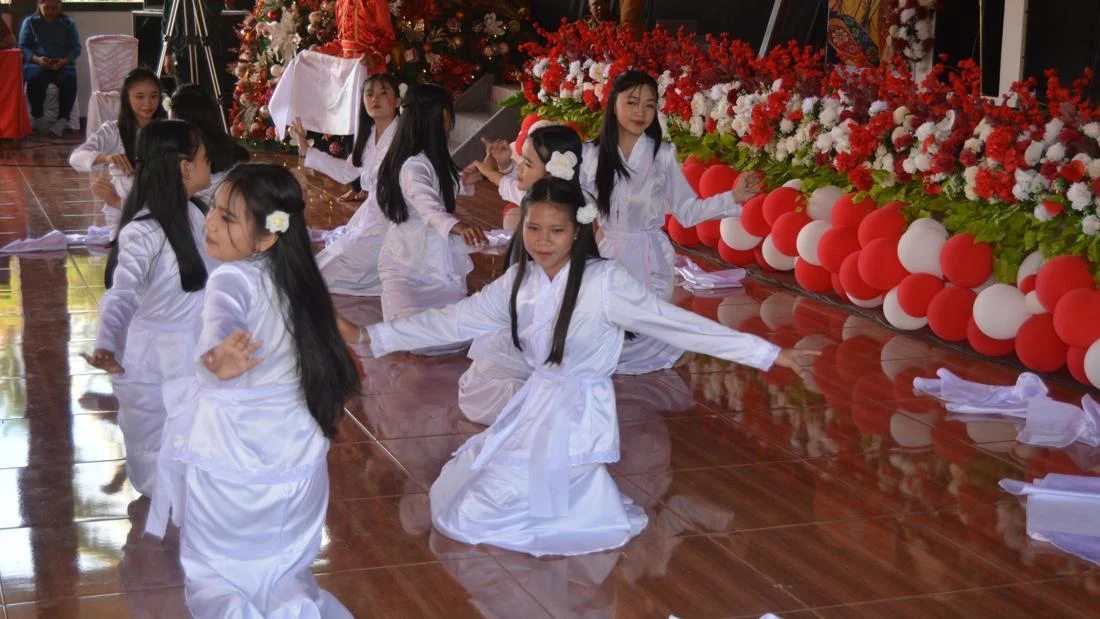
The Balai Pelestarian Kebudayaan (Cultural Preservation Center) of North Sulawesi recognizes Tumatenden as a vital site for the preservation of intangible heritage. The legend has been successfully transitioned from oral tradition into the Tumatenden Dance, a performative art form that has become a cultural hallmark of the Minahasa region.
The Tumatenden Dance is a sophisticated group performance typically executed by female dancers. Eschewing verbal dialogue, the dance relies entirely on rhythmic movement, traditional Minahasan musical accompaniment, and expressive choreography to convey the story of the celestial encounter. This medium has allowed the legend to survive in a dynamic form, ensuring that younger generations maintain a connection to their ancestral history.
Today, the dance is a staple of cultural diplomacy in North Sulawesi. It is frequently performed during traditional wedding ceremonies, state-sanctioned art exhibitions, and major regional festivals. Its popularity underscores the resilience of Tonsea traditions in an increasingly modernized society, serving as a reminder of the importance of indigenous narratives in contemporary regional branding.
The Phenomenon of the Healing Springs
Beyond its mythological status, Tumatenden attracts a significant number of visitors seeking potential therapeutic benefits. There is a persistent belief, held by both the local Tonsea population and visitors from across Indonesia, that the water from the nine spouts possesses healing properties. While there is no empirical medical evidence to support claims of miraculous cures, the cultural belief in the sanctity and purity of the water remains a powerful driver of local tourism.
Anthropologically, this belief reflects a long-standing tradition of animism and spiritual connection to water sources in Indonesian highland cultures. The ritualistic washing or drinking of the water is often accompanied by prayers or silent reflection, reinforcing the springs’ status as a site of pilgrimage. For the tourism sector in Minahasa Utara, this spiritual dimension provides a unique selling point that distinguishes Tumatenden from standard recreational water parks or leisure destinations.
Economic and Tourism Implications
The development of Tumatenden as a tourism asset represents a broader strategy by the Minahasa Utara government to diversify its economic base. By leveraging "heritage tourism," the region aims to attract travelers interested in history and cultural immersion. The site is managed with a view toward balancing accessibility for tourists with the preservation of the site’s inherent tranquility.
Data from the regional tourism office indicates that interest in sites associated with local folklore is on an upward trajectory. Travelers, particularly those from urban centers, are increasingly seeking "authentic" experiences that move beyond the superficial. Tumatenden provides this by offering a combination of nature-based activities and in-depth cultural education.
However, the preservation of the site is not without challenges. Increased foot traffic brings the necessity for rigorous environmental management to protect the purity of the water and the structural integrity of the stone conduits. Furthermore, there is the ongoing task of documenting oral histories before they are lost to time, a mission prioritized by experts like Hari Suroto, who works closely with the Balai Pelestarian Kebudayaan.
Analysis: A Bridge Between Past and Future
The significance of Tumatenden lies in its role as a bridge between the historical identity of the Minahasa people and their modern aspirations. As the region continues to develop, the preservation of such sites is critical for maintaining a sense of place.
From an administrative perspective, the official recognition of Tumatenden as a cultural asset serves several purposes:
- Identity Preservation: It validates the local Tonsea history and ensures it is taught and performed.
- Economic Stimulation: It provides employment opportunities for local guides, artisans, and performers.
- Environmental Stewardship: By branding the site as a cultural heritage area, there is a stronger mandate to protect the natural spring from pollution and over-commercialization.
The impact of the Tumatenden legend on local society cannot be overstated. It is a unifying narrative. Whether through the lens of the traditional dance or the physical act of visiting the springs, the legend of Mamanua and Lumalundung remains a living entity. It dictates how the community views their natural environment—not as a commodity to be exploited, but as a "tenden" or support of life that must be honored and protected.
Future Prospects for Tumatenden
As North Sulawesi seeks to cement its position on the national tourism map, Tumatenden is poised to play a central role. Future development plans, according to local officials, involve improving infrastructure while maintaining the aesthetic integrity of the area. There is also potential for expanded academic research, as the site offers a wealth of data for folklorists, linguists, and anthropologists studying the migration and social structures of the Tonsea people.
For the traveler, a visit to Tumatenden is an exercise in slowing down and engaging with a deep, layered history. It is a place where the distinction between the physical and the metaphysical blurs, allowing for an experience that is as much about introspection as it is about sight-seeing. As the Balai Pelestarian Kebudayaan continues its documentation and preservation efforts, Tumatenden will likely remain a cornerstone of Minahasa Utara’s cultural landscape, reminding all who visit that some legends are far more than mere stories—they are the very bedrock upon which a community is built.
In summary, Tumatenden is a microcosm of the Minahasan spirit: resilient, connected to nature, and deeply proud of its ancestral roots. Whether one visits for the legend, the dance, or the hope of healing, the nine springs of Airmadidi offer an unparalleled glimpse into the heart of North Sulawesi. As the world becomes increasingly globalized, such sites serve as vital anchors, ensuring that the stories of the past continue to inform and enrich the realities of the future.