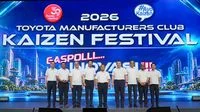
Jakarta, Indonesia — PT Toyota Motor Manufacturing Indonesia (TMMIN), in strategic collaboration with the Toyota Manufacturers Club (TMClub), successfully convened the 39th annual Kaizen Festival at the Integrity Convention Center in Jakarta on Saturday, November 28. This premier industry event served as a critical platform for showcasing operational enhancements, engineering ingenuity, and quality-control methodologies pioneered by local automotive component suppliers.
The convention yielded a remarkable total of 300 actionable operational improvement ideas submitted by local suppliers. This figure marks a significant 20.5 percent increase compared to the previous year, which recorded 249 innovative proposals. Drawing the active participation of more than 2,500 delegates, engineers, and manufacturing professionals from member companies within the TMClub network, the event underscored a unified commitment to reinforcing the operational capabilities, human resource competencies, and structural integration of Indonesia’s national automotive supply chain.
The high-profile gathering was attended by senior government officials and international corporate leaders, notably including Minister of Industry Muhammad Sarmuji and Toyota Motor Corporation Regional CEO for Asia, Masahiko Maeda. Their presence highlighted the strategic alignment between national industrial policies and multinational manufacturing strategies aimed at transforming Indonesia into a globally competitive automotive hub.
The Evolution of Kaizen Culture and the 39th Festival Milestones
At its core, the Kaizen philosophy—meaning "continuous improvement"—serves as the operational heartbeat of Toyota’s manufacturing ecosystem globally and locally. Established nearly four decades ago in 1987, the TMClub has functioned as a vital knowledge-sharing nexus, fostering collaborative learning, educational initiatives, specialized training programs, and synergistic relationships across the manufacturing sector.
The 39th iteration of the festival highlighted that operational excellence does not exclusively rely on capital-intensive technology or complex automation. Instead, many of the most impactful ideas presented on the convention floor focused on practical, cost-effective innovations deployed directly at the production level. A prominent example highlighted during the exhibition was the implementation of "Karakuri" engineering principles. This traditional methodology utilizes simple mechanical devices, leverage, and gravity to optimize material handling, reduce operator fatigue, and drastically boost assembly line efficiency without high energy consumption.
In addition to Karakuri mechanisms, participating suppliers showcased advanced problem-solving frameworks such as Quality Control Projects (QCP) and Group Quality Control Circles (G-QCC). These frameworks empower factory-floor workers to systematically identify bottlenecks, root out waste, minimize defects, and elevate overall manufacturing standards.
The event culminated in an awards ceremony recognizing top-performing enterprises and individuals across several distinct categories, including Individual Improvement, Group Improvement, the Suggestion System, Karakuri applications, QCP, and G-QCC. These accolades celebrate not only the economic value generated by the ideas but also the cultural shift toward continuous self-evaluation and problem-solving among local workforce populations.
Strengthening the National Supply Chain and Economic Impact
Addressing the convention delegates, Minister of Industry Muhammad Sarmuji commended the sustained efforts of the organizers in elevating the standards of domestic component manufacturers.
"I extend my highest appreciation to the Toyota Manufacturers Club and PT Toyota Motor Manufacturing Indonesia for their unwavering commitment to driving innovation and enhancing the competitiveness of the domestic automotive component industry," stated Sarmuji. He emphasized that the growth of local suppliers directly contributes to the resilience of the wider national economy, shielding the industrial sector from global supply chain disruptions.
Echoing this sentiment, TMMIN President Director Nandi Julyanto stressed that a robust, self-reliant industrial ecosystem is an absolute prerequisite for sustainable sectoral growth.
"The national automotive industry cannot develop sustainably without the backing of a strong industrial ecosystem. Collaboration between the government, vehicle manufacturers, and suppliers is essential for strengthening local industrial capabilities, developing human resources, and elevating the competitiveness of Indonesian manufacturing," Nandi remarked. He further noted the company’s expectation that ongoing synergistic partnerships will enable the national automotive sector to generate an even more substantial contribution to Indonesia’s gross domestic product and export earnings.
The scale of TMMIN’s operational footprint in Indonesia provides a clear window into the vast potential of these supply chain initiatives. Currently, TMMIN maintains active commercial partnerships with more than 240 Tier-1 suppliers, alongside an extensive network of over 520 Tier-2 and Tier-3 suppliers. Notably, this expansive network integrates numerous Small and Medium-Sized Enterprises (SMEs), effectively bridging grassroots industrial players with multinational manufacturing standards.
This deeply integrated supplier base does not merely cater to Indonesia’s domestic vehicle demand. It also serves as the backbone for TMMIN’s robust export operations, supplying completely built-up (CBU) vehicles, completely knocked-down (CKD) parts, and specialized automotive components to numerous international markets across the globe. By fostering rigorous quality standards at the Tier-2 and Tier-3 levels, TMMIN ensures that Indonesian-made components meet exacting global benchmarks.
Human Resources as the Foundation of Manufacturing Excellence
Addressing the strategic vision behind the annual Kaizen Festival, TMMIN Vice President Director I Nyoman Winaya underscored that human capital development remains the ultimate catalyst for long-term industrial success.
"This Kaizen Festival is a tangible manifestation of our commitment to continuously driving the capabilities of Toyota’s supply chain, starting from our most vital asset—human beings as the drivers of quality and productivity," Nyoman stated. "We firmly believe that from human resources who continuously develop their skills, a robust local supply chain characterized by high competitiveness will naturally emerge."
This philosophical emphasis on workforce empowerment addresses a critical challenge in modern industrial policy: bridging the skills gap. As advanced manufacturing technologies, electric vehicle architectures, and digital factory floors reshape the global automotive landscape, upskilling frontline workers becomes imperative. Initiatives like the TMClub and its structured training modules ensure that the Indonesian workforce evolves synchronously with modern industrial demands.
Broader Implications and Strategic Outlook for Indonesia’s Automotive Sector
The success of the 39th Kaizen Festival carries several broad implications for the future trajectory of Indonesia’s manufacturing economy:
-
Import Substitution and Localization: By systematically upgrading the capabilities of Tier-2 and Tier-3 suppliers—including local SMEs—the domestic content level (TKDN) of vehicles produced in Indonesia is naturally reinforced. This reduces reliance on imported raw materials and specialized components, insulating domestic assembly plants from foreign currency fluctuations and geopolitical trade frictions.
-
Export Competitiveness: As local suppliers embrace continuous improvement methodologies, their cost efficiency, delivery reliability, and defect-prevention rates improve. This positions Indonesia not merely as a large captive consumer market for automotive products, but as a primary export manufacturing base for the broader ASEAN region and beyond.
-
Technological Adaptation through Simplicity: The integration of Karakuri and grassroots QCP initiatives proves that automation and high-tech investment must be paired with low-cost, highly intelligent mechanical solutions conceived by the workers themselves. This approach maximizes labor engagement while maintaining low overhead costs.
-
Policy Synergy: The active participation of the Ministry of Industry signals a healthy public-private partnership model. By aligning corporate capacity-building programs with national industrial roadmaps—such as the transition toward electrification and sustainable manufacturing—Indonesia is better positioned to achieve its long-term economic development targets.
As global automotive markets navigate an era of profound transformation defined by digital integration, environmental sustainability, and evolving consumer preferences, initiatives like the Toyota Kaizen Festival provide a structural blueprint. By investing relentlessly in human capital, fostering localized supply chain integration, and institutionalizing a culture of continuous operational refinement, TMMIN and its supplier network have demonstrated how traditional manufacturing foundations can successfully adapt to meet the rigorous demands of the future.