Socio Today
The geopolitical landscape of the Middle East has reached a perilous flashpoint following a violent confrontation in the Strait of Hormuz, where the Iranian Islamic Revolutionary Guard Corps (IRGC) confirmed on Thursday that its naval mines successfully intercepted a convoy of oil tankers. According to official statements released by the IRGC and disseminated via Press TV, three US-backed oil tankers attempted to navigate the southern reaches of the strategic waterway, a route that had been explicitly declared a mined zone by Tehran just twenty-four hours prior. The resulting explosion of one vessel and the subsequent retreat of the remaining two marks one of the most significant escalations in maritime warfare in recent years, prompting an immediate and severe ultimatum from Washington.
The Incident: A Calculated Ambush in Strategic Waters
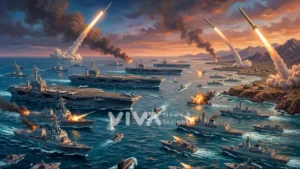
On the morning of Thursday, July 23, 2026, maritime tracking systems and regional security monitors reported a significant kinetic event in the southern sector of the Strait of Hormuz. The IRGC’s naval wing reported that three large-scale tankers, which they identified as being supported by the United States, ignored explicit warnings regarding the presence of underwater explosives. As the lead vessel entered the designated danger zone, it struck a mine, resulting in a massive explosion and an ensuing fire that sent plumes of black smoke visible from the Omani coast.
"Three oil tankers supported by the United States tried to cross the mined route in the south of the Strait of Hormuz. After one of the tankers exploded and caught fire, the other two ships immediately turned around and retreated," the IRGC statement read. The IRGC further clarified that the incident was not an accident but a direct consequence of defying Iranian maritime authority. The command center in Tehran has since declared a total blockade, asserting that no tanker will be permitted to enter or exit the Persian Gulf without direct "coordination" with the Islamic Republic.
The IRGC’s rhetoric has been uncompromising, characterizing the attempt to transit the strait as part of a "deception" orchestrated by the United States. They warned that any vessel following American directives rather than Iranian protocols would meet a "similar fate." This move effectively asserts Iranian sovereignty over a waterway that international law generally recognizes as an international strait where the right of transit passage applies.
Chronology of Escalation: From Warnings to Warfare
The seeds for Thursday’s explosion were sown on Wednesday, July 22, 2026, when IRGC spokesperson Hossein Mohebbi issued a stern public warning. Mohebbi announced that the southern transit lanes of the Strait of Hormuz—the primary artery for global energy supplies—had been seeded with naval mines. At the time, global markets reacted with volatility, but many maritime analysts questioned whether Tehran would follow through on such a provocative act of brinkmanship.
Mohebbi’s warning was explicit: "The southern route of the Strait of Hormuz, which has been mined, will destroy your investment. Do not be trapped by the deception of the United States." This statement was viewed by the international community as a direct response to tightening Western sanctions and the increased presence of the US Fifth Fleet in the region.

The timeline of the crisis indicates a rapid breakdown of diplomatic backchannels:
- July 21: Reports emerge of increased IRGC naval activity and the deployment of mine-laying submersibles.
- July 22 (Morning): IRGC spokesperson Hossein Mohebbi officially declares the southern route a "no-go zone" due to mining.
- July 22 (Evening): President Donald Trump issues a public warning via social media and official briefings, threatening "total destruction" of Iranian infrastructure if shipping is interfered with.
- July 23 (Morning): A convoy of three tankers, reportedly under US naval escort or protection, enters the southern strait.
- July 23 (12:32 WIB): IRGC confirms the lead tanker has been struck, and the blockade is in full effect.
The Strategic Importance of the Strait of Hormuz
To understand the gravity of this incident, one must consider the geographic and economic significance of the Strait of Hormuz. Often described as the "world’s most important oil chokepoint," the strait is a narrow waterway separating Iran from the Musandam Peninsula of Oman. At its narrowest point, the shipping lanes are only two miles wide in either direction, separated by a two-mile buffer zone.
Approximately 20% to 30% of the world’s total oil consumption passes through this corridor daily. It is the primary exit point for crude oil from Saudi Arabia, the United Arab Emirates, Kuwait, and Iraq, as well as liquefied natural gas (LNG) from Qatar. Any disruption to this flow has immediate and catastrophic implications for global energy prices. Following the news of the explosion on Thursday, Brent crude futures surged by nearly 12% within hours, as traders braced for a prolonged closure of the strait.
The use of naval mines is a particularly effective and low-cost "asymmetric" warfare tactic. Mines are difficult to detect, expensive to clear, and create a psychological deterrent that can ground commercial shipping even without a direct hit. By mining the southern route, Iran is effectively holding the global economy hostage, forcing a confrontation that the US and its allies must address either through de-escalation or military force.
The American Response: Trump’s Infrastructure Ultimatum
The response from the White House has been uncharacteristically blunt, even by the standards of the current administration. On Wednesday, shortly after the initial mining announcement by Mohebbi, President Donald Trump issued a "red line" statement that redefined the terms of engagement in the Persian Gulf.
President Trump warned that the United States would no longer limit its retaliation to naval targets or military assets. Instead, he threatened to target Iran’s domestic infrastructure. "Every time Iran launches an attack against a ship crossing the Strait of Hormuz, we will destroy one bridge or one power plant in Iran, including in Tehran," Trump stated.
This shift in strategy—targeting civilian infrastructure in response to maritime interference—represents a significant escalation in the rules of engagement. Analysts suggest that this "tit-for-tat" doctrine is designed to put direct pressure on the Iranian government by making the cost of the blockade felt by the Iranian citizenry and the country’s internal stability. The threat to strike targets in Tehran, the heart of the Islamic Republic’s political power, suggests that the US is prepared for a high-intensity conflict if the blockade is not lifted immediately.

Global Implications and Economic Fallout
The international community has reacted with alarm to the news of the tanker explosion. Maritime insurance companies have reportedly suspended "War Risk" coverage for vessels transiting the Persian Gulf, a move that could effectively halt all commercial traffic even if the IRGC does not fire another shot. The "Joint War Committee" in London is expected to meet urgently to re-evaluate the risk zones in the Middle East.
Key Asian economies, including China, India, and Japan, which are heavily dependent on Persian Gulf oil, have called for "utmost restraint." However, the IRGC’s insistence that shipping must be "coordinated" with Tehran puts these nations in a difficult position. Coordinating with the IRGC could be seen as a violation of US-led sanctions, while refusing to do so risks the loss of multi-billion dollar vessels and environmental catastrophes in the event of an oil spill.
Environmental experts have also warned of the ecological risks. The Strait of Hormuz is home to sensitive coral reefs and diverse marine life. An oil spill from a damaged Supertanker (VLCC) could cause irreparable damage to the coastlines of Oman, the UAE, and Iran itself, affecting desalination plants that provide the region’s drinking water.
Analysis: A New Era of Maritime Conflict
The current crisis in the Strait of Hormuz signifies a departure from the "shadow war" of previous decades. In 2019 and 2021, similar incidents involving limpet mines were met with deniable accusations and limited sanctions. However, the events of July 2026 are different in two fundamental ways: the transparency of the IRGC’s actions and the directness of the US threat.
Iran is no longer seeking plausible deniability. By having the IRGC and its spokespeople openly announce the mining and claim credit for the explosion, Tehran is asserting its role as the dominant regional power capable of dictating the terms of global trade. This is a high-stakes gamble intended to force the United States back to the negotiating table on Iranian terms or to expose the limits of American naval power in confined waters.
Conversely, the US threat to strike inland infrastructure suggests a lack of confidence in traditional "freedom of navigation" operations. If the US Fifth Fleet cannot safely escort tankers through a minefield without risking their destruction, the only remaining leverage is the threat of devastating aerial bombardment.
As of Thursday evening, the situation remains fluid. The damaged tanker continues to burn, and the two retreating vessels are reportedly under the protection of US naval assets outside the immediate danger zone. The world now waits to see if President Trump will follow through on his threat to strike Iranian soil, or if a diplomatic corridor can be opened before the "Tanker War" of 2026 turns into a global economic and military catastrophe. For now, the Strait of Hormuz remains a silent, deadly graveyard of mines, and the world’s energy lifeline is effectively severed.